
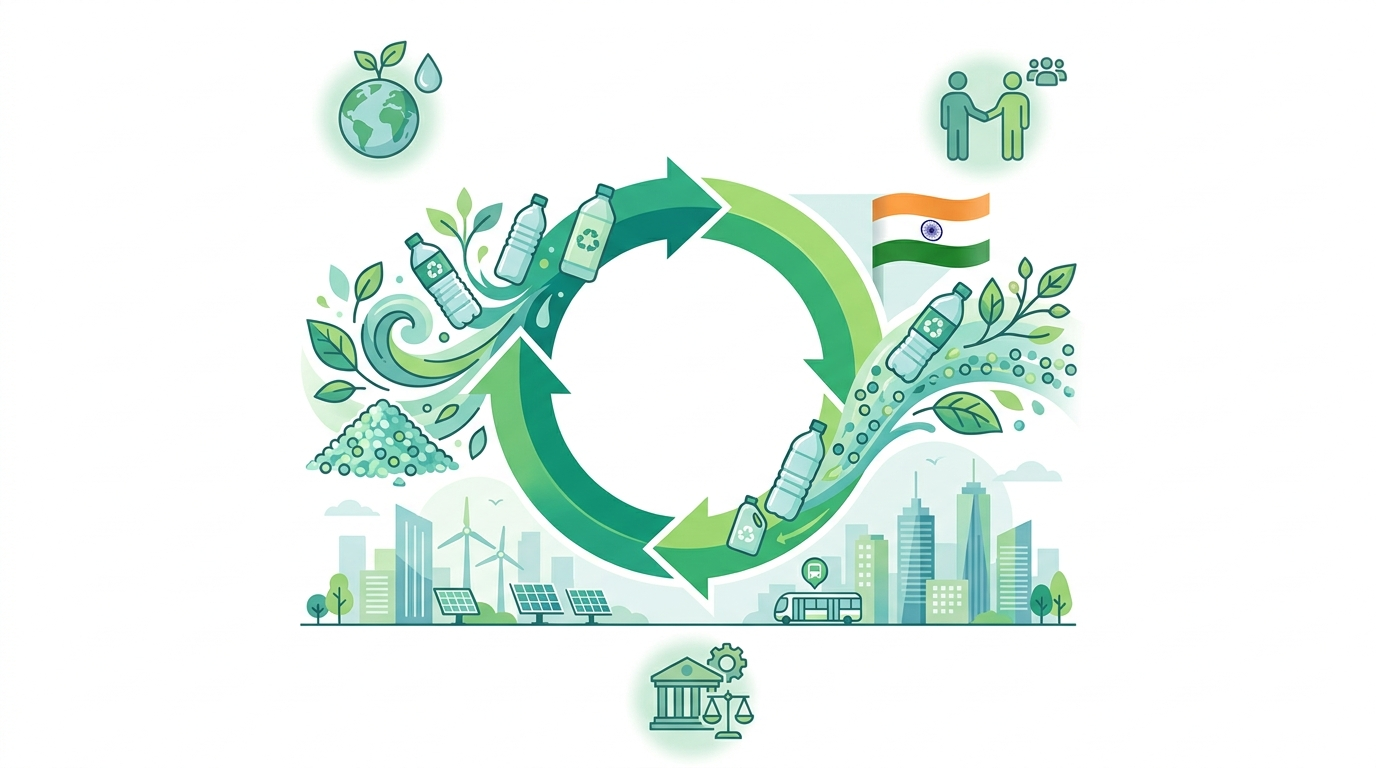
ESG Compliance in India: Why Plastic Waste Management Is Now a Boardroom Priority
For years, “ESG” sounded like a buzzword reserved for annual reports and investor decks. In 2026, it is anything but. Environmental, Social and Governance (ESG) performance now shapes who a company can raise money from, sell to, and partner with — and in India, plastic waste management has moved to the very centre of the “E” in ESG.
If your business generates, packages in, or handles plastic — and almost every business does — your plastic footprint is now a measurable, reportable, and reputational issue. The good news: turning that liability into an ESG win is more achievable than most leaders think. This is exactly the gap Operation SHUDDHI® was built to close.
The Scale of the Problem — By the Numbers
The case for action is not opinion; it is in the data from official and global sources:
- India generates about 3.9 million tonnes of plastic waste every year — roughly 10,689 tonnes every single day, according to the Central Pollution Control Board’s Annual Report 2022-23 (CPCB, via PIB).
- Globally, plastic production reached 460 million tonnes in 2019 — double the level of 2000 — yet only 9% of all plastic waste is actually recycled. Nearly a quarter is mismanaged: dumped, openly burned, or leaked into the environment (OECD Global Plastics Outlook, 2022).
- Under India’s EPR framework, registered producers, importers, and brand-owners carried an Extended Producer Responsibility of around 3 million tonnes of plastic packaging for 2022-23 (CPCB, via PIB).
These numbers explain why investors, regulators, and customers are no longer satisfied with intentions — they want evidence.
What ESG Actually Means for an Indian Business
ESG is a framework for measuring how responsibly a company operates across three pillars:
- Environmental — emissions, energy, water, and crucially, waste and circularity.
- Social — workers, communities, health, and livelihoods.
- Governance — ethics, transparency, compliance, and accountability.
What changed in India is that ESG is no longer voluntary storytelling. The Securities and Exchange Board of India (SEBI) has made Business Responsibility and Sustainability Reporting (BRSR) mandatory for the top 1,000 listed companies by market capitalisation since FY 2022-23, covering roughly 140 ESG data points (SEBI). Value-chain expectations are flowing down from these companies to their suppliers, vendors, and MSMEs. Add the Plastic Waste Management Rules and Extended Producer Responsibility (EPR) obligations, and plastic is now a hard compliance line item — not a soft commitment.
Why Plastic Sits at the Heart of the “E”
Plastic is uniquely visible, uniquely persistent, and uniquely traceable. A single mismanaged shipment of packaging can end up photographed in a drain; a well-run collection system can be documented, weighed, and verified. That makes plastic one of the easiest environmental metrics for stakeholders — and regulators — to scrutinise.
Under EPR, producers, importers, and brand-owners are legally responsible for collecting and recycling a defined quantity of the plastic they put into the market. Falling short means penalties and reputational damage; meeting it credibly strengthens your ESG score. (We break the rules down in our guide to Extended Producer Responsibility in India.)
How Plastic Waste Management Strengthens Every ESG Pillar
Responsible plastic management is rare in that it improves all three pillars at once:
- Environmental: Diverting plastic from landfills and drains and channelling it into modern recycling reduces pollution and cuts the emissions associated with virgin plastic production. Using recycled content such as rPET shrinks your carbon footprint further.
- Social: Organised collection creates dignified livelihoods for waste workers and engages communities — turning a local nuisance into local employment.
- Governance: A transparent, auditable collection and recycling chain gives you the documentation and traceability that BRSR and EPR reporting demand.
The Carbon and Credit Dimension
There is a financial upside, too. Recycling plastic instead of producing it new avoids greenhouse-gas emissions — emissions that can, in many cases, be quantified and monetised. Our explainer on carbon credits and plastic recycling shows how environmental action can become a measurable asset rather than a pure cost. For an ESG-minded board, “compliance that pays for itself” is a powerful story.
A Practical ESG Plastic Playbook for Businesses
You don’t need a sustainability department to start. Here is a realistic sequence any organisation — corporate office, factory, hospital, school, RWA, or retailer — can follow:
- Measure your plastic. Estimate how much plastic waste your operations generate weekly. You can’t manage what you don’t measure.
- Segregate at source. Clean, separated plastic is far more recyclable and valuable. Start with our guide to waste segregation at source.
- Install a capture point. A dedicated plastic collection dustbin turns your premises into a permanent recovery point — and a visible signal of intent.
- Route it to responsible recyclers. Partner with a verified collection-and-recycling network so your plastic is genuinely recovered, not just relocated.
- Close the loop. Where possible, buy back recycled granules for your own products and packaging.
- Document everything. Keep records of quantities collected and recycled — this is the evidence base for your ESG and EPR reporting.
How Operation SHUDDHI Helps You Get There
Operation SHUDDHI is a nationwide plastic recovery and circular-economy mission — “From Waste to Wealth.” We give businesses and communities a ready-made, end-to-end system to act on the playbook above:
- Free plastic collection for Delhi NCR residents and organisations.
- Plastic collection dustbins placed at high-footfall locations — offices, hospitals, schools, societies, and markets. You can see every active collection point on our live dustbin locator.
- Collection Centre Partnerships for entrepreneurs and organisations across India who want to build local recovery infrastructure.
- Recycled granules for manufacturers who want to close the loop and raise their recycled-content share.
In a single day, our team installed 126 plastic collection bins across Delhi NCR — proof that ESG-aligned infrastructure can scale fast when intent meets execution.
Frequently Asked Questions
1. Is ESG reporting mandatory for businesses in India? For the largest listed companies, SEBI mandates Business Responsibility and Sustainability Reporting (BRSR). Even unlisted companies and MSMEs increasingly face ESG expectations from larger clients, lenders, and supply-chain partners, making plastic waste management broadly relevant.
2. How does managing plastic waste improve our ESG score? It strengthens all three pillars at once — reducing environmental pollution and emissions, creating social value through livelihoods and community engagement, and providing the transparent, auditable records that governance and compliance reporting require.
3. What is EPR and how is it linked to ESG? Extended Producer Responsibility makes producers, importers, and brand-owners legally responsible for collecting and recycling a set quantity of the plastic they put into the market. Meeting EPR credibly is both a compliance requirement and a direct contributor to your environmental performance.
4. We are a small office or society — can we still participate? Yes. Any premises that generates regular plastic waste can host a collection dustbin and route plastic to responsible recycling. Hospitals, schools, RWAs, and offices are ideal locations.
5. How can our business start with Operation SHUDDHI? You can request a free collection or a plastic dustbin for your premises, become a Collection Centre Partner, or source recycled granules — all through the Operation SHUDDHI website.
Turn Compliance into Contribution
ESG is no longer a report you publish once a year — it is a set of decisions you make every day about the waste your organisation creates. Plastic is the most visible of those decisions, and the easiest place to show real, verifiable progress.
Make your premises part of the solution. Request a plastic dustbin for your organisation, become a Collection Centre Partner, or join the Operation SHUDDHI mission today. Together, we can turn plastic waste into wealth — and compliance into genuine contribution. From waste to wealth, for a cleaner, circular India.