
126 Dustbins in One Day: How Operation SHUDDHI Is Cleaning Delhi NCR
Executive Summary
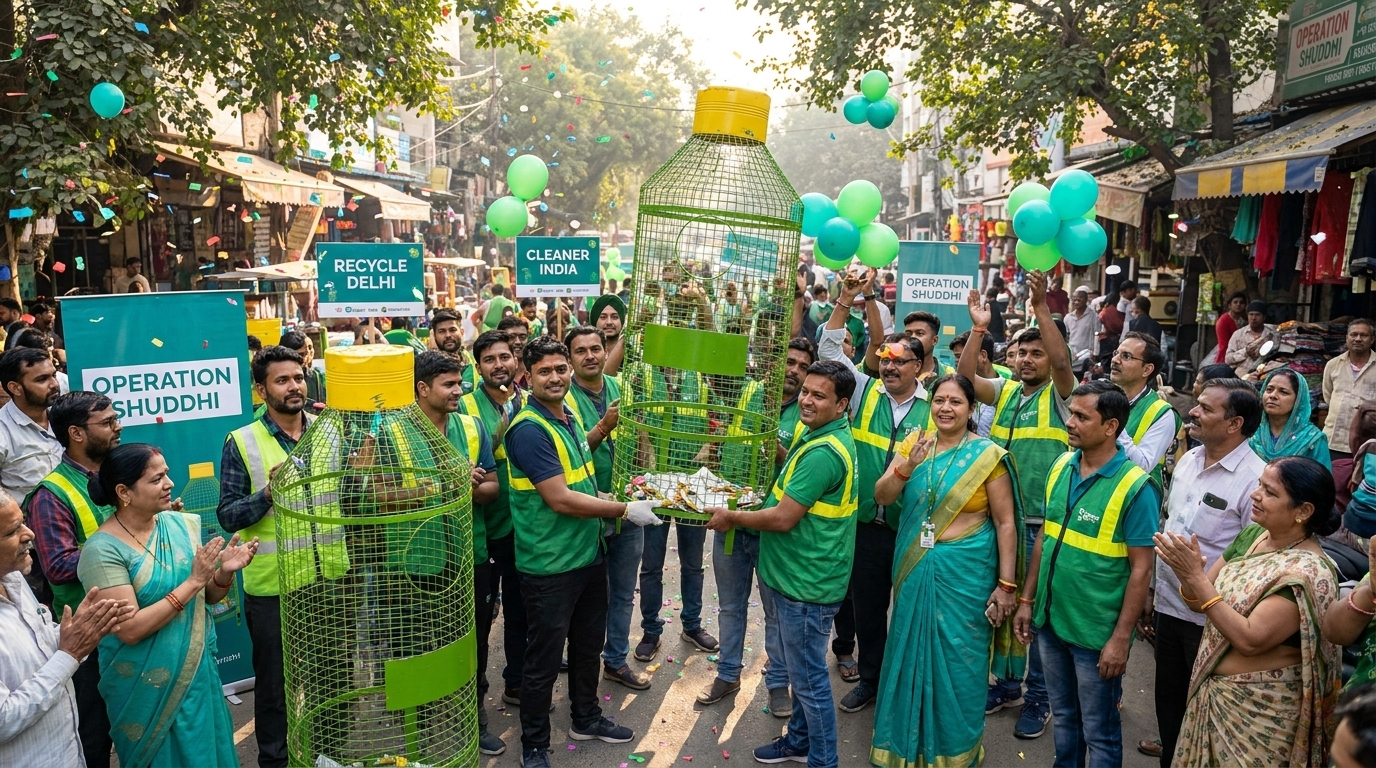
On World Environment Day, 5 June 2026, Operation SHUDDHI® — India’s Plastic Waste Recovery and Circular Economy Mission, an initiative of the AVRO Group — installed 126 plastic-waste dustbins across 22 locations in 16 areas of Delhi NCR in a single day. The bins span Delhi, Noida, Greater Noida, Ghaziabad, Faridabad, and Gurugram, including schools, colleges, hospitals, markets, residential colonies, and institutions. Rather than a one-time clean-up, the drive created permanent collection infrastructure — the critical first mile of the circular economy — that captures plastic every day and channels it to responsible recycling. Every bin is mapped on a public live dustbin locator, and the model is built to scale across India.
Key Takeaways
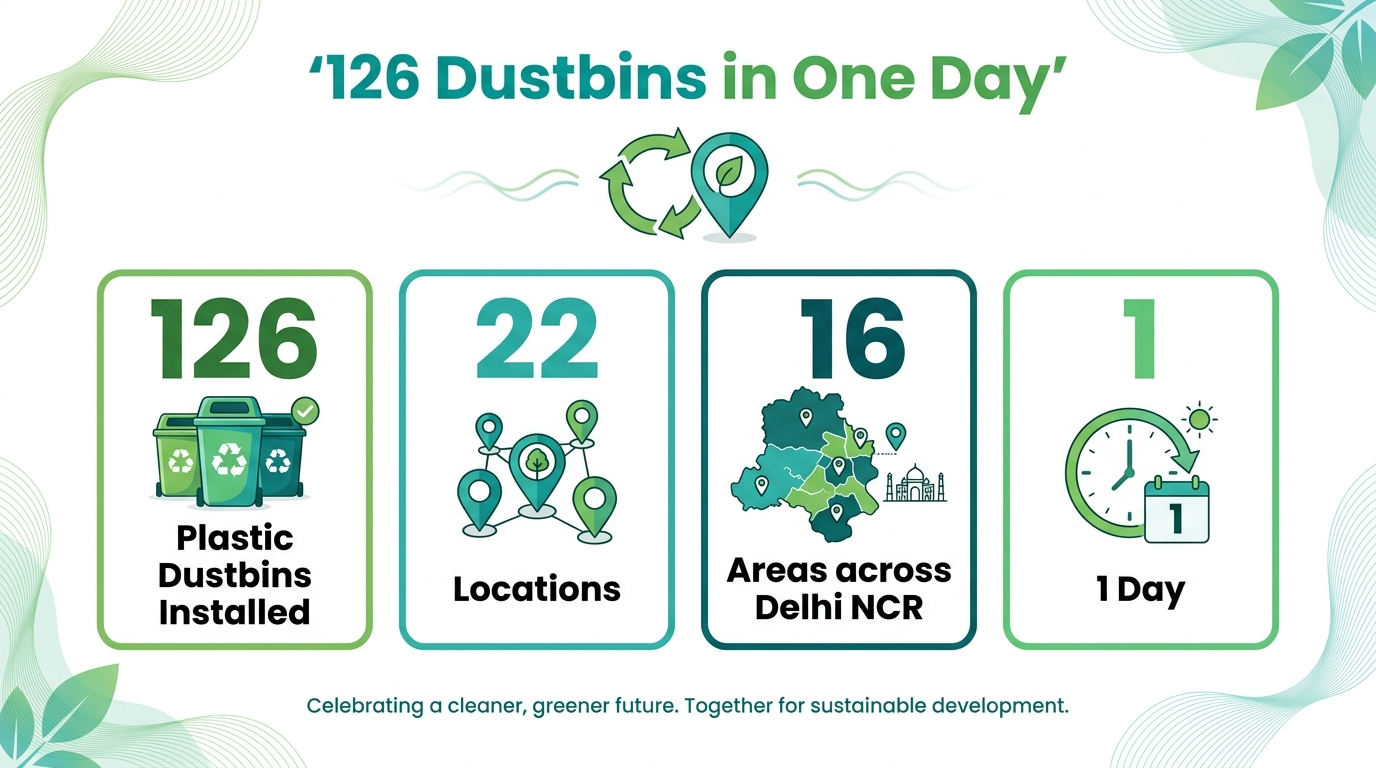
- Operation SHUDDHI installed 126 plastic dustbins in one day across Delhi NCR on World Environment Day, 5 June 2026.
- The bins cover 22 locations across 16 areas in Delhi, Noida, Greater Noida, Ghaziabad, Faridabad, and Gurugram.
- Each bin is a permanent capture point, not a one-time clean-up — impact compounds daily.
- The 126 bins can realistically recover an estimated 26–52 tonnes of plastic per year, avoiding roughly 34–68 tonnes of CO₂e annually.
- Every bin is locatable on a public live map, and collected plastic is tracked and routed to responsible recyclers.
- The drive directly supports the Swachh Bharat Mission and India’s circular-economy goals.
Quick Facts
| Fact | Detail |
|---|---|
| What | Single-day plastic dustbin installation drive |
| How many | 126 dustbins |
| Where | 22 locations across 16 areas of Delhi NCR |
| When | World Environment Day, 5 June 2026 |
| Cities covered | Delhi, Noida, Greater Noida, Ghaziabad, Faridabad, Gurugram |
| Run by | Operation SHUDDHI® (an AVRO Group initiative) |
| Live map | opshuddhi.org/locator |
Most clean-up drives end with a photo and a pile of collected waste. Operation SHUDDHI wanted something that would still be working long after the cameras left. So on World Environment Day, 5 June 2026, our team and community partners installed 126 plastic-waste dustbins at 22 locations spread over 16 areas across Delhi NCR — turning a single day of effort into permanent, everyday infrastructure for plastic recovery.
This is the story of how it happened, exactly where the bins went, the impact they can create, and the bigger mission behind Operation SHUDDHI.
What Happened: 126 Bins, One Day, Across Delhi NCR
A dustbin sounds like a small thing. A hundred and twenty-six of them, placed where people actually generate plastic waste, is something else entirely — it’s a network. In one coordinated drive on World Environment Day, Operation SHUDDHI placed bins at schools, colleges, hospitals, markets, residential areas, and community hubs across the National Capital Region.
The numbers from the day:
- 126 plastic dustbins installed
- 22 locations activated
- 16 areas across Delhi NCR covered
- 1 day of execution
Some partners took a single bin for their gate; others — committed community champions — took 20 to 24 bins to blanket an entire campus or colony. Every bin is now a fixed point where plastic can be dropped, separated, and channelled into recycling instead of ending up in a drain, a landfill, or being burned. You can see them all on our live dustbin locator map — search your area and find the nearest Operation SHUDDHI bin.
Areas Covered During the Drive
The 5 June drive concentrated on Delhi NCR, with bins installed across the following areas:
Delhi
The largest share of bins went up across the capital, including Rohini (Sector 9), Dwarka, Vikaspuri, Badarpur, Chattarpur Enclave (Phase 2), and Kirari, along with major institutions such as Satyawati College (University of Delhi) and Tirath Ram Shah Hospital.
Noida & Greater Noida
Bins were installed across Noida and Greater Noida, including the campus of Mangalmay Institute of Management and Technology, Knowledge Park II, Greater Noida — engaging students directly in plastic segregation and recovery.
Ghaziabad
Coverage in Ghaziabad included the ABES Engineering College campus, complementing Operation SHUDDHI’s flagship Ghaziabad Recovery Centre at the South of G.T. Road Industrial Area, Vijay Nagar.
Faridabad & Gurugram
The network extended into Faridabad and Gurugram (Gurgaon), bringing organised plastic collection to high-footfall community and market areas.
As the network grows, Operation SHUDDHI is expanding bin coverage across the wider NCR — including Indirapuram, Vaishali, Raj Nagar Extension, Crossings Republik, and other colonies in Ghaziabad, Noida, and Greater Noida. If your area isn’t covered yet, you can request a dustbin for your locality.
Why One Day Matters: From Event to Infrastructure
Anyone can run a one-time clean-up. The hard part is leaving behind something that keeps working. That was the whole point of doing this in a single, concentrated push on World Environment Day.
Installing 126 bins in a day does three things at once:
- It creates permanent capture points. A clean-up removes today’s waste; a dustbin keeps capturing waste every single day, indefinitely. The impact compounds.
- It builds the first mile of the circular economy. Recycling can only work if clean plastic is collected at the source. These bins are exactly that first mile — the foundation everything downstream depends on.
- It proves the model can scale. If 126 bins can go up in a day with the right coordination and community partners, then the path to thousands across India is not a dream — it’s a repeatable process.
That shift — from event to infrastructure — is what separates a campaign from a mission.
What Is Operation SHUDDHI?
Operation SHUDDHI® is India’s Plastic Waste Recovery and Circular Economy Mission, an initiative of the AVRO Group. Its purpose is simple but ambitious: to transform plastic waste into wealth, livelihoods, and environmental value through collection, recycling, awareness, and circular-economy initiatives. Learn more on the About Operation SHUDDHI page.
The mission is built on a clear belief — plastic is not waste; plastic in the wrong place is waste. Recovered and recycled properly, plastic is a resource that can re-enter the economy again and again. Lost to a landfill or a river, it becomes pollution. Operation SHUDDHI exists to make sure it ends up in the right place.
Why AVRO Group Launched Operation SHUDDHI
The AVRO Group has deep roots in recycling and sustainable manufacturing. Its leadership saw a structural gap in India’s plastic story: the country generates roughly 3.9 million tonnes of plastic waste a year (CPCB), yet a large share never reaches formal recycling — not because recyclers don’t exist, but because there aren’t enough clean, traceable collection points at the source. AVRO Group launched Operation SHUDDHI to close exactly that gap: to build the on-ground collection grid, formalise and support waste workers, engage communities, and connect everything to responsible recycling — turning a fragmented problem into an organised circular economy.
Mission and Vision
- Mission: Recover plastic waste at the source and transform it into wealth, livelihoods, and environmental value through collection, segregation, recycling, and awareness.
- Vision: A cleaner, circular India where plastic is treated as a resource — supporting the Swachh Bharat Mission, green jobs, and India’s climate and circular-economy commitments.
How the Dustbin Network Works
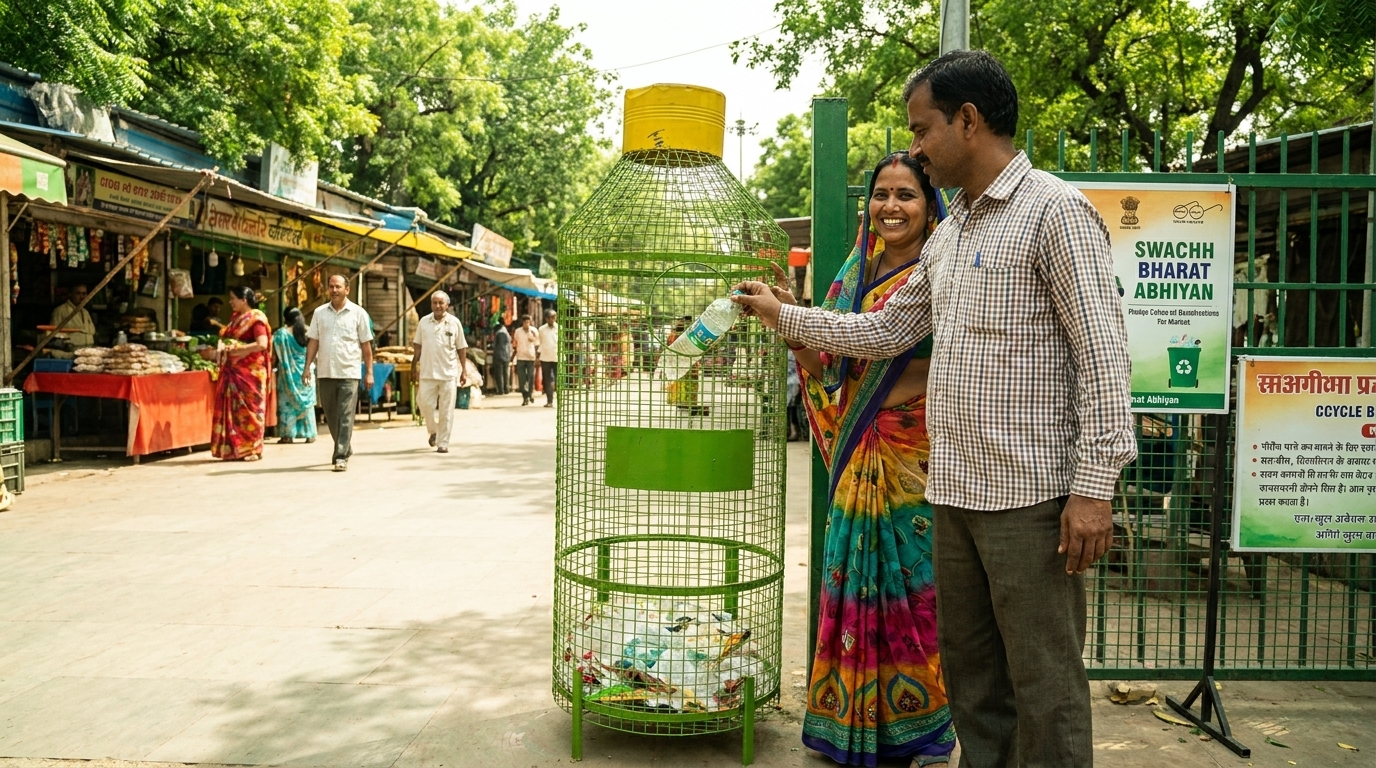
Each Operation SHUDDHI dustbin is more than a container — it’s a node in a coordinated recovery system:
- Placement at source. Bins are installed where plastic is generated — schools, colleges, hospitals, markets, RWAs, and institutions across Delhi NCR.
- Local stewardship. A community champion, school, RWA, or institution hosts and looks after each bin, encouraging correct use.
- Scheduled collection. Plastic is collected from the bins and aggregated, keeping the stream separate so it stays recyclable.
- Routing to recyclers. Collected plastic moves to Operation SHUDDHI collection centres and on to responsible recyclers.
- Mapping and visibility. Every bin and centre is plotted on the public collection centre and dustbin locator, so anyone can find the nearest drop point.
What Happens After You Drop Plastic in a Bin
This is the question most people never get answered — so here it is, step by step:
- You drop clean, dry plastic (bottles, packaging, wrappers) into the bin.
- It’s collected by the local team on a schedule and kept separate from wet waste.
- It’s aggregated and segregated by type at a collection point — clean, sorted plastic is far more valuable and recyclable. (Learn the basics in our plastic waste segregation guide.)
- It’s recycled using modern plastic recycling technologies, becoming raw material for new products instead of landfill.
- It re-enters the economy as recycled material — closing the loop in India’s circular plastic economy.
How Collection and Recycling Are Tracked and Verified
Trust depends on traceability. Operation SHUDDHI maintains records of where each bin is installed, who hosts it, and the plastic recovered from it. Because every bin is geo-mapped on the public locator, communities, sponsors, and partners can independently see and verify the network. Collection data, collection centre routing, and recycling records provide an auditable trail from the bin to the recycler — the same traceability that underpins credible EPR compliance and recycled-content claims for businesses.
Projected Impact of 126 Dustbins (with Assumptions)
How much difference can 126 bins really make? Below is a realistic projection. These are estimates based on stated assumptions, not guaranteed figures — actual results depend on usage, fill rates, and collection frequency.
Assumptions:
- 126 dustbins in service
- Each bin captures an average of 4–8 kg of plastic per week (conservative for public/community bins)
- Weekly collection, 52 weeks a year
- Recycling avoids roughly 1.3 tonnes of CO₂e per tonne of plastic vs virgin production (life-cycle assessment average)
- Average plastic bottle ≈ 20 grams
Annual projections:
| Impact metric | Estimated annual potential |
|---|---|
| Plastic collected | ~26–52 tonnes/year (midpoint ≈ 33 tonnes) |
| Landfill diverted | ~26–52 tonnes/year kept out of landfills, drains & open burning |
| CO₂e emissions avoided | ~34–68 tonnes/year (midpoint ≈ 43 tonnes) |
| Plastic bottle equivalent | up to ~1.3–2.6 million bottles/year recovered |
| Community reach | tens of thousands of citizens engaged across NCR each year |
| Recycling impact | tens of tonnes of new recycled raw material returned to the economy |
To put ~43 tonnes of avoided CO₂e in perspective, that’s roughly the annual emissions of 9–10 passenger cars — from 126 bins alone. Scale that to thousands of bins, and the climate and cleanliness impact becomes regional.
Impact on the Swachh Bharat Mission
Operation SHUDDHI’s drive directly advances the Swachh Bharat Mission and India’s broader sustainability goals. Each bin reduces litter and open dumping in public spaces, builds the habit of responsible disposal, formalises plastic recovery, and supports green livelihoods. By aligning grassroots collection with the national cleanliness and circular-economy agenda, the 126-bin drive turns policy ambition into visible, on-ground change — bin by bin, area by area, across Delhi NCR.
What Operation SHUDDHI Does Year-Round
The 126-bin drive is one visible piece of a much larger, year-round operation:
- Collection infrastructure — public dustbins, collection points, and collection centres that capture plastic close to where it’s generated.
- Segregation & recycling — promoting segregation at source and channelling material to responsible recyclers.
- Community mobilisation — volunteers, teachers, students, RWAs, and champions who host bins and drive behaviour change.
- Awareness & education — school and community programmes that build lasting habits.
- Circular economy for business — traceable recovery that supports brands’ EPR compliance and supplies recycled material back to manufacturing.
How Schools and RWAs Can Participate
Schools, colleges, and Resident Welfare Associations (RWAs) are the backbone of this network — and getting involved is simple:
- Schools & colleges: Host one or more bins on campus, run student-led segregation drives, and turn waste into a live sustainability lesson. Institutions like Mangalmay Institute, ABES College, and Satyawati College are already part of the movement.
- RWAs & housing societies: Place bins at gates, parks, and common areas to make your colony a zero-plastic-to-landfill zone, and give residents an easy, trusted drop point.
Both can join Operation SHUDDHI to request bins, collection support, and impact reporting.
Future Expansion Plans
The 126 bins are a proof point, not a finish line. Operation SHUDDHI plans to:
- Densify Delhi NCR coverage — expanding into Indirapuram, Vaishali, Raj Nagar Extension, Crossings Republik, and more colonies across Noida, Greater Noida, and Ghaziabad.
- Scale to thousands of bins using the repeatable single-day drive model.
- Add more collection centres to shorten the distance from bin to recycler.
- Deepen traceability — richer collection data and public reporting so every stakeholder can verify impact.
- Expand to new cities beyond NCR as the partner and sponsor network grows.
Statistics Summary
- 126 plastic dustbins installed in 1 day (World Environment Day, 5 June 2026)
- 22 locations across 16 areas of Delhi NCR
- 6 cities covered: Delhi, Noida, Greater Noida, Ghaziabad, Faridabad, Gurugram
- ~26–52 tonnes/year estimated plastic recovery potential
- ~34–68 tonnes/year estimated CO₂e avoided
- India generates ~3.9 million tonnes of plastic waste annually (CPCB) — the gap Operation SHUDDHI is closing
Ways to Get Involved
Whoever you are, there’s a way to be part of the cleaner, circular India this drive is building:
RWAs & Housing Societies
Make your colony zero-plastic-to-landfill with trusted drop points.
Businesses & Brands
Meet recycled-content goals and EPR targets with traceable recovery.
Plastic Waste Generators
Offices, shops and institutions with regular plastic waste.
Recycling & Collection Partners
Help us scale the network across India.
📍 See All 126 Bins on the Live Map Source Recycled Plastic Granules
Frequently Asked Questions
1. How many dustbins did Operation SHUDDHI install in one day? Operation SHUDDHI installed 126 plastic-waste dustbins in a single day on World Environment Day, 5 June 2026, across 22 locations spanning 16 areas of Delhi NCR.
2. Which areas of Delhi NCR were covered? Bins were installed across Delhi (including Rohini, Dwarka, Vikaspuri, Badarpur, Chattarpur Enclave, and Kirari), Noida, Greater Noida, Ghaziabad, Faridabad, and Gurugram, including schools, colleges, and hospitals such as Mangalmay Institute, ABES College, Satyawati College, and Tirath Ram Shah Hospital.
3. What is Operation SHUDDHI? Operation SHUDDHI is India’s Plastic Waste Recovery and Circular Economy Mission, an initiative of the AVRO Group, which transforms plastic waste into wealth, livelihoods, and environmental value through collection, recycling, awareness, and circular-economy initiatives.
4. How much plastic can 126 dustbins recover in a year? Based on an estimated 4–8 kg of plastic per bin per week, the 126 bins can recover roughly 26–52 tonnes of plastic per year, potentially avoiding 34–68 tonnes of CO₂e annually. These are projections based on stated assumptions.
5. What happens to the plastic collected in the bins? Plastic is collected on a schedule, kept separate, segregated by type, and sent to responsible recyclers who process it into raw material for new products — keeping it out of landfills and rivers.
6. How can I get a dustbin for my school, society, or area? Schools, colleges, RWAs, institutions, and businesses can request bins, collection points, or pickups by joining Operation SHUDDHI through the website’s join page. Community champions can host multiple bins for a campus or colony.
7. How can communities verify the collection and recycling? Every bin and collection centre is geo-mapped on Operation SHUDDHI’s public live locator, and collection and recycling records provide a traceable trail from bin to recycler — so sponsors, partners, and citizens can independently verify the network.
8. How does this support the Swachh Bharat Mission? By creating permanent, source-level plastic collection points, reducing litter and open dumping, building responsible-disposal habits, and feeding plastic into the circular economy — directly advancing Swachh Bharat and India’s sustainability goals.
Conclusion
A clean-up drive is a moment. A network of dustbins is a movement. By installing 126 plastic bins across Delhi NCR in a single day on World Environment Day, 5 June 2026, Operation SHUDDHI didn’t just remove waste — it built the everyday infrastructure that keeps removing it, day after day, in Delhi, Noida, Greater Noida, Ghaziabad, Faridabad, and Gurugram. That is exactly how a mission scales: not with one grand gesture, but with permanent systems placed where people live, study, and work.
This is the work of Operation SHUDDHI® — turning plastic waste into wealth, communities into changemakers, and single days of focus into lasting change. Find your nearest bin on the live locator map, and join Operation SHUDDHI to bring the next drive to your area. From waste to wealth, one bin at a time. Together for a cleaner, circular India.