Recycled Content in Manufacturing: Cut Cost & Carbon with rPET
For most of manufacturing history, “recycled” was a compromise word — cheaper material, lower quality, used quietly where no one would notice. That assumption is now obsolete. Today, recycled content is a strategic advantage: it lowers carbon footprints, hedges against volatile virgin-resin prices, satisfies tightening regulations, and signals genuine sustainability to customers and investors. For Indian manufacturers and brand owners, building recycled plastic into your products is no longer a niche choice — it’s fast becoming the cost of doing business.
This guide explains what recycled content means in practice, the business case for adopting it, the practical challenges, and how to secure a reliable supply of quality recycled material in India.
What “Recycled Content” Actually Means
Recycled content is the proportion of a product made from recycled material rather than virgin (new) plastic. The two terms you’ll encounter most often are:
- PCR (Post-Consumer Recycled) — plastic recovered from products that consumers used and discarded, such as PET bottles and HDPE containers. This is the gold standard, because it diverts real waste from landfills and rivers.
- PIR (Post-Industrial Recycled) — scrap and offcuts recovered from within the manufacturing process before reaching a consumer.
The most widely used recycled material in India is rPET — recycled polyethylene terephthalate — made from used PET bottles. Advanced processing now produces food-grade rPET clean enough to go back into new bottles, enabling true “bottle-to-bottle” circularity. Recycled HDPE, PP, and LDPE are also increasingly available for non-food packaging, containers, and durable goods.
The Business Case: Why Recycled Content Pays
Adopting recycled content is often framed as an environmental sacrifice. In reality, the strongest arguments are commercial.
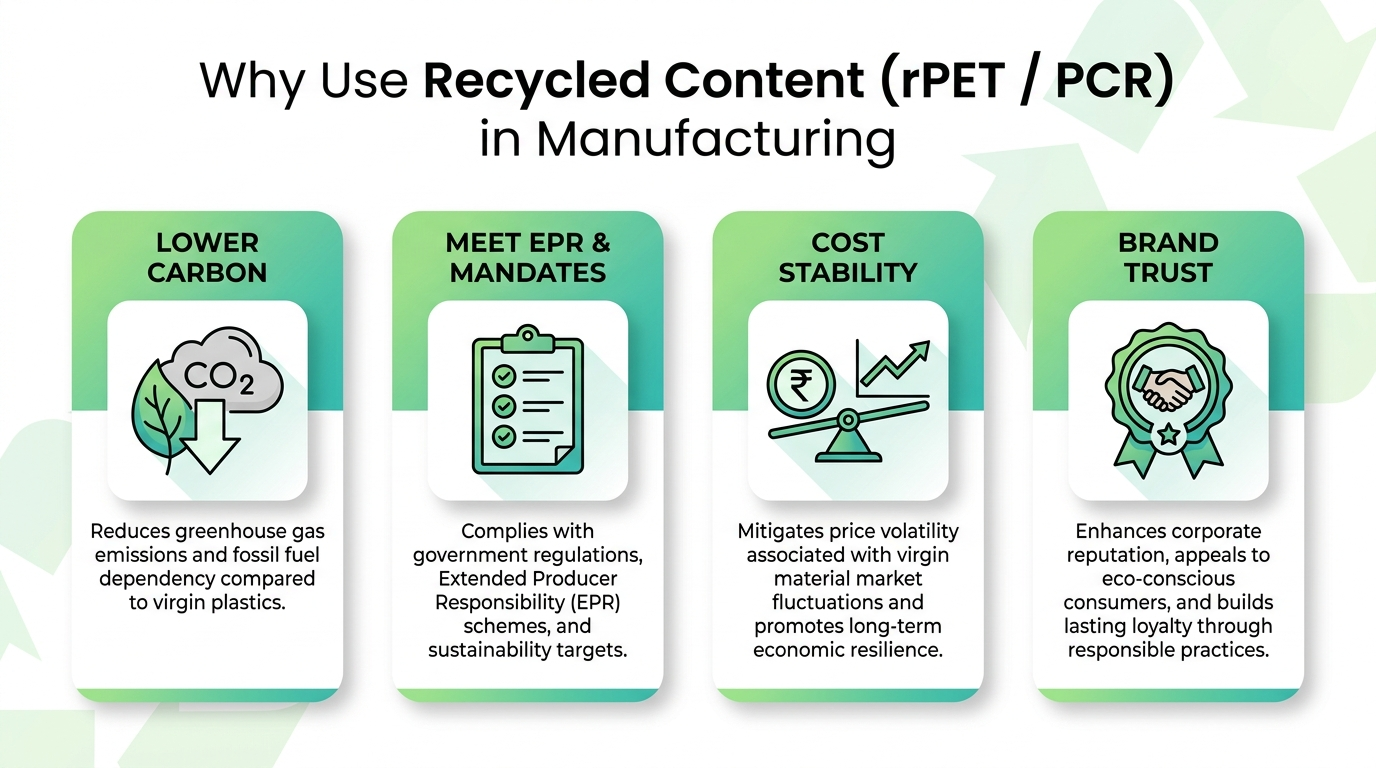
1. Lower Carbon Footprint
Producing plastic from recycled feedstock uses significantly less energy than manufacturing virgin resin from crude oil. Every tonne of recycled plastic used in place of virgin material cuts greenhouse-gas emissions — a direct, measurable improvement to a company’s environmental footprint and Scope 3 reporting.
2. Regulatory Compliance and EPR
India’s regulations increasingly mandate minimum recycled content in plastic packaging, with targets that rise year over year. Using recycled material isn’t just good practice — it’s becoming a legal requirement, and it directly supports a company’s EPR compliance obligations. Brands that build recycled content in early avoid scrambling to meet escalating mandates later.
3. Price Stability
Virgin resin prices swing with crude oil markets, making costs unpredictable. A robust recycled-content supply chain provides a partial hedge against that volatility, smoothing input costs and improving planning.
4. Brand Trust and Market Access
Consumers, retailers, and corporate buyers increasingly demand demonstrable sustainability. Verified recycled content is a concrete, defensible claim — far stronger than a vague “eco-friendly” label. It opens doors to retailers and export markets with strict sustainability requirements, and it strengthens ESG ratings that investors scrutinise.
The Real Challenges — and How to Solve Them
If the case is so strong, why isn’t every product made with recycled content already? Three obstacles recur, and each has a practical answer.
Quality and Consistency
The biggest historical concern is that recycled material is inconsistent. The solution is upstream: quality recycled content depends entirely on clean, well-segregated feedstock and modern processing. Working with recyclers who use advanced recycling technologies and who source from traceable, properly segregated waste yields material that performs reliably in production.
Supply Reliability
Manufacturers worry about securing consistent volumes. This is solved by partnering with an organized recovery network rather than buying ad hoc from fragmented suppliers — a network that aggregates collection at scale can guarantee steady, traceable supply.
Verification and Traceability
A recycled-content claim is only as good as the proof behind it. Without documentation, brands risk greenwashing accusations and audit failures. The fix is sourcing from recyclers who provide end-to-end traceability — documented chain of custody from collection through processing — so every claim is defensible.
Designing Products for Recycled Content
Maximising recycled content is easier when products are designed for it from the start:
- Choose recyclable mono-materials over hard-to-recycle multilayer structures, so your own products can later become feedstock.
- Specify a target recycled-content percentage in your packaging briefs and hold suppliers to it.
- Avoid problematic additives, colours, and labels that contaminate recycling streams.
- Document everything — recycled-content percentage, source, and certification — for ESG reports and EPR filings.
Design and sourcing are two halves of the same strategy: the more recyclable your products are, the more recycled feedstock exists for everyone, and the cheaper and more available it becomes.
Connecting Recycled Manufacturing to the Mission: Operation SHUDDHI
This is exactly the loop that Operation SHUDDHI® is built to close. As India’s Plastic Waste Recovery and Circular Economy Mission, Operation SHUDDHI focuses on transforming plastic waste into wealth, livelihoods, and environmental value through collection, recycling, awareness, and circular-economy initiatives.
For manufacturers, the single biggest barrier to recycled content is a reliable supply of quality, traceable material — and that is precisely what an organized network provides. By building nationwide collection centres, formalising waste workers, and ensuring segregated plastic flows cleanly to recyclers, Operation SHUDDHI helps create the steady, verifiable supply of recycled feedstock that Indian manufacturing needs. The plastic your brand puts into the world can come back as the raw material for your next product — and that is what a circular economy looks like in practice.
Frequently Asked Questions
1. What is recycled content in plastic products? Recycled content is the percentage of a product made from recycled plastic instead of virgin plastic. It is usually either post-consumer recycled (PCR), from used products like bottles, or post-industrial recycled (PIR), from manufacturing scrap.
2. What is rPET and is it safe for food packaging? rPET is recycled polyethylene terephthalate, made from used PET bottles. Advanced “bottle-to-bottle” processing produces food-grade rPET that is decontaminated and safe for direct food and beverage contact, meeting applicable safety standards.
3. Does using recycled content really reduce carbon emissions? Yes. Manufacturing plastic from recycled feedstock generally uses far less energy than producing virgin resin from crude oil, which lowers greenhouse-gas emissions per tonne of material and improves a company’s environmental footprint.
4. Is recycled content mandatory in India? India’s plastic packaging regulations increasingly require minimum recycled-content levels that rise over time, and recycled content supports Extended Producer Responsibility (EPR) obligations. Requirements vary by packaging category, so manufacturers should plan for escalating targets.
5. How can manufacturers ensure a reliable supply of quality recycled plastic? By partnering with organized recovery networks that aggregate traceable, well-segregated feedstock and work with recyclers using modern processing — rather than buying ad hoc from fragmented sources. This ensures consistent quality, steady volume, and verifiable documentation.
Conclusion
Recycled content has crossed the line from environmental gesture to business strategy. It cuts carbon, hedges cost, satisfies regulation, and builds the kind of credible sustainability story that wins customers and investors. The manufacturers who treat it as core to product design — not an afterthought — will lead India’s next decade of green manufacturing.
The one thing standing between ambition and execution is reliable supply of quality, traceable recycled material. That is the gap Operation SHUDDHI® exists to close — turning India’s plastic waste into the raw material for its future. Build it in, source it right, and let your products carry the proof: from waste to wealth, one recycled tonne at a time.
Partner with Operation SHUDDHI for traceable recycled plastic supply and circular-economy solutions. Visit www.opshuddhi.org or write to team@opshuddhi.org.
Partner with Operation SHUDDHI®
Is your business generating plastic waste, or do you need quality recycled material? Let’s turn your plastic into value — and build India’s circular economy together.
♻️ Have plastic waste? Hand it over to us for responsible, traceable recycling — support your EPR compliance and turn waste into wealth.
🏭 Need recycled granules (rPET / PCR)? Source clean, traceable recycled material for your products — contact us for supply.
Join Operation Shuddhi →
Contact Us to Donate Plastic or Buy Granules