
E-Waste Plastics in India: The Hidden Plastic Stream Powering the Circular Economy
Quick Answer: E-waste plastics in India are the plastic casings, cables and components that make up roughly 20–25% of discarded electronics by weight. With India generating about 1.7 million tonnes of e-waste annually (CPCB, 2024), recovering these plastics through registered recyclers under the E-Waste Management Rules 2022 turns a toxic liability into circular economy value.
Key Takeaways
- India is the world’s third-largest e-waste generator, producing about 1.7 million tonnes in FY 2023-24 (CPCB/PIB, 2025) — and the stream is rising every year.
- Plastics make up roughly 20–25% of e-waste by weight (BSEF, 2020); globally, 17 million tonnes of plastics sat inside the 62 million tonnes of e-waste generated in 2022 (Global E-waste Monitor, 2024).
- Only 22.3% of the world’s e-waste was formally collected and recycled in 2022, leaving US$62 billion of recoverable materials unaccounted for (UNITAR/ITU, 2024).
- India’s E-Waste (Management) Rules 2022 mandate EPR recycling targets rising from 60% to 80% of e-waste generated by FY 2027-28 (PIB, 2023).
- Safe recovery of e-waste plastics requires separating flame-retardant fractions, formalising informal workers, and building dedicated WEEE-plastic recycling capacity.
When we talk about plastic waste in India, we picture carry bags, bottles and multilayer sachets. But one of the fastest-growing plastic streams in the country hides in plain sight — inside our discarded phones, laptops, TVs, refrigerators and washing machines. E-waste plastics in India represent a double challenge: they are rising faster than almost any other waste category, and they carry additives that make careless recycling dangerous. Handled right, however, they are also one of the richest circular economy opportunities the country has.
India generated about 1.7 million tonnes of e-waste in FY 2023-24 according to the Central Pollution Control Board (CPCB via PIB, 2025), up from 1.6 million tonnes in 2021-22. Since plastics typically account for a fifth to a quarter of that weight, India is quietly producing an estimated 350,000–425,000 tonnes of e-waste plastics every year — a stream larger than the total plastic waste of many entire Indian states. This article explains what e-waste plastics are, why they matter, how their recycling works, and how India can turn this hidden stream into waste-to-wealth.
What Are E-Waste Plastics?
E-waste plastics — often called WEEE plastics (Waste Electrical and Electronic Equipment plastics) — are the polymer components of discarded electronics: monitor and TV housings, keyboard bodies, cable insulation, refrigerator liners, circuit-board substrates, printer shells and small appliance casings.
The material mix
Unlike PET bottles or HDPE containers, e-waste plastics are a complex cocktail. Common polymers include ABS (acrylonitrile butadiene styrene), HIPS (high-impact polystyrene), polycarbonate, polypropylene and PVC. According to the Bromine Science and Environmental Forum, plastics constitute roughly 20–25% of WEEE by weight (BSEF, 2020), and a significant share — about 9% of WEEE plastics in studied streams — contains brominated flame retardants (BFRs) added to prevent devices from catching fire.
Why they differ from packaging plastics
This additive load is what separates e-waste plastics from packaging waste. Flame retardants, cadmium-based pigments in older equipment and metal contamination mean these plastics cannot simply be melted into food-grade products. They demand identification, sorting and controlled processing — which is precisely why dedicated systems, not open burning or backyard recycling, are essential.
Why E-Waste Plastics Matter for India
The scale is enormous — and growing
The Global E-waste Monitor 2024 (UNITAR/ITU) reports that the world generated a record 62 million tonnes of e-waste in 2022, containing 17 million tonnes of plastics, and is on track to reach 82 million tonnes by 2030. India ranked third globally, behind only China and the United States, with 4.1 billion kg of e-waste in 2022. Around 65 Indian cities generate over 60% of the country’s e-waste.
The value being lost
Only 22.3% of global e-waste was documented as formally collected and recycled in 2022, leaving US$62 billion worth of recoverable resources unaccounted for (Global E-waste Monitor, 2024). The metals inside 2022’s e-waste alone were worth US$91 billion. India’s own recycling rate was about 33% of generated e-waste in 2021-22 (CPCB data via data.gov.in, 2023). Every unrecycled tonne means lost copper, gold, aluminium — and lost plastic that could displace virgin polymer production.
The human cost of informal processing
The majority of India’s e-waste still flows through informal channels — clusters like Seelampur in Delhi, where dismantlers burn cables to extract copper and acid-strip circuit boards. A 2025 study of 100 informal e-waste workers in Seelampur published in the Environment Conservation Journal found that only about 10% regularly used personal protective equipment, while facing daily cuts, infections and exposure to toxic fumes. When e-waste plastics containing flame retardants are open-burned, they release dioxins and furans — among the most persistent toxic pollutants known.
How E-Waste Plastic Recycling Works
Step 1: Collection and channelisation
Under India’s E-Waste (Management) Rules 2022, in force since 1 April 2023, producers of electronics carry Extended Producer Responsibility (EPR): they must ensure collection and recycling of e-waste equivalent to 60% of the waste their products generate in FY 2023-25, rising to 70% in FY 2025-27 and 80% from FY 2027-28 onwards (PIB, 2023). All manufacturers, producers, refurbishers and recyclers must register on the CPCB’s online EPR portal, and over 300 recyclers are already registered.
Step 2: Dismantling and liberation
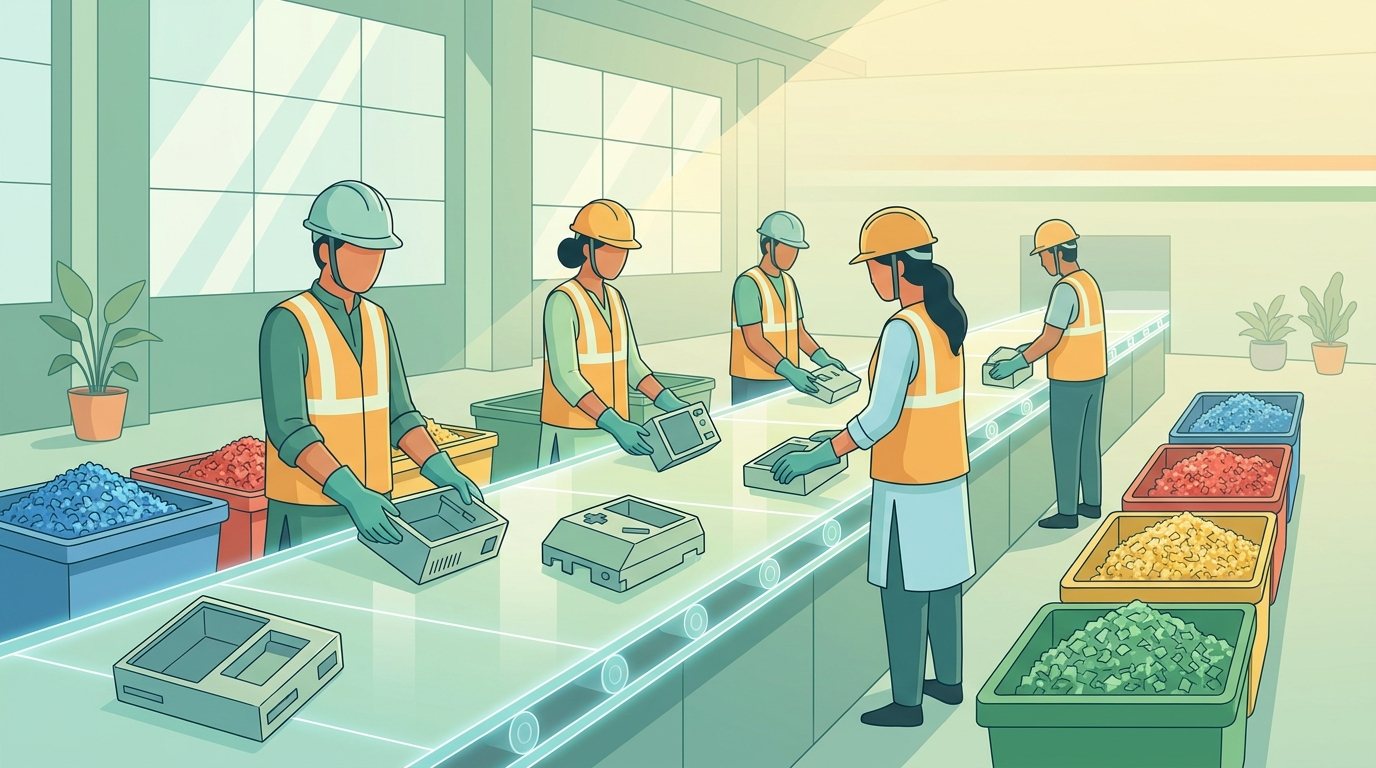
At registered facilities, devices are manually and mechanically dismantled. Plastics are separated from metals, glass and printed circuit boards. Shredding “liberates” mixed plastic flakes from residual metal.
Step 3: Sorting and separation
This is the technical heart of WEEE plastic recycling. Density separation, electrostatic sorting and near-infrared or X-ray fluorescence scanning split the stream by polymer type and identify flame-retardant fractions. European studies show that well-run facilities recycle about 55% of incoming WEEE plastics while concentrating more than 95% of brominated flame retardants into a separate high-density fraction for safe disposal or energy recovery (BSEF, 2020).
Step 4: Reprocessing into new products
Cleaned ABS, HIPS and polypropylene are compounded into recycled granules used in new appliance housings, automotive parts, pallets and construction profiles — closing the loop and cutting demand for virgin plastic made from fossil fuels.
Benefits of Recovering E-Waste Plastics
Recovering this stream delivers on multiple fronts at once. It keeps toxic additives out of open dumps and waterways, protecting soil and groundwater. It reduces greenhouse gas emissions, because recycled polymer carries a far smaller carbon footprint than virgin resin. It creates formal green jobs in dismantling, sorting and compounding — jobs that can absorb and upskill informal workers who already possess collection expertise. And it strengthens resource security: India imports large volumes of polymers, and every tonne of ABS recovered domestically is a tonne that doesn’t need to be imported. For businesses, EPR-compliant recycling of e-waste plastics also supports ESG reporting and BRSR disclosures.
Challenges Holding India Back
Dominance of informal processing
Informal dismantlers offer households instant cash for old electronics, so most e-waste never reaches registered recyclers. Without integrating these workers — through aggregation partnerships, training and formal employment — collection targets will remain hard to meet.
Weak plastic-specific infrastructure
India’s registered recyclers focus heavily on metal recovery, where the money is. Dedicated WEEE-plastic sorting lines with flame-retardant detection remain rare, so much separated plastic is downcycled or landfilled.
Additive and legacy contamination
Older equipment contains restricted substances that must be identified and removed from the recycling loop — a technical and cost burden smaller recyclers struggle with.
Awareness and convenient access
Most households simply don’t know where to responsibly hand over a dead appliance. Convenient, trusted collection points are the missing first mile.
Future Trends: Where E-Waste Plastics Are Headed
Expect four shifts by 2030. First, rising EPR targets (80% from FY 2027-28) will force producers to invest directly in collection networks and recycler partnerships. Second, advanced sorting — AI-assisted optical sorting and marker-based polymer identification — will make mixed WEEE plastic streams economically recyclable at scale. Third, chemical recycling and controlled pyrolysis are emerging as routes to handle flame-retarded fractions safely, with research showing bromine can be recovered and reused. Fourth, brands will increasingly advertise recycled-content electronics, creating demand pull for high-quality recovered ABS and HIPS. Globally, the projected rise to 82 million tonnes of e-waste by 2030 (UNITAR/ITU, 2024) makes this one of the decade’s defining resource questions.
Expert Insight
“E-waste is the fastest-growing solid waste stream in the world, rising five times faster than documented e-waste recycling. We are throwing away gold, copper — and millions of tonnes of recoverable plastic — while informal processing harms the very communities doing the work. Formal, safe recovery is not a cost; it is an investment in health and resource security.”
— Paraphrasing the findings of the Global E-waste Monitor 2024 (UNITAR/ITU), whose authors warned that the gap between e-waste generation and safe recycling is widening worldwide.
Case Study: From Seelampur’s Lanes to Formal Recovery
Seelampur in north-east Delhi is India’s largest informal e-waste hub, where thousands of workers dismantle electronics with bare hands. The 2025 Environment Conservation Journal study documented the paradox: these workers possess remarkable material-identification skills, yet only around 10% use protective equipment, and open burning of cable sheathing and plastic housings exposes entire neighbourhoods to toxic smoke. The study’s recommendation — integrate informal workers into formal recycling frameworks with legal recognition and fair compensation — mirrors the collection-network model Operation SHUDDHI applies to plastic waste: build convenient, dignified, formal channels around the people already doing the work, rather than displacing them. When collection becomes safe and formal, both livelihoods and recovery rates improve.
Conclusion: A Circular Future for India’s Electronic Plastics
E-waste plastics in India sit at the intersection of the country’s two great waste challenges — plastics and electronics. The numbers are stark: 1.7 million tonnes of e-waste a year, a fifth of it plastic, most of it escaping formal recovery. But the policy scaffolding now exists, the technology is proven, and the economic prize — part of a US$91 billion global materials pool — is real. What India needs is the connective tissue: convenient collection, formalised workers, and dedicated plastic-recovery capacity. That is the circular economy in action — and it starts with where you drop off your old device and your everyday plastic waste.
Data Snapshot
| Statistic | Value | Source | Year |
|---|---|---|---|
| Global e-waste generated (2022) | 62 million tonnes | Global E-waste Monitor 2024 (UNITAR/ITU) | 2024 |
| Global e-waste formally recycled | 22.3% | Global E-waste Monitor 2024 (UNITAR/ITU) | 2024 |
| Plastics in global e-waste (2022) | 17 million tonnes | Global E-waste Monitor 2024 (UNITAR/ITU) | 2024 |
| Projected global e-waste by 2030 | 82 million tonnes | Global E-waste Monitor 2024 (UNITAR/ITU) | 2024 |
| Value of metals in 2022 e-waste | US$91 billion | Global E-waste Monitor 2024 (UNITAR/ITU) | 2024 |
| Recoverable resources left unrecovered (2022) | US$62 billion | UNITAR | 2024 |
| India e-waste generated (FY 2023-24) | ~1.7 million tonnes | CPCB via PIB | 2025 |
| India e-waste recycled (2021-22) | ~33% (0.5 of 1.6 Mt) | CPCB, data.gov.in | 2023 |
| Plastic share of WEEE by weight | ~20–25% | BSEF | 2020 |
| EPR e-waste recycling target FY 2027-28 onwards | 80% | E-Waste (Management) Rules 2022, PIB | 2023 |
| Informal Delhi e-waste workers regularly using PPE | ~10% | Environment Conservation Journal | 2025 |
Frequently Asked Questions
Q1. What are e-waste plastics?
E-waste plastics are the polymer parts of discarded electronics — casings, cables, housings and internal components — typically made of ABS, HIPS, polycarbonate, polypropylene and PVC. They make up roughly 20–25% of e-waste by weight.
Q2. How much e-waste does India generate?
India generated about 1.7 million tonnes of e-waste in FY 2023-24 (CPCB via PIB, 2025), making it the world’s third-largest e-waste generator after China and the USA.
Q3. Why can’t e-waste plastics be recycled like ordinary plastic?
Many contain brominated flame retardants and other additives. They must first be sorted so the flame-retarded fraction (about 9% of WEEE plastics) is separated for safe disposal, while clean polymers are recycled.
Q4. What do India’s E-Waste Management Rules 2022 require?
Producers must register on the CPCB portal and meet EPR recycling targets: 60% of e-waste generated in FY 2023-25, 70% in FY 2025-27, and 80% from FY 2027-28 onwards.
Q5. Is burning e-waste plastic dangerous?
Yes. Open burning of flame-retarded plastics releases dioxins and furans — highly toxic, persistent pollutants — harming workers and nearby communities.
Q6. What happens to recycled e-waste plastics?
After sorting and cleaning, polymers like ABS and HIPS are compounded into granules for new appliance housings, automotive components, pallets and construction profiles.
Q7. Who handles most of India’s e-waste today?
Most e-waste still moves through informal channels such as Delhi’s Seelampur cluster, where studies show only about 10% of workers regularly use protective equipment.
Q8. How can households dispose of e-waste responsibly?
Hand devices to CPCB-registered recyclers, producer take-back programmes, or authorised collection points rather than selling to informal cable-burning units.
Q9. What is urban mining?
Urban mining is recovering valuable materials — metals and plastics — from waste streams like e-waste instead of extracting virgin resources. In 2022, urban mining reclaimed US$28 billion of secondary raw materials globally.
Q10. How does e-waste plastic recovery support climate goals?
Recycled polymers carry a much lower carbon footprint than virgin plastics made from fossil fuels, so every tonne recovered cuts emissions while reducing toxic pollution.
Related Resources
- Operation SHUDDHI Mission & Vision
- About Operation SHUDDHI
- Blog & Latest Updates
- Find a Collection Center (Locator)
- Join Operation SHUDDHI
Be Part of the Solution
India’s hidden plastic streams — from packaging to electronics — need formal, convenient recovery channels. Operation SHUDDHI is building exactly that: a nationwide plastic waste recovery network powered by communities, institutions and responsible businesses. Join the mission, install collection bins at your campus or office, and be part of India’s circular economy story. Visit opshuddhi.org today.
Sources & References
- Global E-waste Monitor 2024 — UNITAR/ITU
- UNITAR press release: E-waste rising five times faster than documented recycling (2024)
- PIB — E-Waste (Management) Rules 2022 and EPR regime (2023)
- PIB — Parliament reply on e-waste processing and management (2025)
- data.gov.in — Year-wise e-waste generation and recycling, 2021-22 to 2023-24
- BSEF — Impact of Brominated Flame Retardants on Recycling of WEEE Plastics (2020)
- Environment Conservation Journal — Informal e-waste workers in Seelampur, Delhi (2025)
- CEEW — How can India scale advanced e-waste recycling technology?