Responsible Consumption in India: Buy Better, Not Less
India does not have a plastic over-consumption problem. That statement sounds wrong, but the numbers hold it up.
The average Indian uses roughly 11 kg of plastic a year, against a global average close to 28 kg — and several times that in the richest economies. By the yardstick the world usually applies to responsible consumption, India is already among the most restrained large economies on the planet.
And yet India is the world’s largest emitter of mismanaged plastic, releasing an estimated 9.3 million tonnes a year into the environment (Cottom et al., Nature, 2024). The Central Pollution Control Board recorded 4.1 million tonnes of plastic waste generated in 2022-23. Globally, only about 9% of all plastic ever made has been recycled (OECD).
Put those facts side by side and the conclusion is uncomfortable but useful: India’s plastic crisis is not driven by how much we consume, but by what we consume and what happens after. A country using less than half the global per-capita average still leads the world in leaked plastic, because the material moves through formats and systems that make recovery nearly impossible.
In a high-consumption economy, the lever is volume. In India, the lever is format and disposal — what determines whether a piece of plastic re-enters the economy as raw material or exits it as pollution.
What Responsible Consumption Actually Means in the Indian Context
The Sustainable Development Goal 12 framing — “Responsible Consumption and Production” — is usually read as an instruction to households to cut back. For most Indian consumers, cutting back further is neither realistic nor the highest-value action. Someone buying a ₹10 shampoo sachet is making an affordability choice, not an environmental one, and no amount of awareness messaging changes that arithmetic.
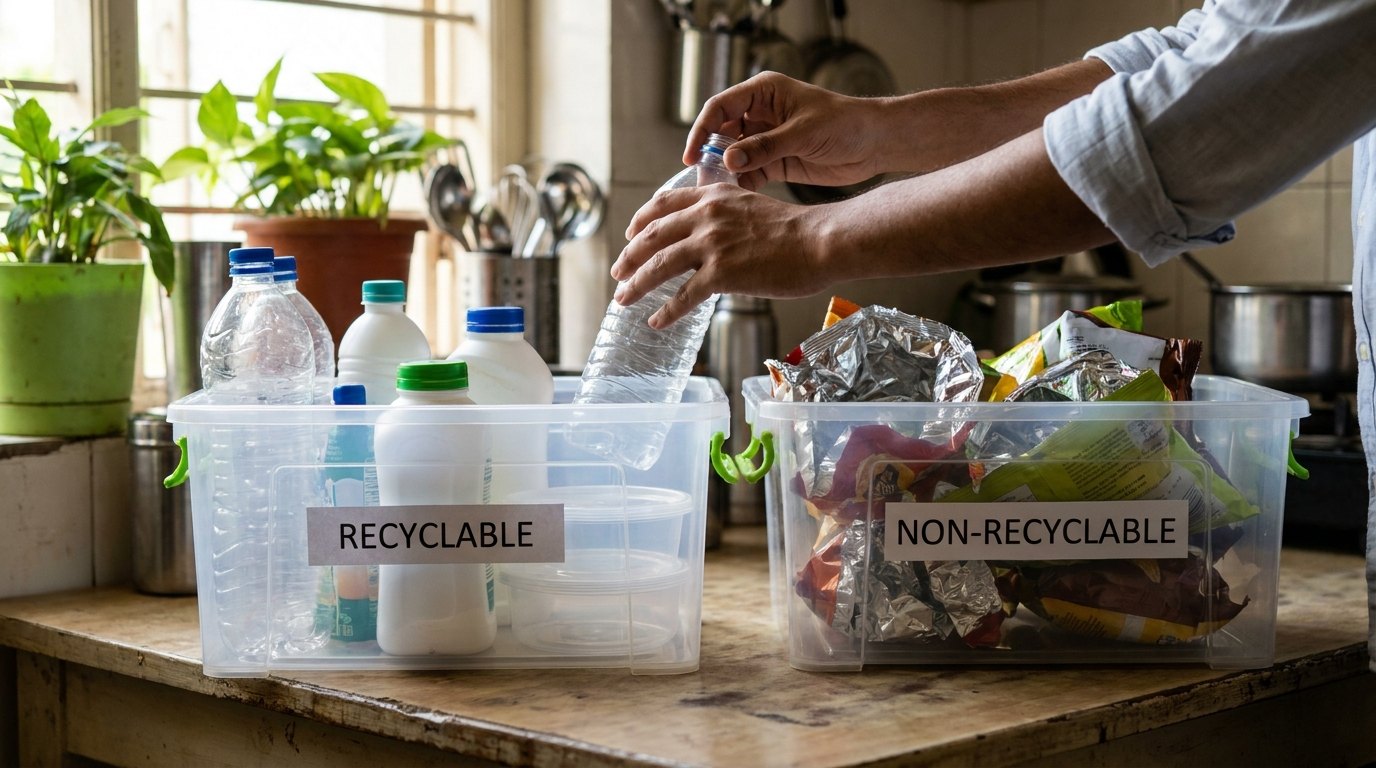
Consider two households with identical plastic footprints by weight. The first buys large mono-material HDPE and PET containers, rinses them, and keeps dry waste separate. Nearly all of that plastic has market value and will be bought by an aggregator. The second buys the same weight in multilayered sachets and mixes everything into one bin. Almost none of it will be recycled — those sachets are laminates of plastic and aluminium that no mechanical recycler can profitably separate, and contamination from wet waste devalues whatever else was in the bag.
Same consumption. Opposite outcomes.
This is why responsible consumption in India is better understood as recoverability-first consumption. The question is not only “do I need this?” but “when I am done with this, can anyone actually use it?”
The formats that decide the outcome
Not all plastic is equally recyclable, and the gap is much wider than most buyers realise:
- PET (water and beverage bottles) — highly recyclable, strong resale value, backbone of India’s bottle-to-bottle rPET industry.
- HDPE (detergent bottles, buckets, crates) — recyclable, reliably bought by aggregators.
- PP (food containers, caps, furniture) — recyclable, moderate value.
- LDPE films and carry bags — recyclable in principle, but low value and easily contaminated.
- Multilayered packaging (MLP) — sachets, chips packets, cement and salt bags. Recoverable only through co-processing or specialised routes; commercially near-worthless in the mainstream chain.
- PVC and thermosets — problematic, frequently landfilled.
A shopper who shifts even part of their basket from the bottom of that list to the top changes the economics of recovery for every collector downstream — a consumption decision doing work no awareness campaign can replicate.
Refuse, reduce, reuse — then recycle
India’s single-use plastic ban, effective 1 July 2022, removed the worst-offending items — straws, cutlery, thin carry bags — from legal circulation. It works best when treated as a floor rather than a ceiling.
The hierarchy still holds, in order: refuse what you do not need, reduce what you do, reuse what you can, and only then rely on recycling — the last line of defence, not the goal, as our guide to the circular economy in India develops.
One caution: “biodegradable” and “compostable” labels are not a free pass. Most need industrial composting conditions that barely exist in India, and they contaminate recycling when mixed in — see our analysis of compostable and biodegradable plastics.
Segregation Is a Consumption Decision, Not a Disposal Chore
Most people file segregation under waste management. It belongs under consumption, because it is the moment your purchase either retains value or loses it.
Plastic that arrives at a sorting facility mixed with food waste must be washed, dried, and often downgraded — much of it is not worth the labour. Plastic that arrives dry and loosely sorted is a commodity with a price per kilogram. The difference is about thirty seconds of effort at disposal.
Those thirty seconds also shape the working conditions of the 1.5 to 4 million informal waste workers who recover most of India’s recycled plastic. When households mix waste, someone else sorts it by hand — through sanitary waste, glass, and rot. When households segregate, that worker handles clean material and earns more per hour. Responsible consumption has a labour dimension that rarely gets discussed, covered in our piece on informal waste workers and the circular economy.
The practical standard for any household is modest:
- Keep dry waste in a separate bin from wet — this single step does most of the work.
- Rinse containers that held food, oil, or shampoo. A quick swill is enough.
- Keep MLP sachets in their own bag so they cannot contaminate high-value plastics.
- Flatten bottles and cartons to keep collection volumes manageable.
- Hand material to an identified collection route rather than a general bin.
Our guide to segregation at source sets out the full method, and the Operation SHUDDHI locator shows the nearest collection centre or dustbin.
For Businesses, Procurement Is Environmental Policy
Household behaviour gets the attention. Institutional purchasing moves far more material.
A company that buys packaging decides, on behalf of thousands of eventual consumers, whether that material is recoverable. Packaging accounts for the majority of plastic consumed in India — commonly estimated near 59%, with roughly 43% single-use (Centre for Science and Environment). Those are procurement decisions, not consumer decisions.
Three forces have turned this from a values question into a commercial one.
Extended Producer Responsibility is now mandatory. Since 2022, producers, importers and brand owners have been legally obliged to ensure their packaging is collected and processed, registered through the CPCB’s EPR portal, with annual returns and environmental compensation for shortfalls. A hard-to-recycle format now creates a liability the business itself must fund. Our EPR guide explains the mechanics.
Recycled content is becoming a specification, not a claim. The 2026 amendments to the Plastic Waste Management Rules introduce a rising recycled-content ladder for rigid packaging — stepping from 30% toward 60% over the coming years — plus the first reuse targets India has written into the rulebook. Procurement teams without secured recycled feedstock are buying a compliance problem.
Disclosure has teeth. ESG and BRSR reporting have made packaging choices legible to investors and buyers, as discussed in our note on ESG compliance and plastic waste.
A short case study
A mid-sized Delhi NCR food brand reviewed its packaging in response to EPR costs, not sustainability targets. Two changes did most of the work: switching a laminated pouch to mono-material PP, and moving from mixed-colour to clear PET on its bottled line.
Neither reduced the quantity of plastic used. Both sharply raised its recoverability — clear PET commands a better rate than coloured, and mono-material PP can be recycled where the laminate could not. The EPR obligation became cheaper to discharge, and the recovered material found a buyer instead of a landfill.
The lesson generalises: responsible consumption at institutional scale is rarely about using less. It is about choosing formats that keep material in the economy.
Building the Habit: What to Actually Do
| Who | Highest-impact action | Why it works |
|---|---|---|
| Households | Separate dry from wet waste, every day | Preserves the value of everything else you do |
| Households | Shift purchases toward PET, HDPE and PP formats | Changes recovery economics downstream |
| Housing societies | Set up a dedicated dry-waste collection point | Aggregates volume to a level collectors will service |
| Offices and institutions | Audit packaging and canteen plastics | Institutional volume moves more material than staff behaviour |
| Brands and manufacturers | Specify mono-material and recycled content | Cuts EPR liability and pre-empts 2026 rules |
| Everyone | Use an identified collection route | Ensures material reaches a recycler, not a dump |
Housing societies are the most underrated unit of change in India. A single 300-household society generates enough dry plastic each month to justify a scheduled pickup — volume no individual flat could command. Once collection is regular and predictable, participation rises, because residents can see where the material goes. Our guide to community recycling programmes sets out how to start one, and our piece on collection systems explains why collection, not recycling capacity, is India’s real bottleneck.
Frequently Asked Questions
1. What is responsible consumption in the Indian context? Choosing products and packaging that can actually be recovered, and disposing of them so they retain value. Because India’s per-capita plastic use is already low — around 11 kg a year against a global average near 28 kg — the biggest gains come from switching formats and segregating properly rather than consuming less.
2. Is reducing plastic use pointless in India, then? No. Refusing unnecessary plastic remains the top of the hierarchy. But for most Indian households, format and disposal decisions deliver a larger return than further cuts in volume — and they are more achievable.
3. Which plastics should I prefer when I have a choice? PET, HDPE and PP are widely recycled and hold resale value. Avoid multilayered sachets, PVC, and mixed-material packaging where an alternative exists. Larger containers usually improve the ratio of product to packaging.
4. Are compostable or biodegradable plastics a good substitute? Usually not, in current Indian conditions. Most need industrial composting facilities that are not widely available, and they contaminate conventional recycling when mixed in. A recyclable conventional plastic that actually gets collected is generally the better outcome.
5. How does responsible consumption connect to EPR and business compliance? Directly. Consumption choices determine what enters the waste stream, and EPR makes producers financially responsible for recovering it. Easy-to-recycle formats lower compliance costs; hard-to-recycle formats raise them. The 2026 recycled-content requirements tighten that link further.
Closing the Loop
Responsible consumption in India is not an exercise in restraint. It is an exercise in judgement — knowing which plastics carry value, which are dead ends, and which small decisions at purchase and disposal keep material circulating instead of leaking.
That judgement only pays off if the infrastructure exists to receive the material. This is where Operation SHUDDHI® works: building the collection network, the partner centres, and the awareness that turn a household’s thirty seconds of segregation into recovered material, into livelihoods for collectors and sorters, and into recycled feedstock for Indian manufacturing. Plastic waste becomes wealth, employment, and environmental value — but only when consumption decisions and recovery systems meet.
A country that already consumes modestly does not need to consume less to lead on plastics. It needs to consume deliberately, and to build the systems that reward the choice.
Become part of it. Find your nearest collection point on the Operation SHUDDHI locator, join as a volunteer, or write to team@opshuddhi.org to set up collection for your society, office, or brand.
Operation SHUDDHI® — From Waste to Wealth 🌐 www.opshuddhi.org · ✉️ team@opshuddhi.org