
Plastic Waste Collection Systems in India: The Missing Link
Quick answer: A plastic waste collection system is the organised network of bins, collection points, transport routes, aggregation centres, and recycler linkages that moves used plastic from where it is discarded to where it can be recovered. In India, collection — not recycling technology — is the real bottleneck. Fix collection, and a circular economy follows.
Recycling gets the headlines. New chemical recycling plants, rPET bottles, plastic roads — these make for good news. But none of it matters if the plastic never reaches the plant. In India, the single biggest reason a discarded shampoo sachet or water bottle becomes pollution rather than a resource is deceptively simple: it was never collected in the first place.
This is the quiet crisis at the heart of India’s plastic story. And it is exactly where Operation SHUDDHI® works — building the on-the-ground collection network that turns scattered waste into a recoverable, revenue-generating resource.
Key Takeaways
- Collection is the bottleneck. India generates roughly 3.9 million tonnes of plastic waste a year (~10,689 tonnes per day), yet a large share never enters a formal collection stream (CPCB, 2022-23).
- India produces over 160,000 tonnes of municipal solid waste per day, and around 21% goes unprocessed, much of it ending up in landfills or the environment (CPCB).
- India is now the world’s single largest source of plastic emissions to the environment — about 9.3 million tonnes a year — driven overwhelmingly by uncollected and mismanaged waste (Nature / University of Leeds, 2024).
- A collection system has five links: segregation → local collection → aggregation → transport → recycler linkage. A weakness in any one breaks the chain.
- Operation SHUDDHI® strengthens the weakest links — placing dedicated collection dustbins, running collection centres, and connecting waste to responsible recyclers — turning waste into wealth, livelihoods, and environmental value.
Why Collection, Not Recycling, Is India’s Real Problem
India actually recycles a higher share of its plastic than many wealthy nations. Estimates suggest around 60% of collected plastic waste is recycled — well above the roughly 9% global recycling rate reported by the OECD. On paper, that sounds like a success story.
The catch is in the word collected. Recycling rates are calculated on the plastic that reaches the system. The plastic that never arrives — dropped in an open drain, burned in a backyard, blown from an overflowing bin, or buried in a mixed-waste dump — simply isn’t counted as a failure of recycling. It becomes pollution.
This is why India can simultaneously be a global recycling performer and the world’s largest plastic polluter, emitting an estimated 9.3 million tonnes of plastic to the environment each year according to a landmark 2024 study in Nature led by the University of Leeds. The gap between what is generated and what is collected is where the environmental damage happens.
The lesson for anyone serious about the circular economy is direct: you cannot recycle what you never collect. Investment in shiny downstream technology delivers little if the upstream collection infrastructure is broken. Collection is the foundation everything else stands on.
Anatomy of a Working Collection System
An effective plastic waste collection system is not a single object — it is a chain of five connected links. Understanding each helps explain where India’s chain breaks and how it can be repaired.
1. Segregation at source
Collection begins before the waste even leaves the home, shop, or office. When plastic is separated from wet and organic waste at the point of disposal, it stays clean, dry, and valuable. Mixed with food waste, the same plastic becomes contaminated, low-value, and often unrecyclable. Segregation at source is the cheapest, highest-leverage intervention in the entire system — and the one most often skipped.
2. Local collection points
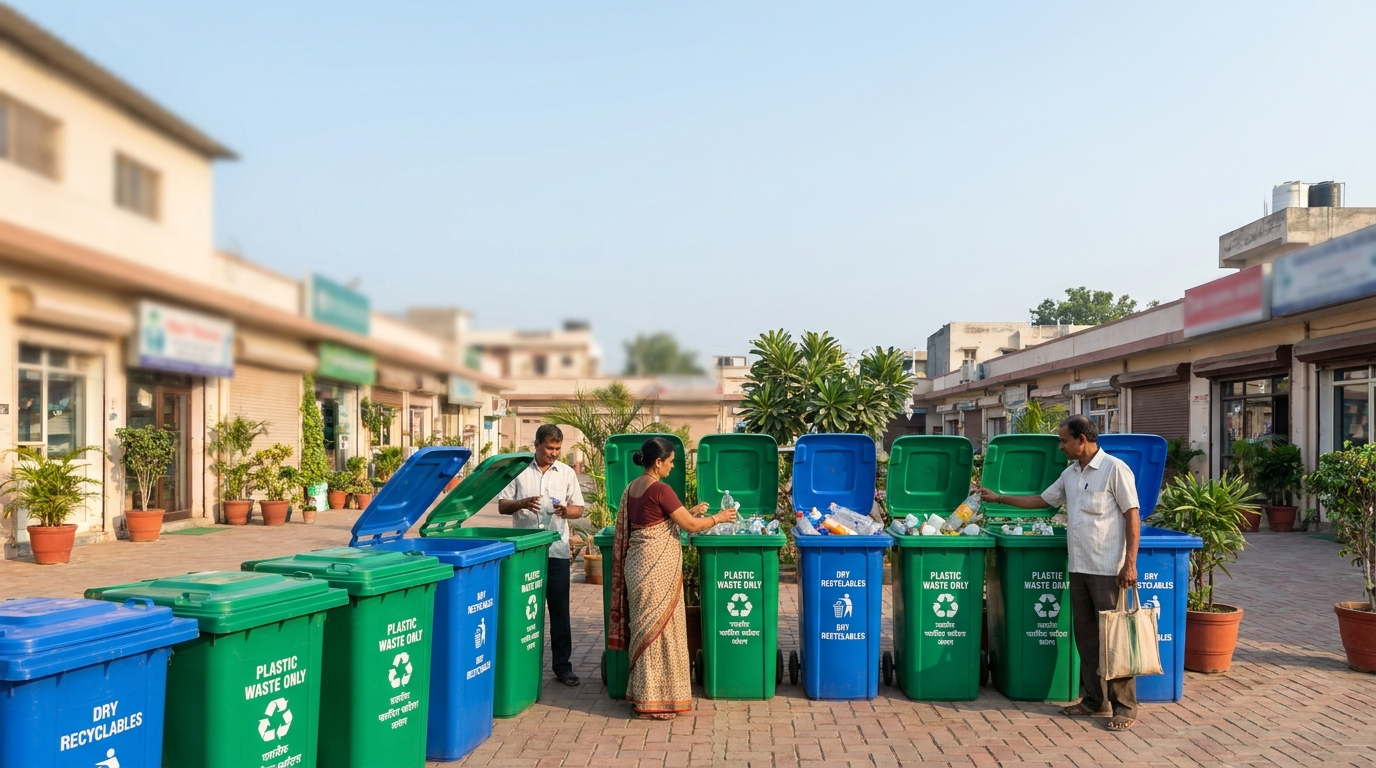
Waste needs somewhere to go. Dedicated, clearly marked plastic collection bins in residential societies, markets, schools, hospitals, and commercial areas give people a correct place to deposit dry waste. Without a visible, convenient collection point, even well-intentioned segregation collapses — people default to the nearest general bin or the ground.
3. Aggregation
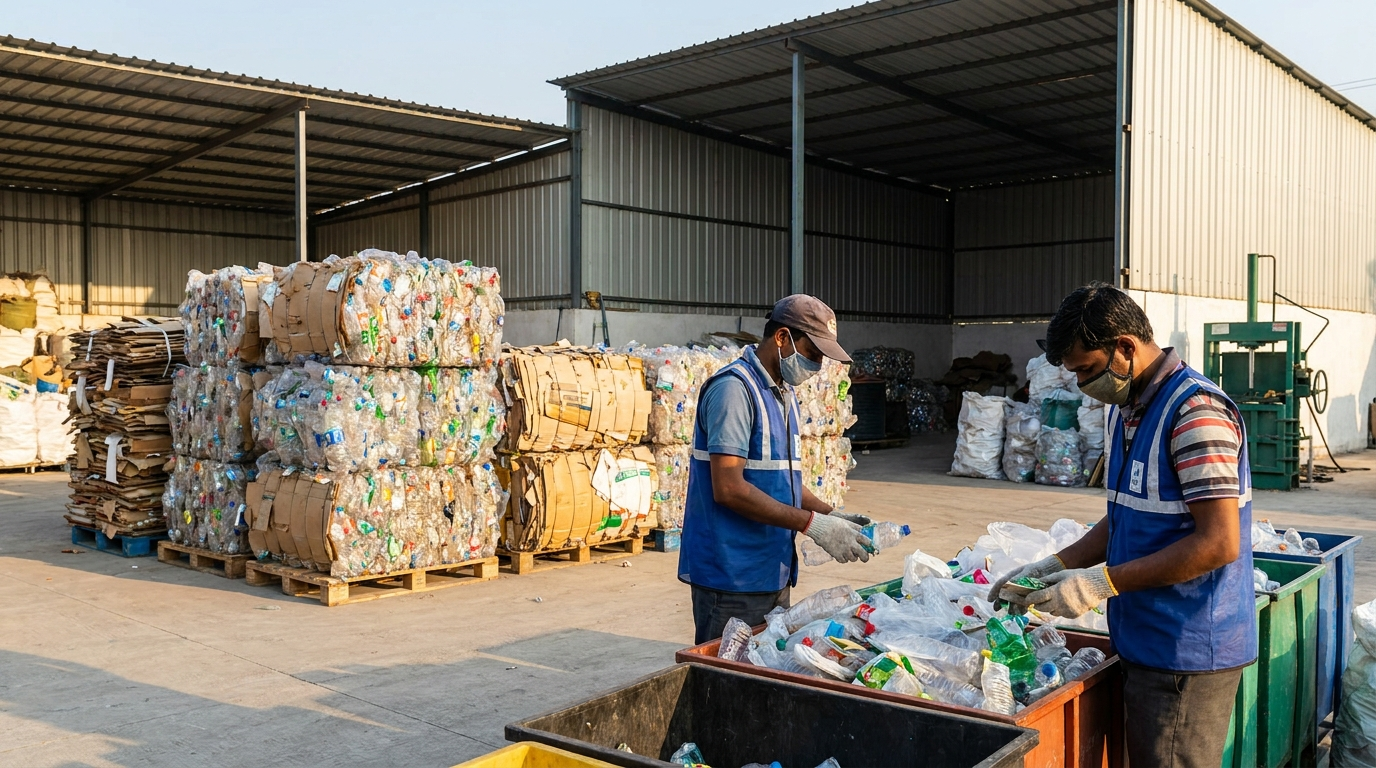
Individual bins hold small volumes. Recyclers need bulk. Aggregation points — collection centres — consolidate plastic from many local sources into economically viable quantities. This is the link that connects a household’s handful of bottles to an industrial recycler’s truckload requirement.
4. Transport and logistics
Plastic is light but bulky, which makes transport disproportionately expensive relative to its value. Efficient routing, baling, and scheduled pickups are what make the economics work. Poor logistics is a silent killer of collection systems: material gets collected, then sits, then contaminates, then is discarded.
5. Recycler linkage
Finally, aggregated plastic must reach a responsible recycler — one that processes material safely and to standard, not one that dumps residuals or burns rejects. A collection system that feeds an irresponsible endpoint just relocates the pollution. Closing the loop responsibly is what makes the system genuinely circular.
When all five links hold, plastic flows from discard to resource. When any one fails, the material leaks out — and leaked plastic is exactly what shows up as India’s pollution figures.
The Formal–Informal Collection Divide
India’s collection system has a defining characteristic that policymakers ignore at their peril: most of it is informal.
Millions of waste pickers, kabadiwalas, and small aggregators form the backbone of the country’s plastic recovery. They collect from streets, dumps, and doorsteps, sort by hand, and feed material into the recycling economy — largely invisibly and without recognition. In many cities, this informal network recovers more high-value plastic than the formal municipal system does.
The informal sector is efficient at what pays — bottles, hard plastics, anything with resale value. But it systematically ignores what doesn’t: low-value multilayered sachets, thin films, and contaminated packaging. These “worthless” plastics are precisely the ones that leak into the environment. A modern collection system doesn’t replace the informal sector; it integrates and supports it, adding structure and reach for the low-value streams the market alone won’t touch.
This is the design philosophy behind Operation SHUDDHI®’s model — building formal collection infrastructure that complements existing recovery networks rather than competing with them, and extending collection to the waste everyone else leaves behind.
How Operation SHUDDHI® Strengthens the Chain
Operation SHUDDHI®, India’s Plastic Waste Recovery and Circular Economy Mission, was built around a simple diagnosis: India’s problem is collection, so collection is where we work.
Dedicated collection dustbins. SHUDDHI places clearly branded plastic-collection bins in the places waste is generated — residential societies, schools, hospitals, and commercial areas. A visible, correct place to deposit dry plastic is the first and most important nudge toward a clean stream. In one Delhi NCR drive, the network placed over a hundred dedicated dustbins in a single day, turning scattered disposal into organised collection points overnight.
Collection centres for aggregation. Bins alone don’t close the loop. SHUDDHI’s collection-centre model consolidates plastic into recycler-ready volumes, solving the aggregation link that so often breaks. Businesses, institutions, and partners can register to host a collection point or become a collection partner, plugging directly into the network.
A live map of where to give. SHUDDHI is building a public locator platform — a live map of collection points and dustbins — so that anyone can find the nearest place to deposit their plastic. Convenience is not a nice-to-have in collection; it is the deciding factor between a bottle recycled and a bottle littered.
Responsible recycler linkage. Every stream SHUDDHI collects is routed to responsible recycling and circular-economy pathways, ensuring collected plastic is genuinely recovered — transformed into wealth, livelihoods, and environmental value rather than relocated pollution.
Through collection, recycling, awareness, and circular-economy initiatives, Operation SHUDDHI® turns the missing link into a working one.
A Practical Blueprint for Businesses and Communities
For a housing society, corporate campus, school, or manufacturer wanting to build reliable collection, the path is straightforward:
- Start with segregation. Introduce two-bin (wet/dry) separation and communicate it simply and repeatedly. Clean plastic is valuable plastic.
- Install dedicated collection points. Place marked plastic bins where people actually generate waste — not tucked away, but visible and convenient.
- Aggregate on a schedule. Consolidate collected plastic and arrange regular pickups before material sits and contaminates.
- Link to a responsible recycler. Partner with a network that guarantees traceable, responsible recycling — critical for EPR compliance and ESG reporting.
- Measure and communicate. Track kilograms collected and diverted. Visible progress sustains participation and builds a credible sustainability story.
Done well, collection stops being a cost centre and becomes a source of value — recovered material, EPR credits, ESG credentials, and genuine environmental impact.
Frequently Asked Questions
1. What is a plastic waste collection system? It is the organised chain that moves used plastic from disposal to recovery — segregation at source, local collection bins, aggregation at collection centres, transport, and linkage to a responsible recycler. All five links must work for plastic to be recovered rather than lost.
2. Why is collection considered India’s biggest plastic problem? Because India already recycles a high share of the plastic it collects (~60%). The pollution comes from plastic that never enters the system at all. India emits an estimated 9.3 million tonnes of plastic to the environment yearly (Nature, 2024) — largely uncollected, mismanaged waste.
3. How much plastic waste does India generate and collect? India generates roughly 3.9 million tonnes of plastic waste annually (CPCB, 2022-23). Of the country’s 160,000+ tonnes of daily municipal solid waste, around 21% goes unprocessed — a direct consequence of collection gaps.
4. What role does the informal sector play in collection? A huge one. Waste pickers and kabadiwalas recover much of India’s high-value plastic. But they skip low-value items like sachets and films, which then leak into the environment. Effective systems integrate and support the informal sector rather than replacing it.
5. How can my organisation set up plastic collection? Start with source segregation, install dedicated collection bins, aggregate on a schedule, and link to a responsible recycler for traceable recycling. Operation SHUDDHI® helps businesses and communities set up collection points and connect to the recovery network — write to team@opshuddhi.org.
Conclusion: Close the Gap, Close the Loop
The circular economy is often drawn as a neat, closed circle. In reality, India’s circle has a break in it — and that break is collection. Every uncollected sachet, every overflowing bin, every bottle that never reaches a centre is a place where the loop leaks and the resource becomes pollution.
Recycling technology will keep improving. Policy like EPR will keep tightening. But none of it recovers a single gram of plastic that was never collected. Collection is the foundation — unglamorous, essential, and the highest-leverage investment India can make in its plastic future.
That is the work of Operation SHUDDHI®: building the collection network, bin by bin and centre by centre, that turns India’s plastic waste into wealth, livelihoods, and environmental value. Close the collection gap, and you close the loop.
Partner with the mission — host a collection point, request a dustbin, or find your nearest one. Write to team@opshuddhi.org or visit www.opshuddhi.org.