
Compostable Plastics in India: Promise, Pitfalls & the Road Ahead (2026)
Quick Answer
Compostable plastics in India are certified alternatives to banned single-use plastics, tested to IS/ISO 17088 and approved by CPCB. They break down only in industrial composting conditions — not in landfills, drains or oceans. Without segregated collection and composting infrastructure, they behave like conventional plastic, so certification, disposal systems and honest labelling matter as much as the material itself.
Key Takeaways
- Compostable plastics must be CPCB-certified and tested to IS/ISO 17088 before they can be legally made or sold in India; oxo-degradable plastics are banned outright.
- Global bio-based plastics capacity is just 2.31 million tonnes (2025) — about 0.5% of the 431 million tonnes of plastics produced annually (European Bioplastics, 2025).
- India’s bioplastics market was worth about USD 454 million in 2024 and is projected to grow at ~20% CAGR through 2033 (IMARC, 2025).
- UNEP warns that “biodegradable” plastics are not a solution to marine litter — most need sustained industrial-composting temperatures above 50°C to break down (UNEP, 2015).
- Compostables only deliver climate and waste benefits when paired with segregation at source, collection systems and industrial composting — which is exactly where recovery missions like Operation SHUDDHI fit in.
Walk through any Indian market today and you will see carry bags stamped “100% compostable” and food containers labelled “biodegradable”. Since India banned identified single-use plastic items in July 2022, compostable plastics in India have moved from a niche curiosity to a mainstream packaging choice. But do these materials actually vanish harmlessly into soil — or are they a greenwashed detour on the road to a circular economy? The honest answer: it depends almost entirely on certification, disposal infrastructure and how we use them. This guide explains what compostable plastics in India really are, how the CPCB certification system works, where the materials genuinely help, and where they quietly fail.
What Are Compostable and Biodegradable Plastics?
The two terms are often used interchangeably, but they mean different things — and the difference matters legally in India.
Biodegradable plastics
A biodegradable plastic is any polymer that microorganisms can break down into water, carbon dioxide and biomass. The catch is the missing fine print: under what conditions, and how fast? A material that biodegrades in an industrial composter at 58°C may persist for years in a landfill, a drain or the sea.
Compostable plastics
Compostable plastics are a stricter subset. To be called compostable in India, a product must disintegrate and biodegrade within a defined time frame under composting conditions, leaving no toxic residue, and must pass laboratory testing against the Indian Standard IS/ISO 17088. Common compostable polymers include PLA (polylactic acid, typically made from corn or sugarcane starch), PBAT (a fossil-derived but compostable co-polyester used in films and carry bags), PHA (polyhydroxyalkanoates produced by bacteria) and starch blends.
Oxo-degradable plastics: banned, not better
A third category — oxo-degradable plastic, conventional plastic with additives that make it fragment faster — is explicitly prohibited under India’s Plastic Waste Management (Amendment) Rules. Fragmenting is not biodegrading: oxo-degradables simply crumble into microplastics faster. Any bag sold as “oxo-biodegradable” in India today is non-compliant.
Why Compostable Plastics Matter for India
India generated roughly 4.1 million tonnes of plastic waste in 2020–21 according to CPCB’s annual reporting, and independent estimates place current generation well above that. Globally, the OECD finds that only 9% of plastic waste is ever recycled, while 22% is mismanaged — dumped, openly burned or leaked into the environment (OECD Global Plastics Outlook, 2022).
Against that backdrop, compostable plastics in India serve three strategic purposes. First, they provide a legal substitute for banned single-use items — cutlery, straws, thin carry bags — where reuse is impractical. Second, they target the hardest fraction of the waste stream: food-soiled, flexible packaging that mechanical recycling cannot economically process. A compostable food container contaminated with curry can, in principle, go into the wet-waste stream instead of ruining a batch of recyclables. Third, they can reduce fossil-carbon lock-in when made from renewable feedstocks.
The market is responding. India’s bioplastics market reached approximately USD 454 million in 2024 and is projected to grow at around 20% annually through 2033 (IMARC, 2025). Globally, bio-based production capacity stands at 2.31 million tonnes in 2025 and is expected to roughly double to 4.69 million tonnes by 2030, with packaging accounting for 41.3% of demand (European Bioplastics, 2025). Yet that still represents only about 0.5% of the world’s 431 million tonnes of annual plastics production — a reminder that compostables are a complement to recycling and reduction, not a replacement.
How the System Works: Certification, Standards and Disposal
CPCB certification and IS/ISO 17088
India runs one of the more rigorous compostable-plastic regimes in the world. Before a manufacturer can produce or sell compostable carry bags or products, it must obtain a certificate from the Central Pollution Control Board (CPCB) under a defined Standard Operating Procedure. Products are tested to IS/ISO 17088 at CIPET or BIS/NABL-recognised laboratories, covering disintegration, biodegradation, heavy metals and ecotoxicity. Manufacturers must also register with their State Pollution Control Board, mark products with a “compostable” label and certificate number, and file six-monthly compliance reports on CPCB’s e-certification portal.
For buyers — retailers, hotels, event managers, municipal bodies — the practical rule is simple: ask for the CPCB certificate number and verify it. An uncertified “biodegradable” bag is both illegal and, most likely, ordinary polyethylene.
The disposal reality check
Here is the inconvenient truth: certification tests what a material can do under industrial composting conditions — typically sustained temperatures above 50–58°C, controlled moisture and active microbial loads. Almost none of those conditions exist in an open dump, a household bin, a roadside drain or the ocean.
The UN Environment Programme’s landmark assessment concluded bluntly that “biodegradable” plastics are not the answer to marine litter: complete biodegradation occurs in conditions “rarely, if ever, met in the marine environment,” and labelling products biodegradable may even increase littering by making disposal feel guilt-free (UNEP, 2015). A certified compostable bag thrown into the Yamuna behaves, for years, like any other bag.
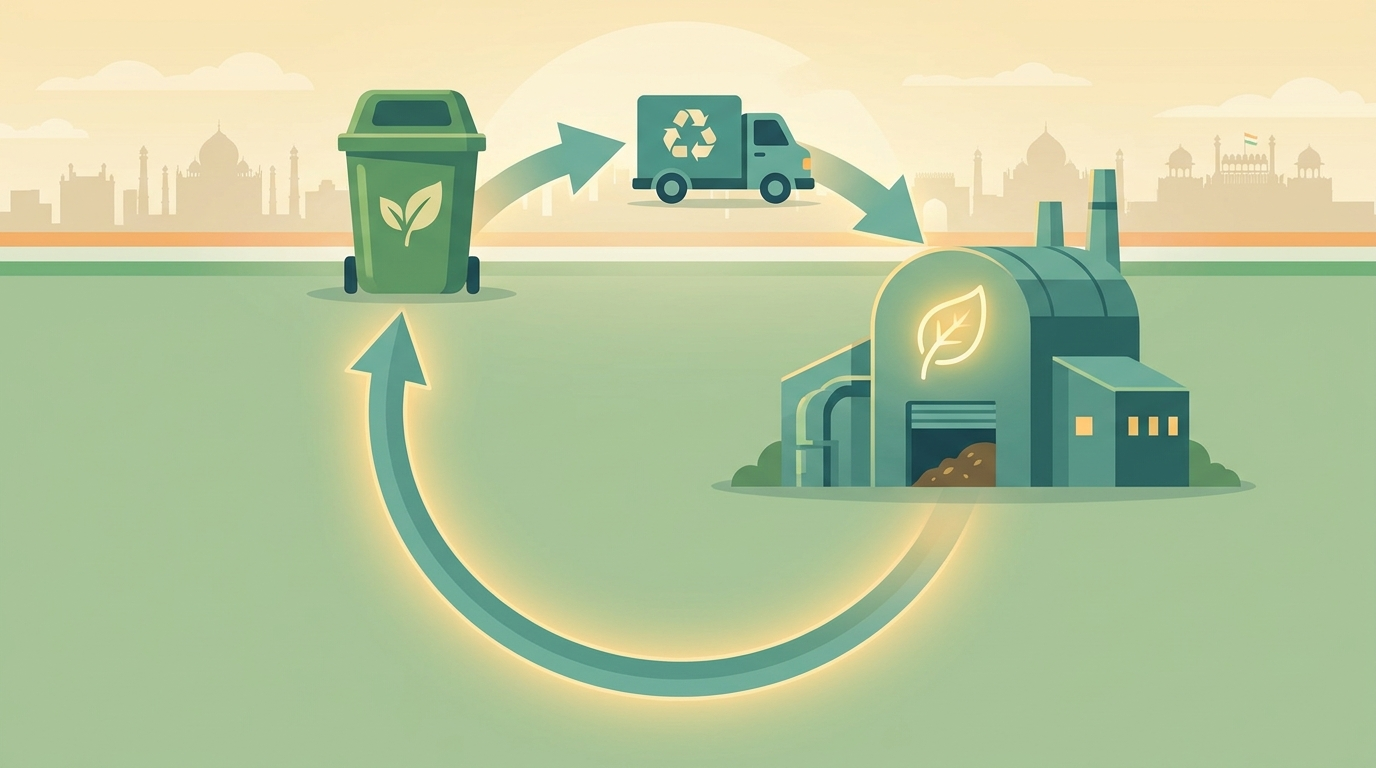
So the system only closes when three links connect: source segregation (compostables go with wet waste), collection (someone actually transports that stream), and industrial composting capacity (facilities that accept certified compostables). India’s Swachh Bharat Mission has expanded urban composting, but most cities still lack dedicated lines for compostable packaging — which is why collection and recovery networks remain the decisive link.
Benefits of Compostable Plastics — When the System Works
- A legal, functional substitute for banned SUP items where reusables are impractical — certified compostable courier bags, cutlery and films keep businesses compliant.
- Cleaner recycling streams. Diverting food-soiled flexibles into composting protects the quality of rigid-plastic recycling — supporting the bottle-to-bottle and mechanical recycling economy.
- Organic waste synergy. Compostable liners can raise wet-waste capture rates because households can bin food waste bag-and-all.
- Lower fossil-carbon footprint for bio-based grades like PLA and PHA, and rural income opportunities from agricultural feedstocks such as sugarcane and maize starch.
- Soil-safe end of life — certified products leave no toxic residue or persistent microplastics when processed correctly.
Challenges and Honest Limitations
- Infrastructure gap. India has very few industrial composting facilities that formally accept compostable plastics; most certified products still end up in mixed waste.
- Cost. Compostable films typically cost two to three times their conventional equivalents, pushing small vendors toward illegal thin-film bags.
- Greenwashing and fake labels. Uncertified “compostable” bags remain widespread; enforcement against counterfeit marking is patchy.
- Contamination both ways. Compostables that enter recycling streams degrade recyclate quality, while conventional plastic mixed into compost lines contaminates compost.
- Feedstock questions. Scaling PLA raises land, water and food-versus-material debates that India must manage carefully.
- Behavioural risk. As UNEP warns, a “compostable” label can license careless disposal — the opposite of responsible consumption.
Expert Insight
“A compostable bag is a promise, not a property. The material only keeps that promise inside a managed composting system. Certification tells you the polymer can biodegrade; only segregation, collection and processing infrastructure ensure it actually does. India’s opportunity is to build both sides at once — honest materials and honest systems.”
— Sustainability materials researcher, circular-economy sector (synthesis of UNEP and CPCB guidance)
Case Study: From Certified Bag to Finished Compost
A useful model comes from India’s temple towns and event economies, where food service generates enormous volumes of soiled packaging. Several municipal pilots — including bulk-generator programmes run under Swachh Bharat Mission-Urban — have paired certified compostable serviceware with on-site organic waste converters. In these closed loops, caterers use only CPCB-certified compostable plates and cutlery; everything, food scraps included, goes into a single wet stream; and in-vessel composters running above 55°C turn the mixture into soil amendment within weeks. The lesson is transferable: compostables succeed in contained systems — campuses, hospitals, events, food courts, housing societies — where one operator controls purchasing, segregation and processing. That is precisely the kind of node a collection-centre network can service, aggregating the residual dry plastics for recycling while the wet-plus-compostable stream goes to composting.
Future Trends: Where India’s Bioplastics Story Goes Next
Three shifts will define the next five years. First, capacity: with global bio-based production expected to double by 2030 (European Bioplastics, 2025) and Indian manufacturers converting lines to PBAT and PLA compounds, prices should fall as scale rises. Second, policy convergence: EPR frameworks, the national push on biomanufacturing, and tightening carry-bag rules are aligning to reward genuinely certified materials and punish counterfeits, with digital verification of CPCB certificates making fakes easier to catch. Third, infrastructure: expect composting-acceptance standards for cities, co-processing of compostables in biogas and composting plants, and marketplace rules requiring certificate numbers on listings. For businesses, the strategic play is clear — treat compostables as one tool inside a hierarchy that starts with reduction and reuse, runs through recycling, and reserves compostables for food-contact and flexible formats that recycling cannot handle.
Conclusion
Compostable plastics in India are neither a miracle nor a scam — they are a conditional technology. Certified to IS/ISO 17088 and processed in real composting systems, they solve a genuine problem: the food-soiled, flexible packaging that recycling cannot touch. Dumped in mixed waste, they are just expensive litter. The deciding factor is not chemistry but systems — segregation at source, reliable collection, and processing capacity. That is the work Operation SHUDDHI exists to do: building the recovery infrastructure that makes every material, compostable or recyclable, actually circular.
Data Snapshot
| Statistic | Value | Source | Year |
|---|---|---|---|
| Global bio-based plastics production capacity | 2.31 million tonnes (~0.5% of 431 Mt total plastics) | European Bioplastics | 2025 |
| Projected global bio-based capacity by 2030 | ~4.69 million tonnes | European Bioplastics | 2025 |
| Packaging share of global bioplastics market | 41.3% | European Bioplastics | 2025 |
| India bioplastics market size (2024) | ~USD 454 million; ~20% CAGR to 2033 | IMARC Group | 2025 |
| Plastic waste generated in India (2020-21) | ~4.1 million tonnes | CPCB via PIB | 2023 |
| Share of global plastic waste actually recycled | 9% | OECD Global Plastics Outlook | 2022 |
| Compostable product standard in India | IS/ISO 17088 + CPCB certification mandatory | CPCB | 2020 |
| UNEP verdict on “biodegradable” as marine litter fix | Not a solution; needs >50 deg C industrial composting | UNEP | 2015 |
Frequently Asked Questions
Q1. What is the difference between biodegradable and compostable plastic?
Biodegradable means microbes can eventually break the material down under some conditions; compostable means it must fully disintegrate and biodegrade within a defined time in composting conditions, leaving no toxic residue, verified by testing to IS/ISO 17088.
Q2. Are compostable plastics legal in India?
Yes — but only if the manufacturer holds a CPCB certificate based on IS/ISO 17088 testing and the product carries the compostable marking. Uncertified products are illegal.
Q3. Are oxo-degradable plastics allowed in India?
No. Oxo-degradable plastics are prohibited under the Plastic Waste Management Rules because they merely fragment into microplastics rather than biodegrading.
Q4. Will a compostable bag break down in my garden or a landfill?
Usually not. Most certified compostables need industrial composting conditions — sustained temperatures above 50°C with controlled moisture and microbes. Home composting or landfills rarely provide these.
Q5. Do compostable plastics solve ocean plastic pollution?
No. UNEP’s assessment found biodegradable plastics are not a solution to marine litter because marine conditions almost never support complete biodegradation.
Q6. What materials are compostable plastics made from?
Common polymers include PLA (from corn/sugarcane starch), PBAT, PHA and starch blends — often combined to balance strength, flexibility and compostability.
Q7. How do I verify a compostable bag is genuine?
Check for the compostable marking with the manufacturer’s CPCB certificate number, and verify it against CPCB’s public list of certified manufacturers.
Q8. Should compostable plastic go in the recycling bin?
No — it contaminates plastic recycling. Certified compostables belong with wet/organic waste destined for industrial composting.
Q9. Are compostable plastics more expensive?
Yes, typically 2–3 times conventional film prices today, though costs are falling as domestic PBAT/PLA capacity grows.
Q10. How big is India’s bioplastics market?
About USD 454 million in 2024, projected to grow at roughly 20% CAGR through 2033 (IMARC, 2025).
Related Resources
- Operation SHUDDHI Mission & Vision
- About Operation SHUDDHI
- Blog & Latest Updates
- Find a Collection Center (Locator)
- Join Operation SHUDDHI
Be Part of the Solution
Compostable or recyclable, no material becomes circular without collection. Operation SHUDDHI is building India’s plastic waste recovery network — one collection centre, one community at a time. Join the mission, install collection bins at your campus or society, and be part of India’s waste-to-wealth movement. Visit opshuddhi.org today.
Sources & References
- CPCB — SOP for Issuing Certificate to Manufacturers of Compostable Plastics (2020)
- CPCB — Overview of Plastic Waste Management
- PIB India — Ban on Identified Single Use Plastic Items from 1st July 2022
- PIB India — Generation of Plastic Waste (CPCB data, 2023)
- UNEP — Biodegradable Plastics and Marine Litter (2015)
- European Bioplastics — Bioplastics Market Development Update 2025
- OECD — Global Plastics Outlook (2022)
- IMARC Group — India Bioplastics Market Report (2025)