
River Plastic Pollution in India: How Intercepting Waste Before the Ocean Can Turn the Tide
Quick Answer: River plastic pollution in India occurs when mismanaged plastic waste from towns and cities washes into rivers like the Ganga and is carried to the ocean. Research shows over 1,000 rivers drive 80% of global riverine plastic emissions, so intercepting plastic on land and in rivers — through collection, segregation and recycling — can prevent most ocean plastic.
Key Takeaways
- More than 1,000 rivers carry about 80% of the world’s riverine plastic emissions into the ocean — between 0.8 and 2.7 million tonnes every year (Meijer et al., Science Advances, 2021).
- India is the world’s largest source of plastic pollution, emitting an estimated 9.3 million tonnes annually — about one-fifth of the global total (Cottom et al., Nature, 2024).
- The Ganges basin is one of the largest plastic-emitting river catchments on Earth, contributing an estimated 0.12 million tonnes of plastic to the ocean each year (Lebreton et al., Nature Communications, 2017).
- Once plastic reaches the sea it is nearly impossible to recover — interception on land and in rivers is dramatically cheaper and more effective than ocean cleanup.
- Decentralised collection networks, EPR-funded recovery and community bins are the most scalable “upstream” defence — the model Operation SHUDDHI® is building across India.
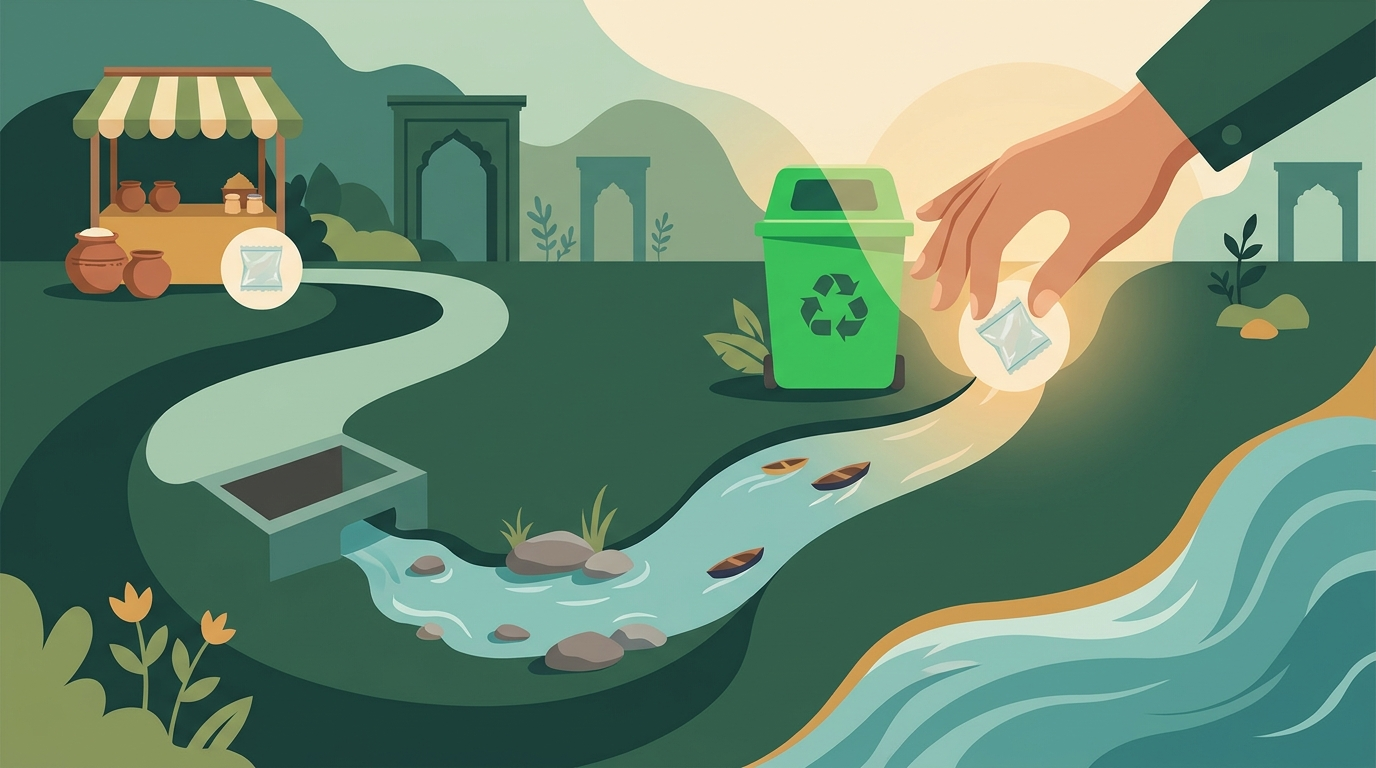
Every monsoon, India’s rivers swell — and with the rainwater comes a second, darker tide: plastic. Wrappers, carry bags, multilayered sachets and bottles wash out of open drains, unmanaged dumpsites and roadside heaps into streams, then rivers, then the sea. River plastic pollution in India is not a coastal problem that begins at the beach; it begins in every town and village where plastic waste escapes collection. And that is precisely why it can be solved — upstream, on land, before a single wrapper touches the water.
This article explains what river plastic pollution is, why India sits at the centre of the global challenge, how plastic travels from street to sea, and what science says about the most effective interventions — from river interception barriers to the decentralised collection networks that Operation SHUDDHI® is building across the country.
What Is River Plastic Pollution?
River plastic pollution refers to plastic waste — from large debris like bottles and bags (macroplastics) to fragments smaller than 5 mm (microplastics) — that enters rivers and is transported downstream toward lakes, estuaries and the ocean. Rivers act as conveyor belts: they collect mismanaged waste from the land that drains into them and deliver it to the sea.
The scale is sobering. A landmark study in Science Advances found that more than 1,000 rivers account for roughly 80% of global riverine plastic emissions, which total between 0.8 and 2.7 million tonnes per year (Meijer et al., 2021). Crucially, the study overturned an older assumption that a handful of giant rivers were responsible. Instead, hundreds of small and medium urban rivers — the kind that flow past densely populated Indian towns — are among the worst emitters.
Why Small Urban Rivers Matter Most
Plastic does not travel far. Most plastic that enters a river comes from land within a few kilometres of its banks, and most emissions happen where large populations live close to water with weak waste collection. That describes thousands of Indian settlements along the Ganga, Yamuna, Brahmaputra, Godavari and their tributaries. The good news hidden in this finding: because pollution is generated locally, it can be captured locally.
Why Is River Plastic Pollution Important for India?
India is now the world’s largest contributor to plastic pollution. A 2024 study in Nature estimated that India emits 9.3 million tonnes of plastic into the environment every year — roughly one-fifth of the global total — of which about 5.8 million tonnes are openly burned and 3.5 million tonnes escape as environmental debris (Cottom et al., 2024). A significant share of that debris is mobilised by rain and wind into waterways.
The Ganges river basin illustrates the stakes. Modelling published in Nature Communications identified the Ganges as one of the largest plastic-emitting catchments in the world, delivering an estimated 0.12 million tonnes of plastic to the ocean annually (Lebreton et al., 2017). The UNEP CounterMEASURE project, which mapped plastic leakage along the Ganga using drones and machine learning, confirmed that plastic types and hotspots vary town by town — meaning solutions must be local, data-driven and community-led (UNEP, 2020).
Beyond the ocean, river plastic harms India directly. Plastic chokes drains and worsens urban flooding. It degrades into microplastics that enter drinking water and food chains. It kills livestock and aquatic life, damages fisheries that millions depend on, and undermines river-linked tourism and cultural life — no small matter for rivers as sacred as the Ganga.
How River Plastic Pollution Happens: From Street to Sea
Understanding the journey of a plastic wrapper explains where to intervene.
Step 1: Leakage on Land
Plastic escapes the waste system at the point of disposal — littering, open dumping, or collection gaps. India generates over 4.1 million tonnes of plastic waste annually as per CPCB reporting (CPCB/PIB, 2023), and every uncollected tonne is a candidate for leakage.
Step 2: Mobilisation by Rain and Wind
Monsoon rains flush accumulated plastic from streets, drains and dumpsites into nullahs and streams. Studies consistently show riverine plastic flows spike during the wet season.
Step 3: Transport Downstream
Rivers carry buoyant plastics toward the sea, fragmenting them along the way. Some plastic strands on banks and floodplains — a persistent reservoir that remobilises with each flood.
Step 4: Ocean Emission
What reaches the estuary largely cannot be recovered. UNEP estimates 19–23 million tonnes of plastic leak into aquatic ecosystems globally each year (UNEP, 2023) — and ocean cleanup recovers only a tiny fraction at enormous cost.
The lesson is arithmetic: a rupee spent preventing leakage on land is worth many spent trawling the ocean.
Benefits of Intercepting Plastic Upstream
Stopping plastic before the ocean delivers layered returns. Environmentally, it protects marine ecosystems, reduces microplastic formation and cuts the open burning that pollutes air. Economically, intercepted plastic re-enters the circular economy — PET bottles become fibre and new bottles, rigid plastics become granules for manufacturing, and even low-value film can feed cement kilns or road construction, converting waste to wealth. Socially, collection networks create dignified green livelihoods for waste workers and self-help groups. And for brands, upstream recovery is the backbone of Extended Producer Responsibility (EPR) compliance — every tonne collected and channelled to registered recyclers generates auditable recovery against EPR targets.
Challenges in Tackling River Plastic Pollution
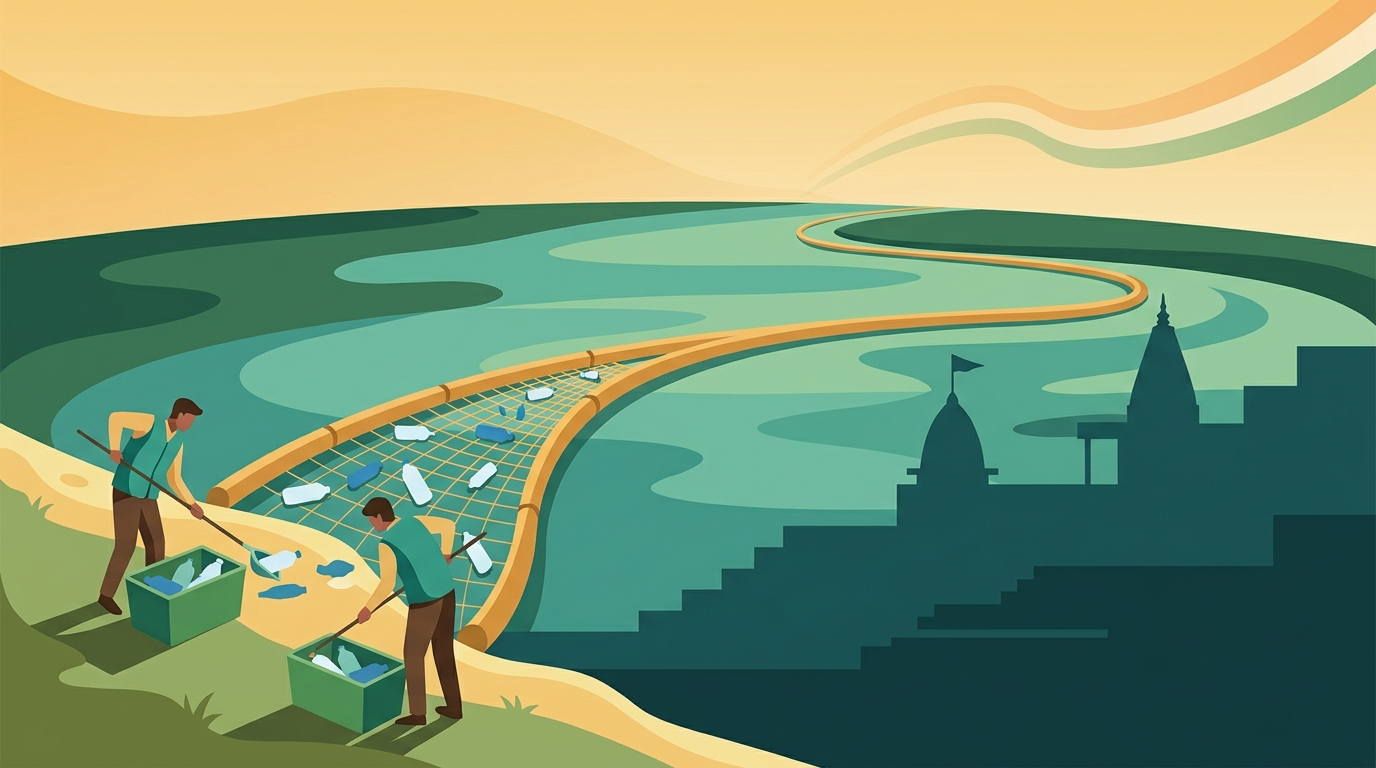
The obstacles are real. Collection coverage remains uneven, especially in peri-urban and rural river towns. Low-value plastics like multilayered packaging have weak market pull, so they are the most likely to leak. River interception devices — booms, trash barriers, conveyor “interceptors” — work best in slow, channelised stretches but struggle with monsoon flows and heavy debris loads, and they treat the symptom, not the source. Data gaps persist: without knowing where leakage happens, investments are misallocated. Finally, behaviour change is slow; segregation at source is still the exception rather than the rule in most Indian households.
Future Trends: Technology, Policy and Circular Systems
Momentum is building. The Ocean Cleanup’s “30 Cities Program” aims to cut river plastic emissions from key cities by roughly a third by 2030 using Interceptor technology paired with local waste management (The Ocean Cleanup, 2025). Under Namami Gange, India had taken up 467 projects worth over ₹39,000 crore by mid-2024, spanning sewage treatment, solid waste management and riverfront cleanup (PIB, 2024). AI-powered leakage mapping — pioneered on the Ganga by UNEP’s CounterMEASURE — is making hotspot targeting routine. And EPR funding under the Plastic Waste Management Rules is beginning to pay for collection in exactly the towns where rivers are most at risk. The frontier is integration: pairing in-river interception with doorstep collection, materials recovery facilities and recycling markets so that captured plastic never returns to the water.
Expert Insight
“Ocean plastic is a land management problem. The moment a wrapper is collected at a doorstep or deposited in a community bin, it is permanently removed from the river’s supply chain. Interception barriers are valuable insurance, but the decisive battle is fought in every ward and village along the river — with bins, collectors and recyclers. That is where a tonne prevented costs a fraction of a tonne recovered.”
— Operation SHUDDHI® Mission Desk, AVRO India
Case Study: Mapping and Intercepting Plastic on the Ganga
The UNEP CounterMEASURE project (2019–2022) deployed drones, GPS trackers and machine-learning image analysis across Ganga river cities including Haridwar, Agra, Prayagraj and Patna to identify where plastic enters the river. The project found leakage concentrated at specific ghats, drains and informal dumpsites, and that waste composition shifted city by city — packaging film dominated in some stretches, ritual and festival waste in others. Armed with hotspot maps, city authorities and NGOs targeted collection points, drain screens and awareness drives at the highest-leakage sites, demonstrating that data-led, city-specific intervention beats blanket campaigns (UNEP, 2020). The replicable insight for every Indian river town: measure first, then place your bins, barriers and collection routes where the plastic actually flows.
How Operation SHUDDHI® Fits In
Operation SHUDDHI®, India’s Plastic Waste Recovery & Circular Economy Mission by AVRO India, is built on exactly this upstream logic. By installing community collection bins, running doorstep recovery networks, partnering with schools, RWAs, temples and businesses, and channelling recovered plastic into registered recycling streams, the mission removes plastic from circulation before the monsoon can carry it to a river. Every collection centre in a river-basin town is, in effect, a piece of invisible river-cleaning infrastructure — one that also creates livelihoods and EPR value.
Conclusion
River plastic pollution in India is massive but not mysterious. Science has mapped its sources: mismanaged waste in the thousands of towns that line our rivers. The same science points to the remedy — intercept plastic upstream, on land, through collection, segregation and recycling, and back it up with in-river barriers, hotspot data and strong EPR financing. If just the highest-emitting river catchments received reliable collection coverage, India could eliminate the bulk of its ocean-bound plastic within a decade. The tide turns not at the beach, but at the bin.
Data Snapshot
| Statistic | Value | Source | Year |
|---|---|---|---|
| Share of global riverine plastic emissions from ~1,000 rivers | ~80% (0.8–2.7 Mt/yr total) | Meijer et al., Science Advances | 2021 |
| India’s annual plastic pollution emissions | 9.3 million tonnes (~20% of global) | Cottom et al., Nature | 2024 |
| Plastic openly burned in India each year | ~5.8 million tonnes | Cottom et al., Nature | 2024 |
| Ganges catchment plastic emission to ocean | ~0.12 million tonnes/yr | Lebreton et al., Nature Communications | 2017 |
| Plastic leaking into aquatic ecosystems globally | 19–23 million tonnes/yr | UNEP | 2023 |
| India’s reported plastic waste generation | ~4.1 million tonnes/yr | CPCB via PIB | 2023 |
| Namami Gange projects taken up (till June 2024) | 467 projects, ₹39,080 crore | PIB / NMCG | 2024 |
Frequently Asked Questions
Q1. What is river plastic pollution?
It is plastic waste that escapes land-based waste systems, enters rivers via drains, wind and rain, and is transported downstream toward the ocean, fragmenting into microplastics along the way.
Q2. How much plastic do rivers carry to the ocean?
Global riverine plastic emissions are estimated at 0.8–2.7 million tonnes per year, with over 1,000 rivers responsible for about 80% of the total (Meijer et al., Science Advances, 2021).
Q3. Which Indian rivers carry the most plastic?
The Ganga basin is among the world’s largest plastic-emitting catchments (~0.12 Mt/yr), with the Indus and Brahmaputra basins also significant (Lebreton et al., 2017).
Q4. Why is India the largest plastic polluter?
A 2024 Nature study attributes India’s 9.3 Mt/yr emissions primarily to gaps between waste generation and collection — uncollected waste is burned or dumped, and much of the debris reaches waterways.
Q5. Do river cleanup barriers work?
Interception devices (booms, trash skimmers, Interceptors) capture meaningful quantities in suitable stretches, but they address the symptom. Studies and practitioners agree land-based collection prevents far more plastic per rupee.
Q6. When does most plastic enter Indian rivers?
During the monsoon, when rains flush accumulated street and dumpsite plastic into drains and streams — riverine plastic flows spike sharply in the wet season.
Q7. What happens to plastic once it reaches the ocean?
It disperses, sinks or fragments into microplastics; recovery becomes technically difficult and prohibitively expensive, which is why prevention upstream is the global priority.
Q8. How does EPR help reduce river plastic?
Extended Producer Responsibility obliges brands to fund collection and recycling of packaging. EPR credits financed through registered collection channels pay for recovery in the very towns where river leakage originates.
Q9. How can citizens help stop river plastic pollution?
Segregate waste at source, deposit plastic in designated collection bins or centres, avoid littering near drains, and join community collection drives such as those run by Operation SHUDDHI®.
Q10. What is the microplastics risk from rivers?
River-borne plastic degrades into particles that enter drinking water, fish and salt. Reducing plastic inflow into rivers is the most effective way to limit microplastic exposure.
Related Resources
- Operation SHUDDHI Mission & Vision
- About Operation SHUDDHI
- Blog & Latest Updates
- Find a Collection Center (Locator)
- Join Operation SHUDDHI
Take Action Today
Every river begins in a neighbourhood — and so does its cleanup. Operation SHUDDHI is building India’s upstream defence against ocean plastic: community bins, doorstep recovery and verified recycling. Join the mission as a volunteer, school or partner, install collection bins in your community, or find your nearest collection centre today at opshuddhi.org.
Sources & References
- Meijer et al. (2021), “More than 1000 rivers account for 80% of global riverine plastic emissions into the ocean,” Science Advances
- Cottom et al. (2024), “A local-to-global emissions inventory of macroplastic pollution,” Nature
- Lebreton et al. (2017), “River plastic emissions to the world’s oceans,” Nature Communications
- UNEP (2020), CounterMEASURE project — plastic leakage mapping on Asian rivers
- UNEP (2023), “Turning off the Tap: How the world can end plastic pollution and create a circular economy”
- PIB (2024), “Cleaning of Ganga River” — Namami Gange progress
- PIB/CPCB (2023), “Generation of plastic waste”
- The Ocean Cleanup (2025), “30 Cities Program”