
AI in Plastic Waste Management: How Digital Technology Is Transforming India’s Recycling Revolution
Quick Answer: AI in plastic waste management uses machine vision, IoT sensors, QR-code traceability, and digital EPR platforms to identify, sort, track, and recycle plastic more efficiently. In India, these technologies are boosting sorting accuracy above 90%, digitising EPR compliance for thousands of businesses, and connecting waste workers, collection centres, and recyclers into one transparent circular economy.
Key Takeaways
- India generates about 4.13 million tonnes of plastic waste a year — roughly 10,700 tonnes every day — making manual-only management impossible at scale (CPCB Annual Report 2022–23, via PIB, 2025).
- AI-enabled sorting systems deployed across 20+ countries achieve over 90% sorting accuracy and can increase consumer engagement at the bin more than tenfold (World Economic Forum, 2026).
- India’s entire EPR compliance system now runs on a centralized digital portal, with EPR certificates worth 2.5 million tonnes generated against roughly 3 million tonnes of obligation in 2022–23 (MoEFCC/PIB, 2025).
- The 2025 amendment to the Plastic Waste Management Rules mandates barcode/QR-based traceability on plastic packaging, effective 1 July 2025.
- Only 17% of Indian households fully segregate waste — AI, apps, and smart bins can close this gap, and NITI Aayog estimates India needs USD 50–80 billion of circular-economy infrastructure over the next decade.
- Operation SHUDDHI® integrates digital tracking across its collection-centre network so every kilogram of recovered plastic is traceable from citizen to recycler.
India’s plastic waste challenge is enormous — about 4.13 million tonnes generated every single year, or nearly 10,700 tonnes a day, according to the Central Pollution Control Board’s Annual Report 2022–23 (PIB, 2025). No army of workers with clipboards can track, sort, and recycle that volume alone. This is where AI in plastic waste management changes everything. From machine-vision sorting lines and IoT-enabled smart bins to QR-code traceability and blockchain-backed EPR certificates, digital technology is quietly rebuilding India’s waste economy — making it faster, fairer, and far more transparent. In this article, we explore how these tools work, why they matter for India’s circular economy, and how missions like Operation SHUDDHI® are putting them to work on the ground.
What Is AI in Plastic Waste Management?
AI in plastic waste management refers to the use of artificial intelligence — computer vision, machine learning, robotics, and data analytics — combined with digital infrastructure like IoT sensors, mobile apps, QR codes, and cloud platforms to manage the plastic waste value chain.
The core technology stack
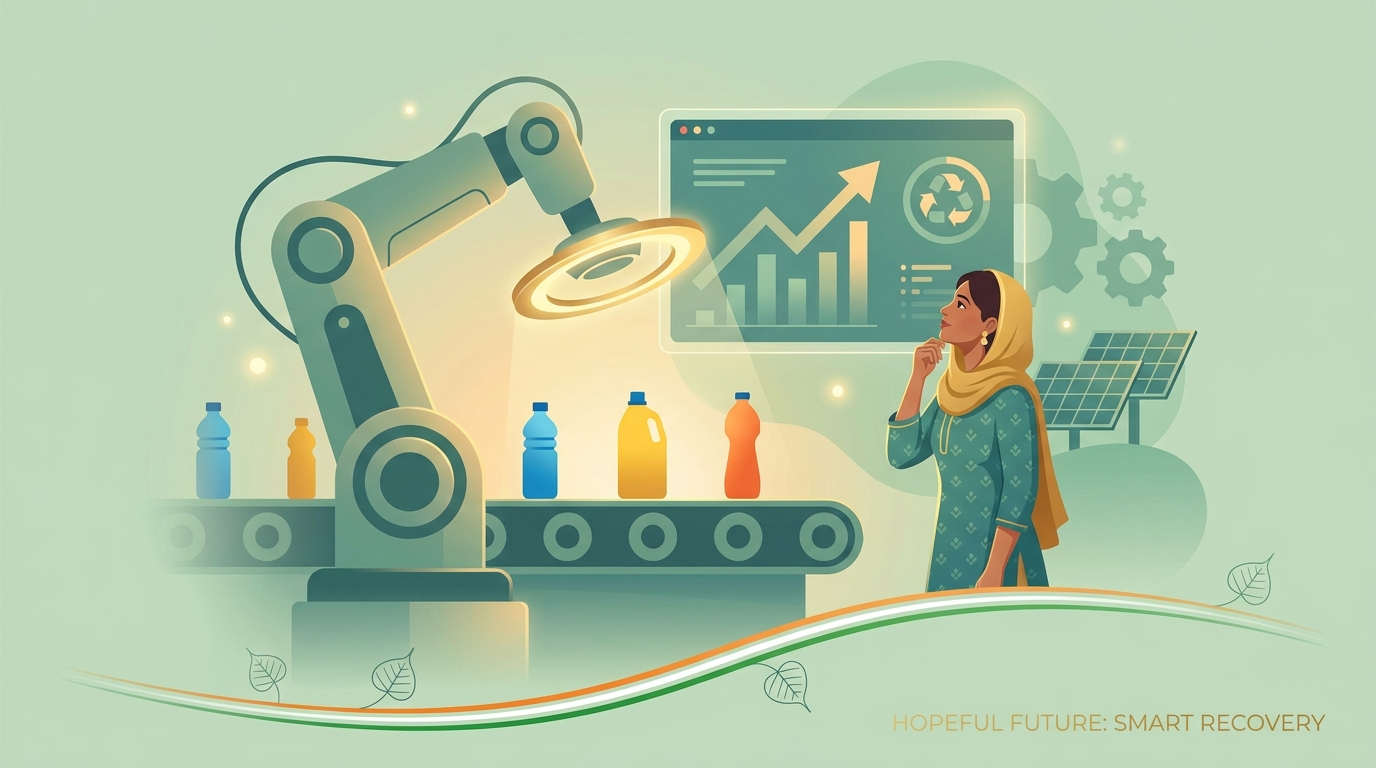
- Machine-vision sorting: Cameras and AI models identify plastic items on conveyor belts by polymer type (PET, HDPE, LDPE, PP), colour, and shape, guiding robotic arms or air jets to separate them.
- IoT smart bins and sensors: Fill-level sensors tell municipalities when bins need emptying, optimising collection routes and cutting fuel use.
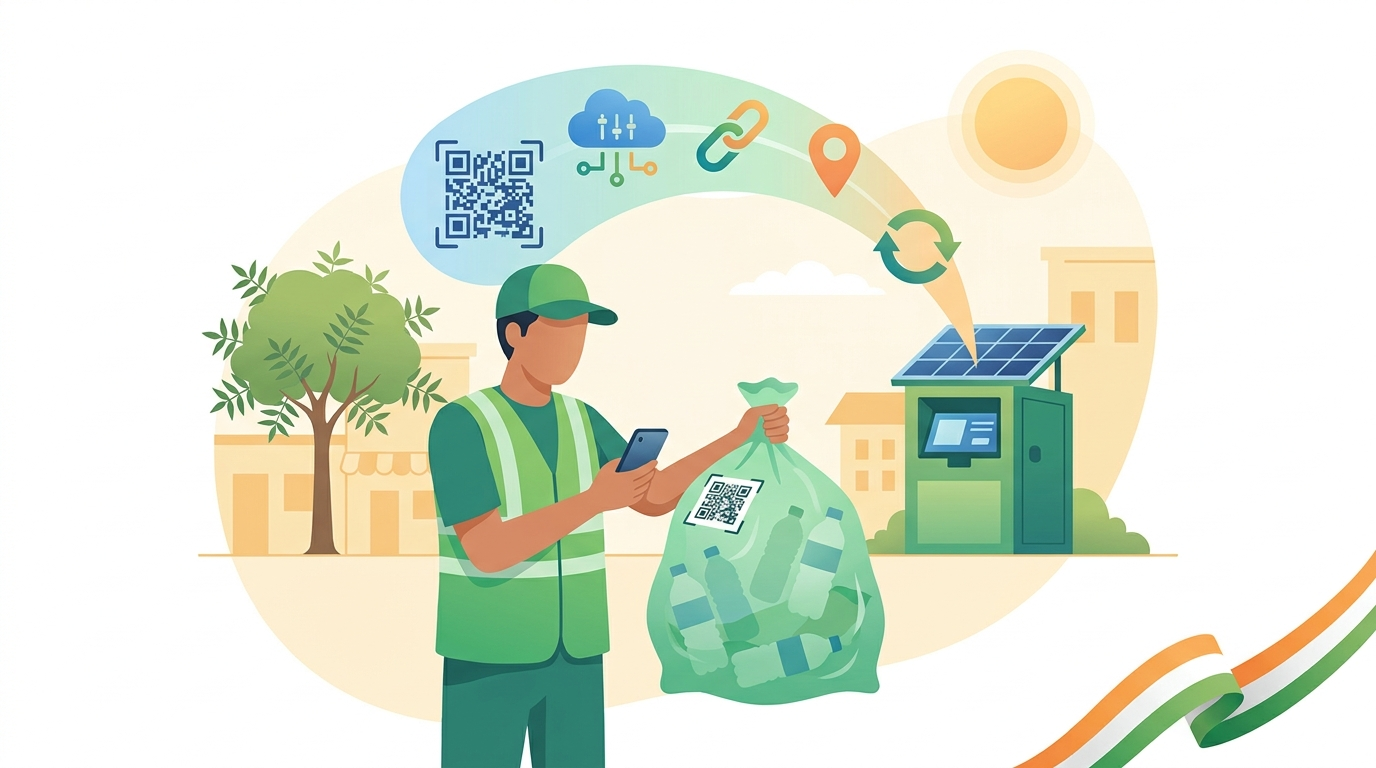
- QR-code and barcode traceability: Every batch of packaging or collected waste carries a scannable identity, so material can be followed from producer to recycler.
- Digital EPR platforms: Producers, importers, and brand owners register, report, and trade recycling certificates on centralized government portals.
- Blockchain ledgers: Tamper-proof records verify that recycled content claims and waste-collector payments are genuine.
How it differs from traditional waste management
Traditional systems rely on manual sorting, paper records, and trust. Digital systems generate verifiable data at every step — what was collected, where, by whom, and what happened to it. That data is the raw material of a genuine circular economy.
Why Is Digital Technology Important for India’s Plastic Waste Crisis?
The scale problem
The World Bank projects global waste could grow from 2.56 billion tonnes in 2022 to 3.86 billion tonnes by 2050, with management costs already exceeding USD 250 billion a year (World Economic Forum, 2026). India, as the world’s most populous nation, sits at the centre of this curve. Its plastic waste stream is growing with urbanisation, e-commerce, and consumption — while its formal recycling infrastructure races to catch up.
The segregation gap
Only about 17% of Indian households practise full waste segregation, according to a 2023 NITI Aayog assessment (CEED India, 2025). Unsegregated waste is the single biggest reason recyclable plastic ends up in landfills. AI-assisted sorting recovers value from mixed streams, while citizen apps and smart bins nudge better behaviour at the source.
The investment case
NITI Aayog estimates India needs USD 50–80 billion in circular-economy infrastructure over the next decade. Digital systems make that investment bankable: lenders and brands will only fund collection centres, MRFs, and recycling plants whose throughput and quality can be measured and audited in real time.
How Does AI-Powered Plastic Waste Management Work?
Step 1: Smart collection
Citizens locate their nearest collection point through apps and locators — like the Operation SHUDDHI collection centre locator — while IoT-enabled bins report fill levels. Under the Swachh Bharat Mission, the Swachhata App has already enrolled more than 2 crore users who report and resolve cleanliness issues digitally (Janaagraha/MoHUA).
Step 2: Digital weighment and traceability
At the collection centre, every bag of plastic is weighed, tagged, and logged. India’s Plastic Waste Management (Amendment) Rules make packaging traceable to its source through barcode/QR marking, effective 1 July 2025 (GreenSutra, 2026). Each transaction credits the waste worker instantly — turning informal labour into recorded, dignified livelihood.
Step 3: AI sorting at material recovery facilities
At MRFs, machine-vision systems scan the belt and classify items in milliseconds. Early deployments across more than 20 countries have demonstrated sorting accuracy above 90% and more than tenfold increases in consumer engagement at smart bins (World Economic Forum, 2026). Robotic sorting arms — first showcased globally in facilities profiled by the World Economic Forum in 2019 — now work alongside human sorters, taking on the fastest, most repetitive picks.
Step 4: Digital EPR compliance
India runs one of the world’s largest digital EPR systems. All producers, importers, and brand owners (PIBOs) and plastic waste processors must register on the CPCB centralized EPR portal. In 2022–23, registered PIBOs carried an EPR obligation of about 3 million tonnes, against which processors generated EPR certificates covering 2.5 million tonnes of plastic packaging waste (PIB/MoEFCC, 2025). Every certificate is a digital token proving real recycling happened.
Step 5: Closing the loop with verified recycled content
Blockchain and digital product passports let brands prove recycled-content claims. The Ellen MacArthur Foundation highlights blockchain’s role in verifying material flows and even rewarding informal waste collectors transparently (Ellen MacArthur Foundation).
Benefits of AI and Digital Technology in Plastic Waste Management
- Higher recovery rates: AI sorting lifts both the quantity and purity of recovered plastics, raising the value of every tonne collected.
- Radical transparency: Digital EPR and QR traceability make greenwashing harder and genuine recyclers more competitive.
- Dignity and inclusion for waste workers: Digital IDs, instant payments, and recorded contributions bring India’s informal collectors — the backbone of its 60%+ recycling performance — into the formal economy.
- Lower costs for cities: Route optimisation and fill-level sensors cut collection costs and emissions.
- Better policy: Real-time dashboards give regulators like CPCB and state boards evidence to enforce rules and reward performers.
- Investor confidence: Auditable data converts waste infrastructure into an investable asset class, unlocking the capital NITI Aayog says the sector needs.
Challenges: What Stands in the Way?
- Cost and access: AI sorting lines and IoT networks need capital many small aggregators lack; India’s recycling backbone is still dominated by micro-enterprises.
- Data quality: Digital systems are only as honest as their inputs — fake weighments or duplicate certificates can undermine trust, which is why audits and blockchain verification matter.
- Digital literacy: Waste workers and kabadiwalas need training and smartphone access to participate fully.
- Fragmented systems: Municipal apps, state portals, and private platforms don’t always talk to each other; interoperability standards are urgently needed.
- The segregation bottleneck: Technology downstream cannot fully compensate for mixed waste upstream — behaviour change remains essential.
Future Trends: Where Is This Heading?
- AI-first MRFs in tier-2 India: As hardware costs fall, machine-vision retrofits will spread from metros to smaller cities.
- Digital product passports: Global buyers will increasingly demand cradle-to-cradle traceability for packaging, aligning India’s exporters with EU-style rules.
- Satellite and drone monitoring: Remote sensing will map dumpsites and plastic leakage into rivers, directing clean-up resources where they matter most.
- Unified national waste data grids: NITI Aayog’s net-zero waste scenarios point toward integrated, data-driven planning for 2030 and beyond (NITI Aayog, 2026).
- AI copilots for compliance: Small businesses will use AI assistants to navigate EPR filings, certificate purchases, and recycled-content reporting.
Expert Insight
“The plastic waste crisis is, at its heart, a data crisis. When every kilogram of plastic has an identity — where it came from, who collected it, where it went — recycling stops being charity and becomes infrastructure. India’s digital public-infrastructure mindset, which transformed payments and identity, is exactly what its circular economy needs next.” — Editorial analysis, Operation SHUDDHI® Research Desk
Case Study: Digital Traceability in Action with Operation SHUDDHI®
Operation SHUDDHI®, AVRO India’s plastic waste recovery mission, is building a nationwide network of standardised collection centres designed around digital-first operations. Every collection event is logged — material type, weight, source, and collector — creating an unbroken digital chain of custody from a citizen’s doorstep to a certified recycler. This mirrors the model UNDP India has demonstrated in its plastic waste management programme, where cloud-based traceability and material recovery facilities across Indian cities have shown that transparent data systems dramatically improve both recovery rates and waste-worker incomes (UNDP India). For citizens, the experience is simple: find a centre on the locator, drop clean plastic, and watch it enter a verified recycling stream instead of a landfill.
Conclusion
AI in plastic waste management is not science fiction — it is already sorting bottles, settling EPR certificates, and paying waste workers across India. The technology exists; the policy scaffolding, from the digital EPR portal to QR traceability rules, is in place. What India needs now is scale: more smart collection centres, more AI-enabled MRFs, and more citizens participating in a system where every piece of plastic is seen, counted, and returned to the economy. That is the future Operation SHUDDHI® is building — a Swachh, digital, circular Bharat where technology ensures nothing of value is wasted.
Data Snapshot
| Statistic | Value | Source | Year |
|---|---|---|---|
| Plastic waste generated in India | ~4.13 million tonnes/year (~10,700 t/day) | CPCB Annual Report 2022–23 via PIB | 2025 |
| EPR obligation of registered PIBOs (2022–23) | ~3 million tonnes | MoEFCC / PIB | 2025 |
| EPR certificates generated by processors (2022–23) | 2.5 million tonnes | MoEFCC / PIB | 2025 |
| AI sorting accuracy in early deployments (20+ countries) | Over 90% | World Economic Forum | 2026 |
| Global waste projection | 2.56 bn t (2022) → 3.86 bn t (2050) | World Bank via WEF | 2026 |
| Indian households fully segregating waste | ~17% | NITI Aayog (2023), via CEED India | 2025 |
| Circular-economy investment needed in India | USD 50–80 billion over next decade | NITI Aayog, via CEED India | 2025 |
| Swachhata App users | 2+ crore | MoHUA / Janaagraha | 2024 |
Frequently Asked Questions
Q1. What is AI in plastic waste management?
It is the use of artificial intelligence — computer vision, robotics, and data analytics — along with IoT sensors, QR traceability, and digital platforms to collect, sort, track, and recycle plastic waste more efficiently and transparently.
Q2. How accurate is AI-based plastic sorting?
Early AI sorting deployments across more than 20 countries have demonstrated accuracy above 90%, significantly higher than typical manual sorting of mixed waste streams (WEF, 2026).
Q3. How much plastic waste does India generate?
India generates about 4.13 million tonnes of plastic waste per year — roughly 10,700 tonnes daily — per the CPCB Annual Report 2022–23.
Q4. What is India’s digital EPR portal?
The CPCB’s centralized EPR portal (eprplastic.cpcb.gov.in) is where all producers, importers, brand owners, and plastic waste processors register, report obligations, and generate or purchase EPR certificates digitally.
Q5. What are QR-code traceability rules for plastic packaging?
Under the Plastic Waste Management (Amendment) Rules, plastic packaging must carry barcode/QR-based marking making it traceable to its producer, with effect from 1 July 2025.
Q6. Do smart bins really work in India?
Yes — IoT fill-level sensors and app-linked bins optimise collection routes and have shown large increases in citizen engagement; the Swachhata App alone has over 2 crore users reporting waste issues.
Q7. How does blockchain help plastic recycling?
Blockchain creates tamper-proof records of collection, recycling, and payments — verifying recycled-content claims and ensuring informal waste collectors are paid fairly for documented work.
Q8. Does technology replace waste pickers?
No. AI handles repetitive sorting while digital IDs and instant payments formalise and improve waste pickers’ incomes. India’s high recycling rate depends on its informal workforce, and digital tools give their work visibility and dignity.
Q9. What is the biggest barrier to digital waste management in India?
Source segregation. Only ~17% of households fully segregate waste; no downstream technology can fully recover value from badly mixed waste.
Q10. How can I participate in a digitally tracked recycling system?
Use the Operation SHUDDHI collection centre locator at opshuddhi.org/locator to find a centre near you, and drop off clean, dry plastic so it enters a verified, traceable recycling stream.
Related Resources
- Operation SHUDDHI Mission & Vision
- About Operation SHUDDHI
- Blog & Latest Updates
- Find a Collection Center (Locator)
- Join Operation SHUDDHI
Be Part of the Change
Technology can see every bottle — but only people can pick it up. Join Operation SHUDDHI, India’s digitally tracked plastic recovery mission. Join the mission as a volunteer or partner, help us install collection bins in your community, and learn more at opshuddhi.org.
Sources & References
- PIB / MoEFCC — Parliament Question: Plastic Waste Management (2025)
- World Economic Forum — Circular economy: Using AI to capture and track waste data (2026)
- World Economic Forum — These robots can sort recycling (2019)
- NITI Aayog — Waste: Scenarios Towards Viksit Bharat and Net Zero (2026)
- CEED India — From Pollution to Prevention (2025, citing NITI Aayog 2023)
- CPCB — Centralized EPR Portal for Plastic Packaging
- Ellen MacArthur Foundation — Blockchain can facilitate the circular economy transition
- UNDP India — Plastic Waste Management programme
- Janaagraha / MoHUA — Swachhata Technology Platform
- GreenSutra — Plastic EPR Explained 2026 (PWM Amendment traceability)