
India’s Informal Waste Workers: The Backbone of the Circular Economy
Quick Answer
Informal waste workers in India — including an estimated 1.5 million waste pickers and kabadiwalas — recover the majority of the country’s recyclable plastic, yet most work without contracts, safety gear, or social security. Formalising this workforce through cooperatives, EPR linkages, and skill recognition is essential to building India’s projected $2 trillion circular economy by 2050.
Key Takeaways
- India has an estimated 1.5 million informal waste workers who recover a large share of the country’s recyclables (UNDP India, 2024).
- The informal sector helps India recover close to 60% of its plastic waste (CPCB / industry estimates, 2024).
- India’s circular economy could generate a $2 trillion market and 10 million jobs by 2050 (MoEFCC, 2025).
- Formalisation models like Pune’s SWaCH cooperative prove dignity, fair wages, and efficiency can coexist.
- Integrating informal workers into EPR compliance and the Global Plastics Treaty’s “just transition” clause is now a policy priority.
Introduction
Before sunrise in almost every Indian city, a quiet workforce is already in motion. Pushing handcarts through narrow lanes, climbing landfill slopes, and sorting through household bins, India’s informal waste workers recover the plastic, paper, metal, and glass that keep the recycling economy alive. They are the country’s first and most effective line of defence against plastic pollution — and yet they remain largely invisible in policy, statistics, and public recognition.
The nation generates approximately 3.9 million tonnes of plastic waste every year (CPCB Annual Report, 2022-23), and the people who recover the most of it are also the least protected. As India accelerates toward a circular economy projected to be worth $2 trillion by 2050 (MoEFCC, 2025), the question is no longer whether informal waste workers matter — it is whether the country will formally recognise, protect, and empower them.
What Are Informal Waste Workers?
Informal waste workers collect, sort, trade, and process recyclable waste outside formal municipal or corporate employment. In India this includes waste pickers (who gather recyclables from streets, bins, and dumpsites), itinerant buyers or kabadiwalas (who buy segregated scrap door-to-door), and small scrap dealers who consolidate material before it reaches recyclers. They form the foundational layer of India’s recycling supply chain. According to UNDP India (2024), India is home to an estimated 1.5 million waste pickers, with some studies placing the figure as high as 4 million when buyers and aggregators are included.
Why Are Informal Waste Workers Important?
Informal waste workers make India’s recycling economy function at virtually no cost to the public exchequer. The Central Pollution Control Board and industry estimates suggest that when the informal sector is included, India recovers close to 60% of its plastic waste (2024) — a recovery rate formal systems alone have never achieved. Globally, the informal sector recovers roughly 58% of the world’s post-consumer plastic waste, supported by an estimated 20 million waste pickers worldwide (WIEGO, 2023).
How Does the Informal Recycling System Work?
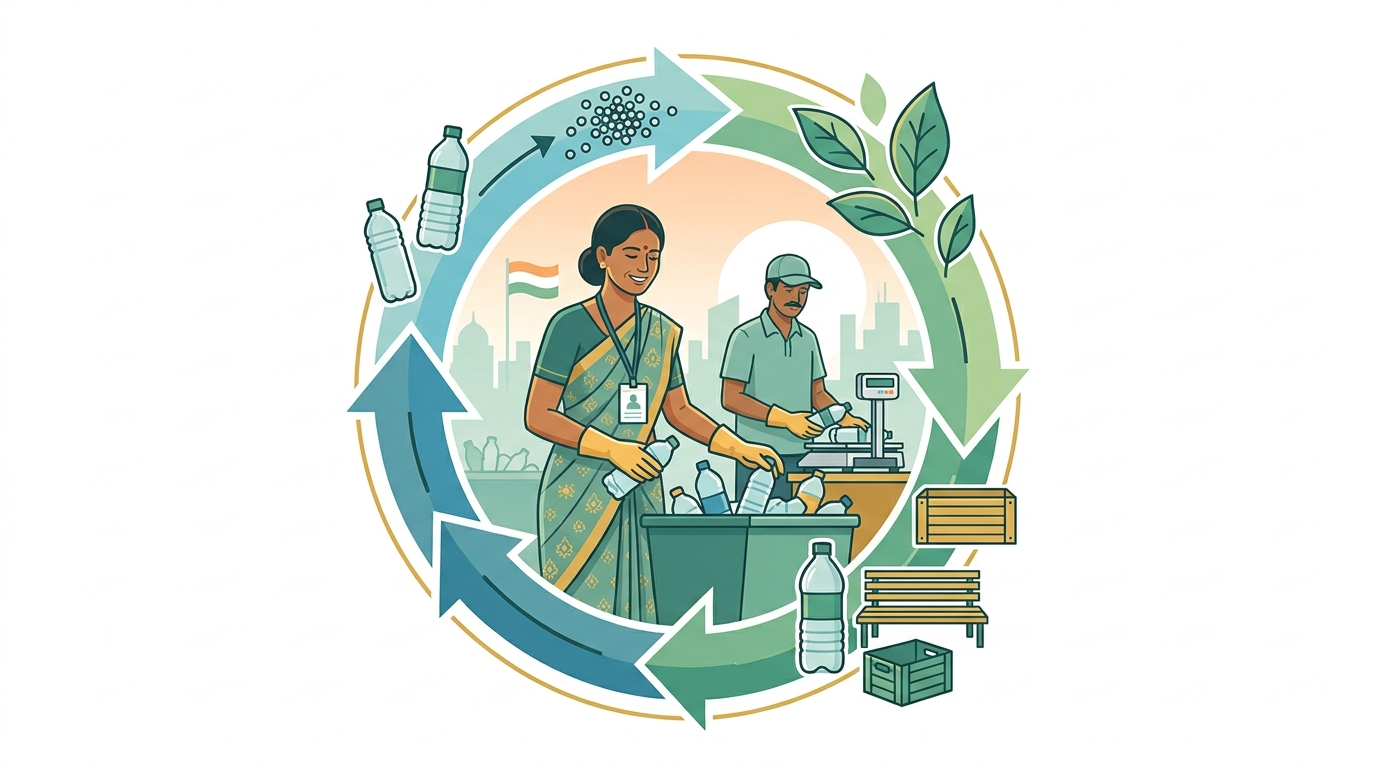
India’s informal recycling chain is a remarkably efficient, self-organising market with four stages. Collection: waste pickers gather recyclables from streets and dumpsites, while kabadiwalas buy pre-segregated scrap from households. Sorting: material is separated by type and grade — PET, HDPE, multilayer plastics, cardboard, metals. Aggregation: scrap dealers consolidate sorted material into commercially viable quantities. Processing: aggregated material reaches registered recyclers, where it is washed, shredded, and converted into flakes or pellets that re-enter manufacturing. The system needs no subsidy, yet delivers recovery rates that rival advanced economies.
Benefits of Formalising Informal Waste Workers
Formal recognition expands collection coverage and improves source segregation, directly supporting plastic waste recovery targets. Contracts, identity cards, fair pricing, and safety equipment transform precarious labour into stable green jobs. Every tonne of plastic recycled avoids the emissions of producing virgin plastic. India’s circular economy is projected to create 10 million jobs by 2050 (MoEFCC, 2025). And brands meeting EPR obligations gain a reliable, traceable collection network when informal workers are integrated.
Challenges Facing India’s Informal Waste Sector
Most informal workers lack legal recognition, leaving them without bargaining power or welfare access. Occupational hazards are severe: workers handle medical, hazardous, and sharp waste without protective equipment. Income is volatile, depending on scrap prices set by intermediaries. Social stigma persists despite the environmental value of the work. And urban modernisation — mechanised collection, waste-to-energy plants — can displace informal workers unless integration is deliberately built into city planning.
Expert Insight
The most sophisticated recycling technology India can deploy is already operating on its streets — it simply wears no uniform. The strategic mistake would be to treat formalisation as charity; it is industrial infrastructure. A waste picker integrated into an EPR-backed supply chain is not a welfare beneficiary — she is a verified node in a traceable material recovery system. The economies that win the circular transition will be those that put their informal recyclers on the balance sheet, not in the blind spot.
Case Study: The SWaCH Model in Pune
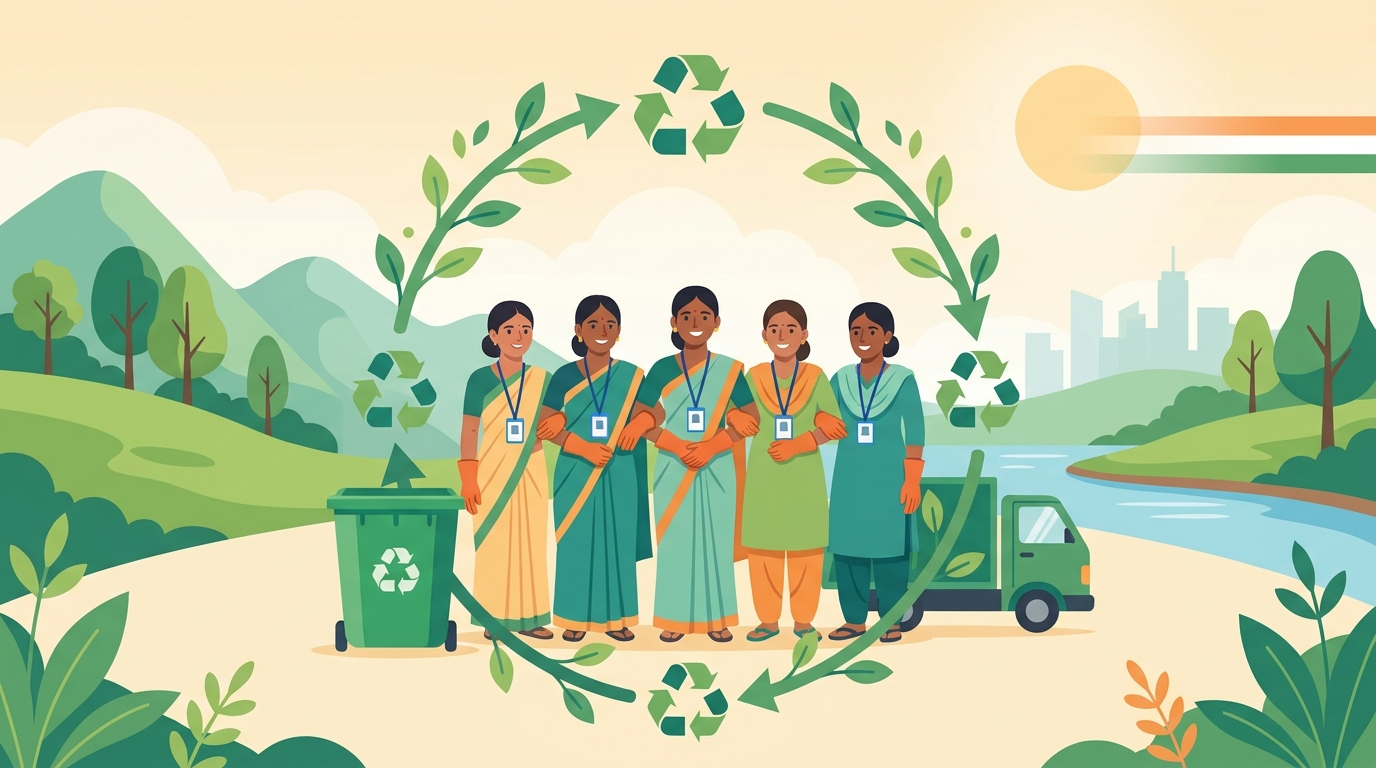
The clearest proof that formalisation works is SWaCH (Solid Waste Collection and Handling) in Pune, Maharashtra. Born from the Kagad Kach Patra Kashtakari Panchayat (KKPKP) trade union founded in 1993, SWaCH was registered in 2008 as India’s first wholly worker-owned cooperative of waste pickers, operating under a memorandum of understanding with the Pune Municipal Corporation. Today it provides door-to-door collection to roughly one million households, with waste pickers — most of them women — as co-owners. Workers receive identity cards, user fees, and access to recovered recyclables, turning stigmatised labour into recognised, dignified employment.
Future Trends: Toward a Just and Circular Transition
NITI Aayog’s circular economy reports released in January 2026 — covering end-of-life vehicles, waste tyres, and lithium-ion batteries — propose Recognition of Prior Learning (RPL) to bring informal scrap workers into the formal skilling system (NITI Aayog, 2026). Globally, Article 10 of the proposed Global Plastics Treaty seeks a “just transition” for informal waste workers — the first time this workforce has been formally recognised in international environmental negotiations (WIEGO, 2023). India’s expanding EPR framework is creating financial pathways to channel producer funds toward inclusive collection.
Conclusion
India cannot build a credible circular economy without the people who already make recycling work. Informal waste workers recover the majority of the nation’s recyclable plastic, reduce emissions, and conserve resources while operating on the margins of recognition and security. The path forward is clear: formalise their roles, integrate them into EPR systems, equip them with skills and safety, and protect them through a planned just transition. As India advances toward a $2 trillion circular economy (MoEFCC, 2025), recognising its invisible recyclers is the smartest sustainability investment the country can make.
Data Snapshot
| Metric | Figure | Source (Year) |
|---|---|---|
| Plastic waste generated annually in India | ~3.9 million tonnes | CPCB Annual Report (2022-23) |
| Estimated informal waste workers in India | ~1.5 million | UNDP India (2024) |
| Plastic recovered with informal sector included | ~60% | CPCB / industry estimates (2024) |
| Global waste pickers | ~20 million | WIEGO (2023) |
| Global post-consumer plastic recovered by informal sector | ~58% | WIEGO (2023) |
| Projected circular economy market value (India) | $2 trillion by 2050 | MoEFCC (2025) |
| Projected circular economy jobs (India) | 10 million by 2050 | MoEFCC (2025) |
| Households served by SWaCH cooperative, Pune | ~1 million | SWaCH / Pune Municipal Corporation (2024) |
Frequently Asked Questions
Who are informal waste workers in India? They are people who collect, sort, and trade recyclable waste outside formal employment — waste pickers, kabadiwalas, and small scrap dealers. They form the base of the recycling supply chain, recovering plastic, paper, and metal from households, streets, and dumpsites without contracts, safety equipment, or social security.
How many waste pickers are there in India? India has an estimated 1.5 million waste pickers (UNDP India, 2024), rising toward 4 million when itinerant buyers and aggregators are included — one of the largest yet least formally recognised environmental workforces in the country.
How much plastic waste does India’s informal sector recover? When the informal sector is included, India recovers close to 60% of its plastic waste (CPCB and industry estimates, 2024) — significantly higher than formal-only systems achieve.
Why should informal waste workers be formalised? Formalisation provides fair wages, safety equipment, recognition, and social security while improving recycling efficiency and supporting EPR compliance. Pune’s SWaCH cooperative shows it benefits workers, cities, and the environment simultaneously.
What is a just transition for waste workers? It ensures informal workers are protected, retrained, and integrated rather than displaced as waste systems modernise. Article 10 of the proposed Global Plastics Treaty seeks to guarantee this (WIEGO, 2023).
How do informal waste workers support the circular economy? They recover and channel recyclable material back into manufacturing, reducing landfill, emissions, and demand for virgin resources. India’s circular economy is projected to reach $2 trillion and create 10 million jobs by 2050 (MoEFCC, 2025).
What role does EPR play for informal workers? Extended Producer Responsibility makes producers accountable for the plastic they market. Channeling EPR funds to inclusive collection gives informal workers stable demand and fair pricing, and gives brands a traceable recovery network.
How can citizens and businesses help? Citizens can segregate waste at source and support local waste pickers. Businesses can integrate informal workers into EPR-backed collection, install collection bins, and fund cooperative models — strengthening recovery rates and protecting livelihoods.
Related Resources
- Operation SHUDDHI Mission & Vision
- About Operation SHUDDHI
- Blog & Latest Updates
- Find a Collection Center (Locator)
- Join Operation SHUDDHI
Join Operation SHUDDHI
Every recyclable bottle recovered in India likely passed through the hands of an informal waste worker. Operation SHUDDHI® is building a cleaner, fairer, circular India — and you can be part of it. Join the mission, become a Collection or Recycling Partner, install collection bins, and support plastic waste recovery across India. Visit opshuddhi.org to take action today. Together, we recover plastic, restore dignity, and rebuild a cleaner India.
Sources & References
- Central Pollution Control Board (CPCB) — Plastic Waste Management
- PIB India — Generation of Plastic Waste
- MoEFCC / DD News — Circular Economy: $2 Trillion & 10 Million Jobs by 2050
- NITI Aayog — Circular Economy Report (2026)
- UNDP — A Circular Economy Creates Value from Plastic Waste in India
- WIEGO — Global Plastics Treaty: Waste Pickers
- SWaCH Cooperative — Recycling Livelihoods