Single-Use Plastic Ban in India: Rules, Impact & The Road Ahead (2026)
Quick Answer
The single-use plastic ban in India, effective 1 July 2022, prohibits the manufacture, sale and use of 19 low-utility, high-littering plastic items such as straws, cutlery and earbuds. Enforced by the CPCB and state boards, it aims to curb plastic pollution and accelerate India’s shift toward a circular economy.
Key Takeaways
- India banned 19 identified single-use plastic items nationwide from 1 July 2022 under the Plastic Waste Management Rules.
- Plastic carry bags thinner than 120 microns have been prohibited since 31 December 2022 to reduce littering.
- India generates roughly 3.9 million tonnes of plastic waste a year, only a fraction of which is properly recycled (CPCB, 2022-23).
- Enforcement remains uneven, with weak ground-level monitoring and data gaps the biggest hurdles.
- Affordable alternatives, Extended Producer Responsibility (EPR) and citizen action are essential to make the single-use plastic ban India enforces actually stick.
Single-Use Plastic Ban in India: Rules, Impact & The Road Ahead
The single-use plastic ban India introduced in 2022 marked one of the country’s most ambitious environmental policy moves in a generation. Overnight, items most of us barely noticed — the straw in a juice carton, the plastic stick on a balloon, the disposable spoon at a wedding — became illegal to manufacture, stock or sell. The goal was simple but enormous: cut off the flow of low-value, high-litter plastics that clog drains, choke rivers and scatter across India’s streets and shorelines.
Four years on, the ban is a useful lens for understanding both the promise and the difficulty of fighting plastic pollution at scale. This article explains exactly what the single-use plastic ban India covers, why it matters, how it is meant to work, the benefits it has already delivered, the challenges holding it back, and where the policy is heading next.
What Is the Single-Use Plastic Ban in India?
A single-use plastic is any plastic product designed to be used once and thrown away. On 1 July 2022, India banned the manufacture, import, stocking, distribution, sale and use of 19 identified single-use plastic items “which have low utility and high littering potential,” according to the Ministry of Environment, Forest and Climate Change (Press Information Bureau, 2022).
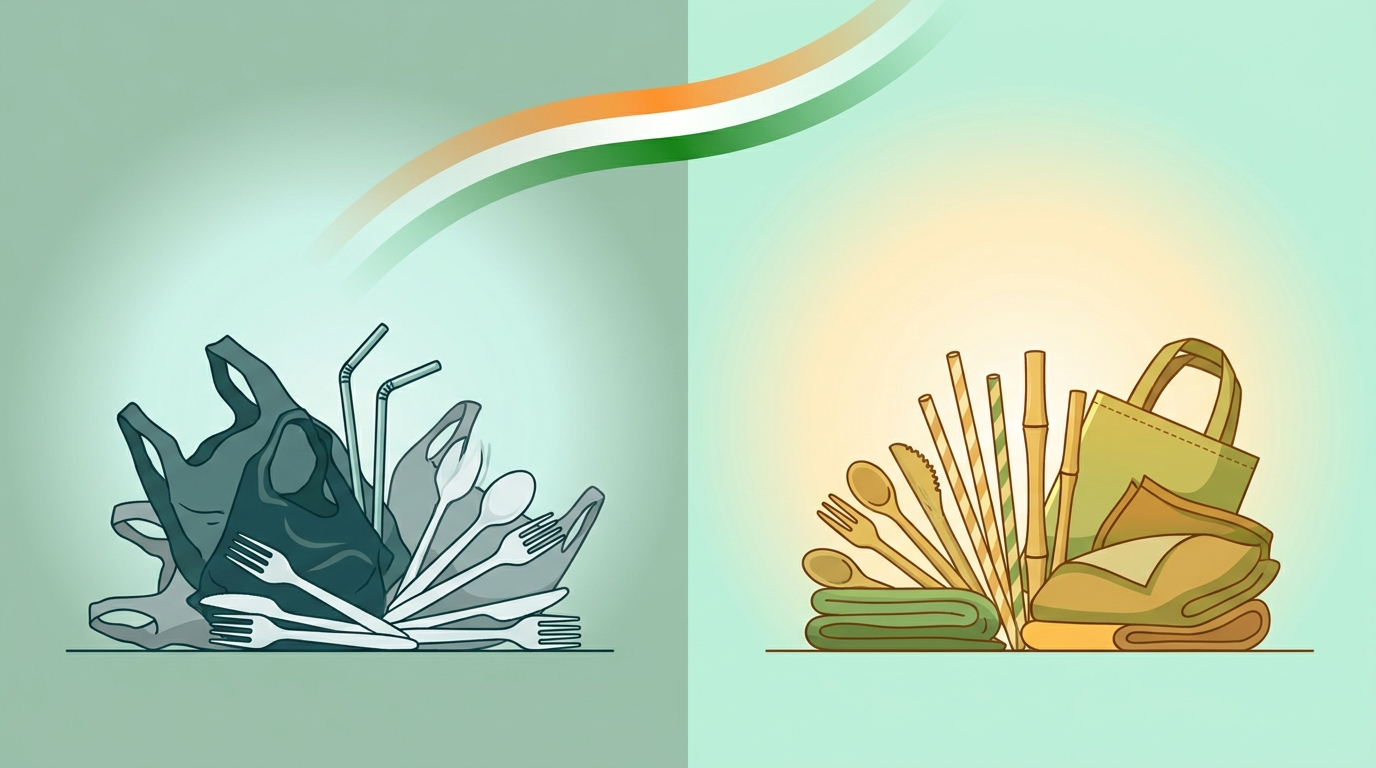
The banned list includes ear buds with plastic sticks, plastic sticks for balloons, plastic flags, candy and ice-cream sticks, polystyrene (thermocol) for decoration, plastic plates, cups, glasses, cutlery such as forks, spoons and knives, straws and trays, wrapping films around sweet boxes, invitation cards, cigarette packets, and plastic banners under 100 microns.
Separately, plastic carry bags were targeted by thickness rules. Carry bags thinner than 75 microns were banned from 30 September 2021, and the threshold was raised so that bags below 120 microns have been prohibited since 31 December 2022 (Press Information Bureau, 2022). Thicker bags are more likely to be reused and recycled rather than discarded after a single trip.
The ban sits within the broader Plastic Waste Management Rules, the legal backbone that also introduced Extended Producer Responsibility (EPR) — the principle that producers, importers and brand owners are financially responsible for collecting and recycling the plastic they put on the market.
Why the Single-Use Plastic Ban Is Important
The numbers explain the urgency. Globally, humanity produces more than 400 million tonnes of plastic every year, around 36% of which is used in packaging — much of it single-use (UNEP, 2024). Between 19 and 23 million tonnes of plastic waste leak into rivers, lakes and seas annually, and plastics generated 1.8 billion tonnes of greenhouse gas emissions in 2019, about 3.4% of the global total (UNEP, 2024).
India is a major contributor. The country generates approximately 3.9 million tonnes of plastic waste each year — close to 10,689 tonnes every single day — according to the Central Pollution Control Board’s 2022-23 data (CEEW, 2024). A large share is single-use packaging that has almost no recycling value, making it the kind of waste most likely to end up as litter, in landfills, or burned in the open.
Single-use items are disproportionately damaging precisely because they are cheap, lightweight and discarded immediately. They fragment into microplastics, block urban drainage during the monsoon, harm livestock and marine life, and impose clean-up costs on municipalities already stretched thin. A targeted ban on the worst offenders is therefore one of the most direct policy levers available to reduce plastic pollution India faces.
How the Single-Use Plastic Ban Works
Enforcement of the single-use plastic ban India relies on a multi-layered system coordinated by the Central Pollution Control Board (CPCB) and implemented through State Pollution Control Boards and Pollution Control Committees.
The CPCB’s approach combines supply-side measures (cutting off raw materials and manufacturing of banned items), demand-side measures (discouraging use and promoting alternatives), and enforcement drives. A month-long pan-India enforcement campaign ran from 1 to 31 July 2022, followed by special drives in October and November that year (Press Information Bureau, 2022).
To monitor compliance, the CPCB created digital tools including a National Dashboard tracking the comprehensive action plan, a Monitoring Module for compliance on single-use plastic elimination, and a Grievance Redressal App that lets citizens report violations. On the ground, penalties can include fines and, in serious cases, imprisonment under the Environment (Protection) Act.
Running alongside the ban, the EPR framework — administered through the CPCB’s Centralized EPR Portal for Plastic Packaging launched on 5 April 2022 — pushes producers to fund collection and recycling. This is the mechanism that connects a national ban to the everyday work of organisations like Operation SHUDDHI®, which builds the collection and recovery infrastructure the rules depend on.
Benefits of the Ban
The benefits of a well-implemented single-use plastic ban extend well beyond cleaner streets.
First, it reduces litter at source. Removing items that have no realistic recycling pathway means fewer plastics escaping into the environment in the first place — far more efficient than trying to recover them later.
Second, it drives innovation and green jobs. The ban has accelerated demand for alternatives: India’s biodegradable tableware and packaging products market was already estimated at USD 2.06 billion in 2023 and is growing steadily (Grand View Research, 2024). New industries in compostable cutlery, paper straws, bagasse plates and bamboo products create rural and small-business livelihoods.
Third, it strengthens the circular economy. By favouring thicker, reusable and recyclable materials and pairing the ban with EPR, the policy nudges the entire value chain toward designing waste out of the system rather than managing it after the fact.
Fourth, it builds public awareness. Visible enforcement campaigns and the simple act of being offered a paper straw instead of a plastic one have shifted everyday norms, especially among younger consumers and responsible businesses.
Challenges and Limitations
Honesty about the obstacles matters. The single-use plastic ban India enforces has not yet delivered its full potential, and several gaps stand out.
Enforcement is uneven. District-wise inventories of producers and sellers, compliance status, and field-inspection details have often not been available in the public domain, making it hard to verify how rigorously the ban is applied across thousands of small vendors. Banned items quietly reappear in informal markets where monitoring is thin.
Affordable alternatives are still scaling. Compostable and paper-based substitutes can cost more than the plastics they replace, creating resistance among small traders and price-sensitive consumers. Until alternatives reach price parity, the incentive to flout the rules remains.
Recycling capacity lags generation. Registered recyclers can process only a fraction of the plastic waste India produces, so even regulated, thicker plastics can overwhelm the system. Plastic waste is projected to nearly triple globally by 2060 under business-as-usual scenarios (UNEP, 2024), underlining how much infrastructure still needs to be built.
Finally, data quality and the vast informal sector make measurement difficult, complicating any honest assessment of the ban’s real-world impact.
Expert Insight
Environmental policy specialists broadly agree that bans are necessary but not sufficient. “A ban removes the worst products from shelves, but lasting change depends on the three things that surround it — affordable alternatives, reliable collection systems, and producers paying for the waste they create,” is a view echoed across analyses from bodies such as the Council on Energy, Environment and Water (CEEW) and the Centre for Science and Environment (CSE). The consensus: enforcement and EPR must mature together, supported by visible, convenient recycling infrastructure that makes doing the right thing the easy thing for ordinary citizens.
Case Study: From Policy to the Pavement
The gap between a national notification and a clean neighbourhood is bridged by on-the-ground recovery networks. Operation SHUDDHI®, AVRO India’s plastic waste recovery and circular economy mission, illustrates the model: by installing accessible collection bins, partnering with institutions and businesses, and channelling recovered plastic into recycling streams, the mission turns the intent of the Plastic Waste Management Rules into measurable diversion of plastic from landfills and waterways. When a hospital, school or housing society sets up a dedicated collection point, single-use and other plastics that would otherwise be littered are captured, sorted and given a second life — exactly the behaviour the ban and EPR are designed to encourage. It is a reminder that policy sets the direction, but community-level infrastructure determines whether the country actually arrives.
Future Trends
Several trends will shape the next phase of India’s fight against single-use plastic. The EPR regime, notified in 2022, is being implemented in phases through fiscal year 2027-28, progressively tightening obligations on producers. The 2024 amendments to the Plastic Waste Management Rules introduce clearer certification and reporting for biodegradable plastics and mandatory disclosure of pre-consumer waste.
Expect rapid growth in bio-based materials, with India’s bioplastic packaging market expanding at double-digit rates and new domestic facilities for compostable products and polylactic acid (PLA) coming online. Digital traceability, deposit-refund pilots, and stronger municipal segregation systems are likely to spread. Above all, the centre of gravity is shifting from a single prohibition toward an integrated circular economy in which bans, EPR, alternatives and citizen participation reinforce one another.
Conclusion
The single-use plastic ban India put in place is a landmark step — a clear signal that the most wasteful, hardest-to-recover plastics no longer belong in everyday life. Its early years show both real progress and real gaps: cleaner intent, growing alternatives, and rising awareness on one side; uneven enforcement, cost barriers and infrastructure shortfalls on the other. Closing that gap is a shared responsibility. Governments must enforce and fund, producers must own their packaging, and citizens must segregate and recycle. Missions like Operation SHUDDHI® supply the connective tissue — the bins, the partnerships, the recovery — that turns a national ban into a national habit.
Data Snapshot
| Statistic | Figure | Source | Year |
|---|---|---|---|
| Single-use plastic items banned in India | 19 items | Press Information Bureau (PIB) | 2022 |
| Carry bag thickness threshold (banned below) | 120 microns (from 31 Dec 2022) | Press Information Bureau (PIB) | 2022 |
| India’s annual plastic waste generation | ~3.9 million tonnes (~10,689 tonnes/day) | CPCB via CEEW | 2024 |
| Global plastic produced annually | 400+ million tonnes | UNEP | 2024 |
| Share of plastic used in packaging | ~36% | UNEP | 2024 |
| Plastic leaking into aquatic ecosystems yearly | 19-23 million tonnes | UNEP | 2024 |
| GHG emissions from plastics (2019) | 1.8 billion tonnes (3.4% of global) | UNEP | 2024 |
| India biodegradable tableware & packaging market | USD 2.06 billion | Grand View Research | 2024 |
| Projected growth in global plastic waste by 2060 | Nearly triples (business-as-usual) | UNEP | 2024 |
Frequently Asked Questions
1. What is the single-use plastic ban in India?
It is a nationwide prohibition, effective 1 July 2022, on manufacturing, importing, stocking, distributing, selling and using 19 identified single-use plastic items that have low utility and high littering potential.
2. Which items are banned under the single-use plastic ban?
Banned items include earbuds with plastic sticks, balloon sticks, plastic flags, candy and ice-cream sticks, thermocol decorations, plastic plates, cups, glasses, cutlery, straws, trays, sweet-box wrapping films, invitation cards, cigarette packets and thin banners.
3. When did the single-use plastic ban take effect in India?
The ban on the 19 identified items came into force on 1 July 2022, while the 120-micron minimum thickness for plastic carry bags applied from 31 December 2022.
4. Why are plastic carry bags allowed if they are thick enough?
Thicker bags (120 microns and above) are more likely to be reused and recycled rather than discarded after one use, so the rules regulate them by thickness rather than banning them outright.
5. Who enforces the single-use plastic ban?
The Central Pollution Control Board (CPCB) coordinates enforcement, working with State Pollution Control Boards and Pollution Control Committees, supported by monitoring dashboards and a citizen grievance app.
6. What are the penalties for violating the ban?
Violations can attract fines and, in serious cases, imprisonment under the Environment (Protection) Act, with enforcement carried out through state and local pollution control bodies.
7. What can I use instead of single-use plastics?
Alternatives include paper and bagasse plates, bamboo and steel cutlery, paper or steel straws, cloth and jute bags, and certified compostable products that meet Indian standards.
8. How does the ban connect to EPR?
Extended Producer Responsibility makes producers, importers and brand owners responsible for collecting and recycling their plastic packaging, complementing the ban by addressing plastics that are not prohibited but still need recovery.
9. Is the single-use plastic ban working?
It has reduced some littering and spurred alternatives, but enforcement gaps, cost barriers and limited recycling capacity mean its full impact depends on stronger infrastructure and citizen participation.
10. How can I help make the ban successful?
Avoid banned items, choose reusable alternatives, segregate waste at home, use authorised collection points, and support recovery missions such as Operation SHUDDHI®.
Related Resources
- Operation SHUDDHI Mission & Vision
- About Operation SHUDDHI
- Blog & Latest Updates
- Find a Collection Center (Locator)
- Join Operation SHUDDHI
Take Action
Operation SHUDDHI is turning India’s single-use plastic ban from policy into practice. Join the mission, install collection bins in your community, and help us recover plastic before it pollutes. Learn more at opshuddhi.org.
Sources & References
- Press Information Bureau (PIB) – Ban on identified Single Use Plastic Items from 1st July 2022
- Press Information Bureau (PIB) – CPCB measures to implement the Single Use Plastic Ban
- Press Information Bureau (PIB) – Ban on Single Use Plastics (status)
- UNEP – Plastic Pollution
- UNEP – Chemicals and Pollution Action: Plastic pollution
- CEEW – How can India Scale Plastic Waste Recycling Process & Management
- CPCB – Overview of Plastic Waste
- Grand View Research – India Biodegradable Tableware & Packaging Products Market
- CPCB – Centralized EPR Portal for Plastic Packaging