
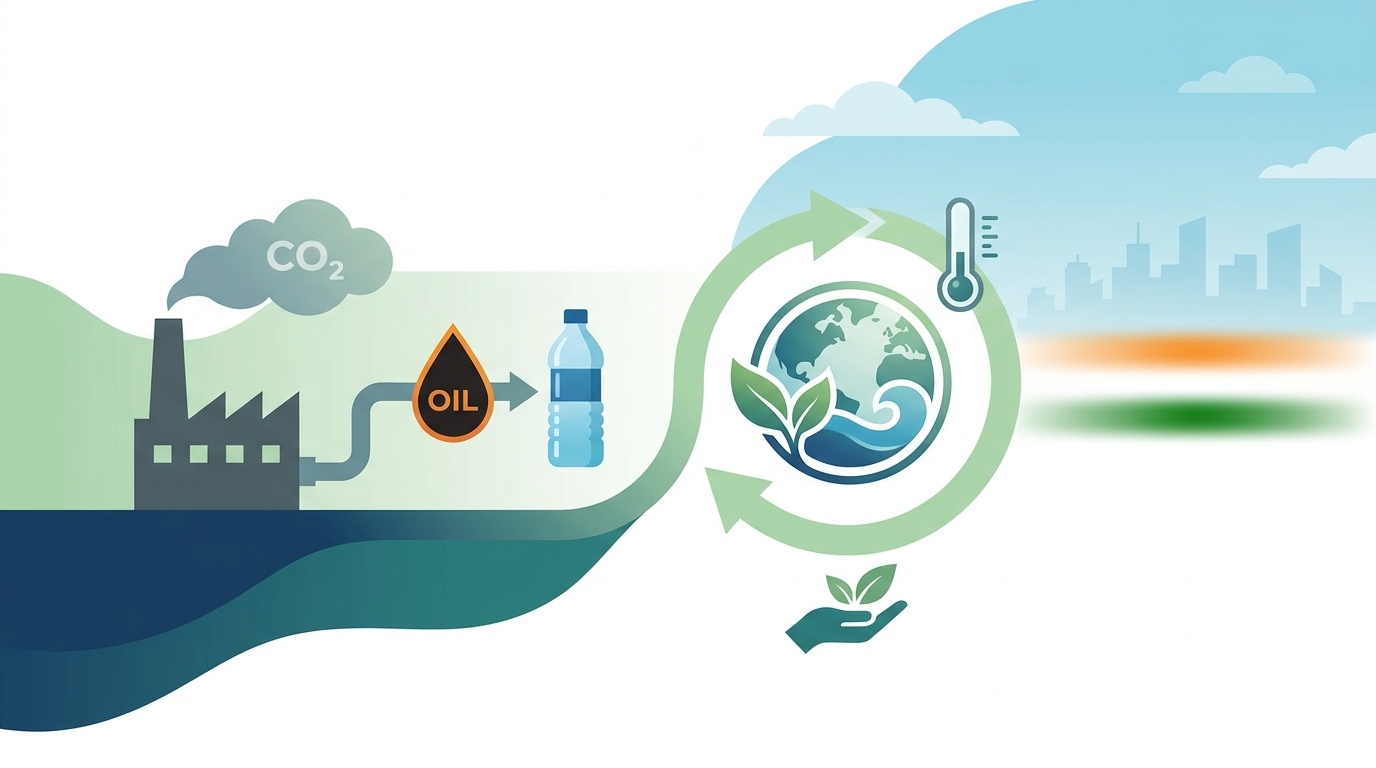
Climate Change & Plastic Waste: The Hidden Connection — and What India Can Do
When we think about plastic, we picture litter: bottles in a drain, bags in a tree, waste on a beach. When we think about climate change, we picture smokestacks, cars, and power plants. We rarely connect the two.
But here is the truth that changes everything: *plastic is a climate problem.* From the oil well to the open burning pit, plastic drives the very emissions warming our planet. For India — already the world’s largest plastic polluter — this hidden connection makes acting on plastic one of the most powerful climate actions available to us.
Plastic Is Fossil Fuel in Disguise
Around 99% of plastic is made from fossil fuels — oil and gas (Center for International Environmental Law). Every shopping bag and bottle begins life as petroleum, extracted, refined, and processed in an energy-hungry chain that releases greenhouse gases at every step.
The numbers are sobering:
- In 2019, plastics generated 1.8 billion tonnes of greenhouse gas emissions — about 3.4% of the global total — with roughly 90% of that coming from production and conversion from fossil fuels (OECD / Our World in Data).
- If we carry on as usual, plastic production could consume as much as 13% of the planet’s remaining carbon budget by 2050 (CIEL).
- Plastic production is on track to double by 2030 and triple by 2050 — locking in ever more emissions (UN).
In other words, the plastic crisis and the climate crisis are not two separate problems. They are the same problem, wearing two different faces.
Why This Hits India Especially Hard
India generates around 3.9 million tonnes of plastic waste a year — roughly 10,689 tonnes every single day (CPCB, via PIB). And a 2024 University of Leeds study in Nature found India to be the world’s largest plastic polluter, emitting about 9.3 million tonnes of plastic pollution a year (Down To Earth).
The climate damage is doubled by how that waste is handled. When uncollected plastic is burned in the open — a daily sight across the country — it releases carbon dioxide and toxic pollutants directly into the air our families breathe. Burning plastic is, quite literally, setting fossil fuels on fire twice.
The Good News: Fixing Plastic Cuts Emissions
Here is the hopeful flip side. Because plastic is so carbon-intensive to make, keeping it in use and recycling it avoids large amounts of emissions.
- Recycling plastic means less demand for new (virgin) plastic — and virgin plastic is where ~90% of the emissions sit.
- Collecting plastic properly stops open burning, eliminating those direct emissions and toxins.
- Using recycled content like rPET instead of new plastic shrinks a product’s carbon footprint.
These avoided emissions are real and measurable — so real they can often be quantified and even monetised through carbon credits. Acting on plastic is climate action you can see, weigh, and verify.
What India Can Do — From Household to Nation
The climate fix for plastic follows the same practical roadmap as the pollution fix:
- Reduce single-use plastic (India banned 19 such items in 2022).
- Segregate at source so plastic stays clean and recyclable — start with our segregation guide.
- Collect it through dedicated points instead of letting it burn or scatter.
- Recycle responsibly using modern recycling technologies.
- Close the loop by choosing recycled materials.
The full playbook is laid out in our guide to plastic pollution solutions for India.
How Operation Shuddhi Turns Plastic Action Into Climate Action
Operation SHUDDHI® is a nationwide plastic recovery and circular-economy mission — “From Waste to Wealth.” Every step we take is also a climate step:
- Free plastic collection in Delhi NCR keeps plastic out of open burning.
- Plastic collection dustbins at offices, hospitals, schools, societies and markets capture plastic before it pollutes. See them on our live dustbin locator.
- Collection Centre Partnerships and recycled granules keep material in the loop and reduce virgin plastic demand.
In a single day, our team installed 126 plastic collection bins across Delhi NCR — that’s 126 new points keeping plastic out of drains and fires.
Frequently Asked Questions
1. How is plastic linked to climate change? Around 99% of plastic is made from fossil fuels, and its production, transport, and disposal release greenhouse gases at every stage. In 2019, plastics caused about 1.8 billion tonnes of emissions — roughly 3.4% of the global total.
2. Does burning plastic waste add to climate change? Yes. Open burning of plastic releases carbon dioxide and toxic pollutants directly into the air. It is one of the most harmful ways to dispose of plastic, both for the climate and for human health.
3. Does recycling plastic actually reduce emissions? Yes. Recycling reduces demand for virgin plastic — where most plastic emissions occur — and prevents open burning. The avoided emissions can often be measured and even monetised through carbon credits.
4. Why is plastic a bigger climate issue for India? India is the world’s largest plastic polluter and generates around 3.9 million tonnes of plastic waste a year, much of it uncollected and openly burned — adding both emissions and toxic air pollution.
5. What can I do to cut plastic’s climate impact? Refuse single-use plastic, segregate at home, use a proper collection point, and support recycling. Hosting or requesting a collection dustbin, or volunteering, multiplies your impact.
A Climate Win Hiding in Plain Sight
We often feel powerless against climate change — the problem seems too big, too distant. Plastic is where that changes. It is the climate crisis you can hold in your hand, and act on today: one segregated bottle, one collection bin, one refusal of single-use plastic at a time.
Be part of the solution. Request a plastic dustbin for your area, join as a volunteer, become a Collection Centre Partner, or join the Operation SHUDDHI mission. Fixing plastic is fixing climate — from waste to wealth, for a cleaner, cooler India.