
Carbon Credits in India: How Plastic Recycling Generates Climate Value
By Ankit Pandey · Operation Shuddhi
As India accelerates toward its net-zero-by-2070 commitment, a powerful financial instrument is moving from the margins to the mainstream of corporate strategy: the carbon credit. Once the concern of only large energy and forestry projects, carbon credits are now relevant to recyclers, manufacturers, waste-management companies, and any business serious about turning climate action into measurable value. And for India’s plastic economy, the link is direct — every tonne of plastic recovered and recycled avoids emissions that would otherwise enter the atmosphere.
This detailed guide explains what carbon credits are, how the market works in India, how plastic recycling can generate them, the difference between carbon credits and plastic credits, and how businesses can participate responsibly.
Carbon Credits & Plastic Recycling: The Numbers
- ~3.9 million tonnes of plastic waste are generated in India every year — about 10,689 tonnes a day — and roughly 40% is still not recycled. (Source: CPCB Annual Report, 2022–23)
- Recycling avoids roughly 1.3 tonnes of CO₂e per tonne of plastic compared with virgin production, cutting an estimated 30–80% of emissions depending on the polymer. (Source: plastic life-cycle assessments)
- India’s carbon credit market was valued at roughly USD 33.7 billion in 2025 and is projected to reach about USD 405 billion by 2034 (~32% CAGR), with the voluntary segment leading. (Market-research estimate: Coherent Market Insights, 2025)
- Voluntary carbon credits in India typically trade around $2–$5 per tonne for standard credits, rising to about $15–$25 per tonne for high-quality nature-based credits. (Source: India carbon credit pricing, 2025)
Latest available figures. Market-size and price estimates vary by source and methodology.
What Is a Carbon Credit?
A carbon credit is a tradable certificate that represents one tonne of carbon dioxide equivalent (CO₂e) either removed from the atmosphere or prevented from being emitted. The logic is simple: if your activity avoids or removes a tonne of emissions, that verified reduction has value — and someone who needs to offset their own emissions can buy it.
Carbon credits exist because climate impact is global. It does not matter where a tonne of CO₂ is reduced; the atmosphere benefits equally. This allows emissions reductions to be financed wherever they are most cost-effective, channelling capital from high-emitting companies to projects that cut emissions on the ground.
There are two broad markets:
- Compliance market — government-regulated systems where companies must stay within emission caps and buy credits if they exceed them.
- Voluntary carbon market (VCM) — where companies, often for ESG and net-zero commitments, voluntarily buy credits to offset their footprint.
India is building toward a formal compliance market through the Carbon Credit Trading Scheme (CCTS), while the voluntary market is already active and growing rapidly.
How the Carbon Credit Lifecycle Works
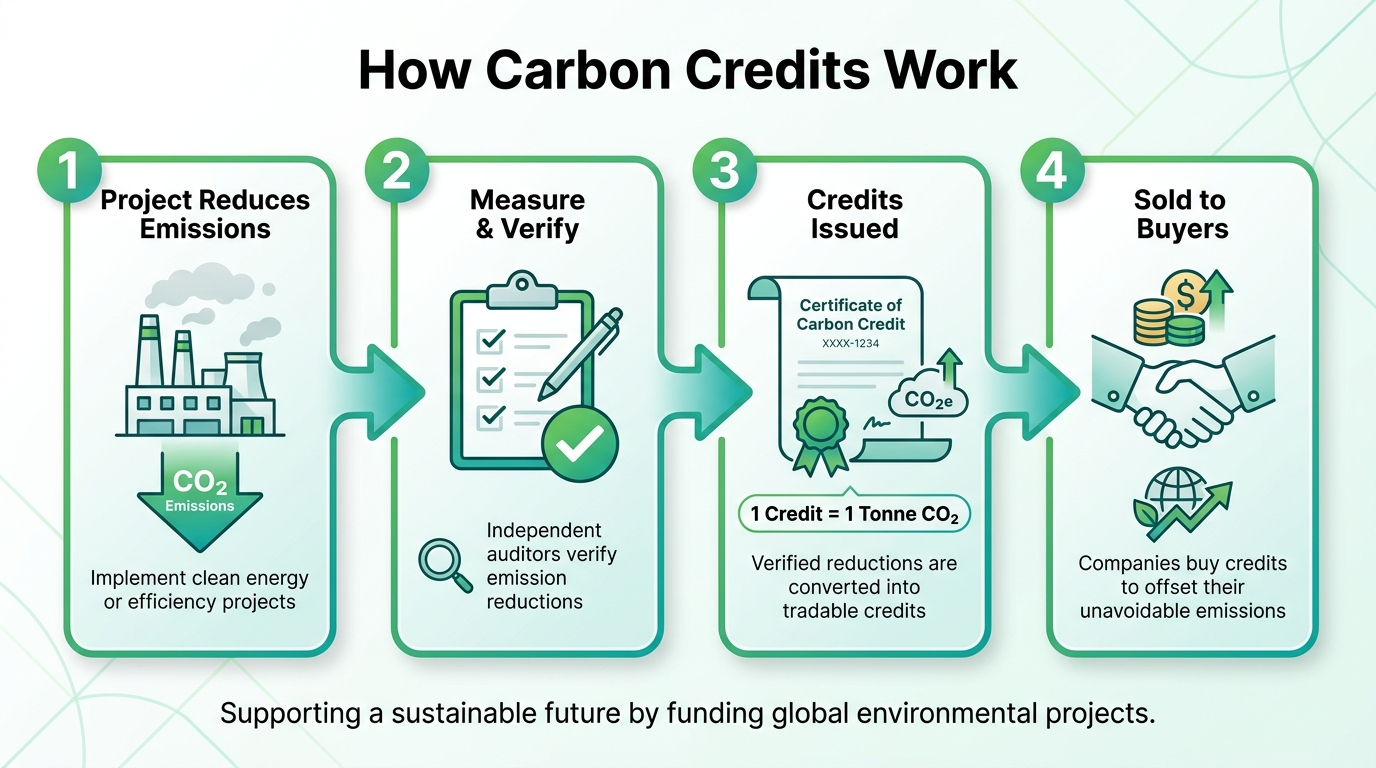
Understanding the lifecycle is essential, because a carbon credit is only valuable if it is credible. The journey from activity to tradable credit follows four stages.
1. A Project Reduces or Removes Emissions
This could be renewable energy, afforestation, methane capture — or, importantly, recycling and waste recovery that avoids the emissions of virgin production and landfill decomposition.
2. Measurement and Verification
The reduction is quantified using an approved methodology and independently audited by a third party. This step is what separates a real, sellable credit from an empty claim. Rigorous Monitoring, Reporting and Verification (MRV) is the backbone of the entire system.
3. Credits Are Issued
Once verified, a registry issues credits — one per tonne of CO₂e — each with a unique serial number to prevent double counting.
4. Credits Are Traded and Retired
Credits are sold to buyers who need to offset emissions. When a buyer uses a credit against their footprint, it is “retired” so it cannot be resold. This traceability is what gives the market integrity.
The Plastic–Carbon Connection
Here is the insight most relevant to India’s circular economy: plastic recycling is a genuine emissions-reduction activity, and therefore a potential source of climate value.
Recycling cuts emissions in several ways:
- Avoided virgin production. Manufacturing plastic from recycled feedstock uses significantly less energy than producing it from crude oil, avoiding the associated emissions. Life-cycle assessments put this saving at roughly 1.3 tonnes of CO₂e per tonne of plastic recycled. This is the same carbon advantage that makes recycled content attractive to manufacturers.
- Diverted landfill and burning. Plastic that is recovered does not sit in landfills or get openly burned — both of which release greenhouse gases and pollutants.
- Displaced fossil demand. Every tonne of recycled plastic that replaces virgin resin reduces upstream demand for fossil fuels.
When these reductions are measured and verified under an approved methodology, recycling and waste-recovery projects can, in principle, generate carbon credits — turning environmental good into a financial asset that funds more recovery. The foundation for this is the same as for all credible recycling: clean, well-segregated waste flowing through traceable recycling technologies.
Carbon Credits vs Plastic Credits: Don’t Confuse Them
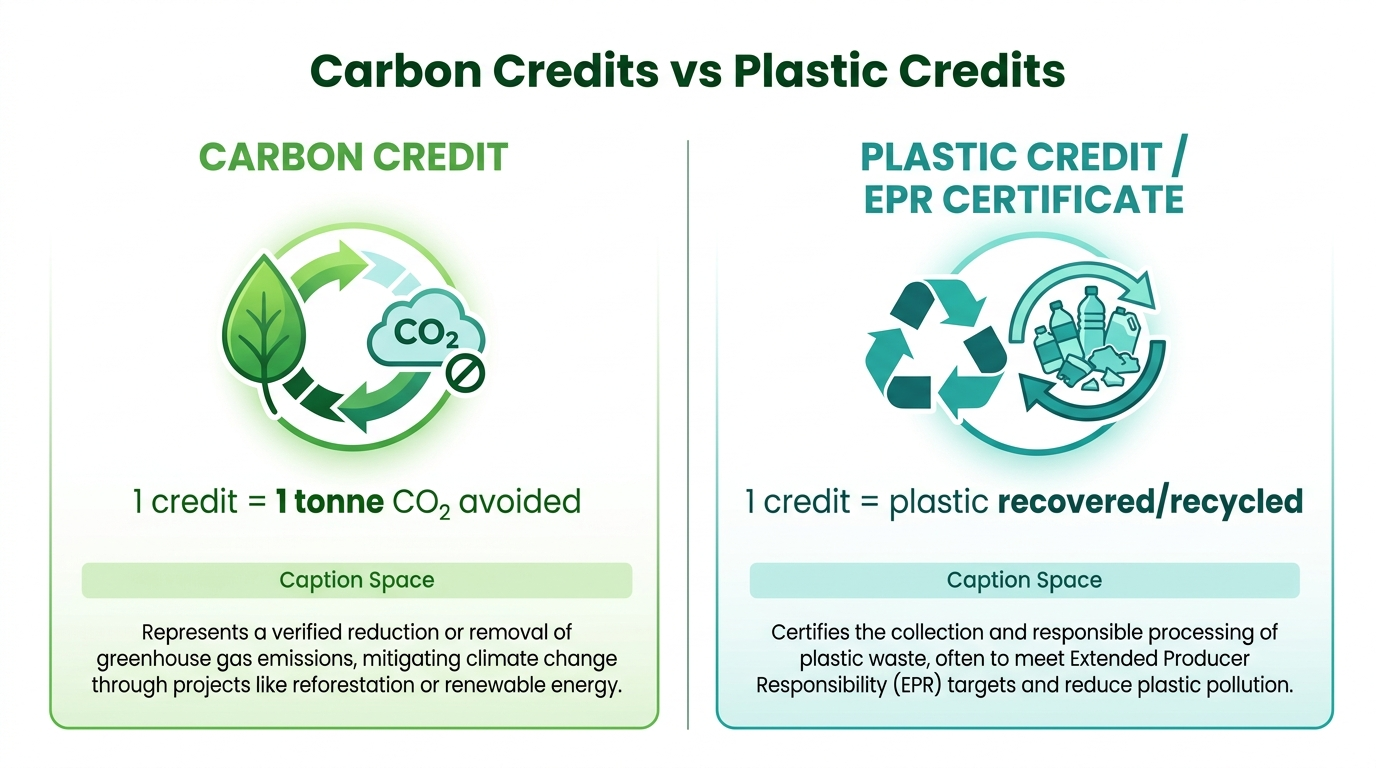
A common point of confusion for Indian businesses is the difference between carbon credits and plastic credits (closely tied to EPR certificates). They are related sustainability instruments but measure different things.
- A carbon credit represents one tonne of CO₂e avoided or removed. It addresses climate change.
- A plastic credit / EPR certificate represents a quantity of plastic collected and recycled. It addresses plastic pollution and is central to EPR compliance in India.
The two can be complementary. A single recycling operation can support plastic-credit (EPR) obligations and, where the emissions reductions are separately measured and verified, contribute to carbon value — as long as the same benefit is never sold twice. Businesses should treat them as distinct instruments with distinct documentation.
The Opportunity — and the Responsibility
Carbon credits offer Indian businesses a real opportunity: a new revenue stream for recovery and recycling projects, a credible way to meet net-zero pledges, and a mechanism to attract climate finance into the circular economy. For an emerging market like India’s plastic recycling sector, this can help fund the infrastructure the country urgently needs.
But the opportunity comes with responsibility. The carbon market’s credibility depends entirely on integrity. Businesses should:
- Insist on verified, registry-issued credits with transparent methodologies — avoid vague, undocumented “offsets.”
- Prioritise real reductions first. Credits should complement genuine emission cuts, not replace them. Buying offsets while ignoring your own footprint invites greenwashing accusations.
- Demand traceability. Just as with EPR certificates, a carbon credit is only as good as the chain of custody and verification behind it.
- Report transparently. Disclose what was reduced, what was offset, and how — for ESG reports and stakeholder trust.
Done right, carbon credits reward exactly the behaviour the planet needs. Done carelessly, they become a reputational liability.
How Operation SHUDDHI Fits In
This is where Operation SHUDDHI® plays a foundational role. As India’s Plastic Waste Recovery and Circular Economy Mission, Operation SHUDDHI focuses on transforming plastic waste into wealth, livelihoods, and environmental value through collection, recycling, awareness, and circular-economy initiatives.
Every credible climate or plastic instrument — whether a carbon credit or an EPR certificate — rests on the same foundation: real, measurable, traceable recovery on the ground. By building nationwide collection centres, formalising waste workers, and ensuring segregated plastic flows cleanly to recyclers, Operation SHUDDHI creates the verifiable recovery activity that gives climate and plastic value its integrity. For businesses, partnering with such a network means their sustainability claims — carbon or plastic — are backed by genuine impact, not paperwork.
Frequently Asked Questions
1. What is a carbon credit in simple terms? A carbon credit is a certificate representing one tonne of carbon dioxide equivalent (CO₂e) that has been avoided or removed from the atmosphere. Companies buy carbon credits to offset emissions they cannot yet eliminate, channelling money to projects that reduce emissions.
2. How does plastic recycling generate carbon credits? Recycling avoids the emissions of producing new plastic from crude oil and prevents landfill and open-burning emissions. When these reductions are measured under an approved methodology and independently verified, recycling and waste-recovery projects can qualify to generate carbon credits.
3. What is the difference between carbon credits and plastic credits? A carbon credit measures one tonne of CO₂e avoided or removed and addresses climate change. A plastic credit (closely linked to EPR certificates in India) measures a quantity of plastic collected and recycled and addresses plastic pollution. They are distinct instruments and the same benefit must never be sold as both.
4. Are carbon credits regulated in India? India is establishing a formal compliance market through the Carbon Credit Trading Scheme (CCTS), while a voluntary carbon market is already active. Businesses should use verified, registry-issued credits with transparent methodologies to ensure credibility.
5. How can a business participate in the carbon credit market responsibly? By prioritising real emission reductions first, buying or generating only verified and traceable credits, avoiding double counting, and reporting transparently. Partnering with organisations that deliver genuine, documented recovery ensures claims are backed by real impact.
Conclusion
Carbon credits represent one of the most promising ways to align India’s climate goals with its circular-economy ambitions. For the plastic sector specifically, the connection is powerful: recovering and recycling plastic is not just good waste management — it is measurable climate action that can, done properly, unlock real financial value. The key word is properly: integrity, verification, and traceability are what separate genuine climate impact from greenwashing.
Operation SHUDDHI® exists to provide that foundation — turning India’s plastic waste into verified recovery that underpins both plastic and climate value. As the carbon market matures, the businesses that built their sustainability on real, traceable impact will be the ones that benefit. From waste to wealth, and from recovery to climate value — the opportunity is here, and the time to build it responsibly is now.
Partner with Operation SHUDDHI for traceable plastic recovery and circular-economy solutions. Visit www.opshuddhi.org or write to team@opshuddhi.org.
About the Author
Ankit Pandey writes for Operation Shuddhi on plastic waste recovery, EPR, recycling, and the circular economy. Operation Shuddhi is India’s Plastic Waste Recovery & Circular Economy Mission, an initiative of AVRO Group.
Partner with Operation SHUDDHI®
Is your business generating plastic waste, or do you need quality recycled material? Let’s turn your plastic into value — and build India’s circular economy together.
♻️ Have plastic waste? Hand it over to us for responsible, traceable recycling — support your EPR compliance and turn waste into wealth.
🏭 Need recycled granules (rPET / PCR)? Source clean, traceable recycled material for your products — contact us for supply.
Join Operation Shuddhi →
Contact Us to Donate Plastic or Buy Granules