EPR Compliance in India: A 2026 Guide to Plastic Packaging Rules, Targets & Plastic Credits
Quick Answer
Extended Producer Responsibility (EPR) in India makes producers, importers, and brand owners (PIBOs) legally accountable for collecting and recycling the plastic packaging they put on the market. Under the Plastic Waste Management Rules, 2022, PIBOs register on the CPCB Centralized EPR Portal, meet category-wise recycling targets, and fulfil obligations using verified plastic credits.
Key Takeaways
- EPR compliance in India is mandatory for all producers, importers, and brand owners of plastic packaging under the Plastic Waste Management Rules, 2022.
- The CPCB Centralized EPR Portal for Plastic Packaging was launched on 5 April 2022 and is the single point for registration, targets, and credits.
- Plastic packaging is split into four categories (I–IV), each with its own recycling target.
- Recycling targets rise sharply — Category I & IV from 50% (FY2025) to 80% (FY2028) and Category II & III from 30% to 60% (Statista, 2024).
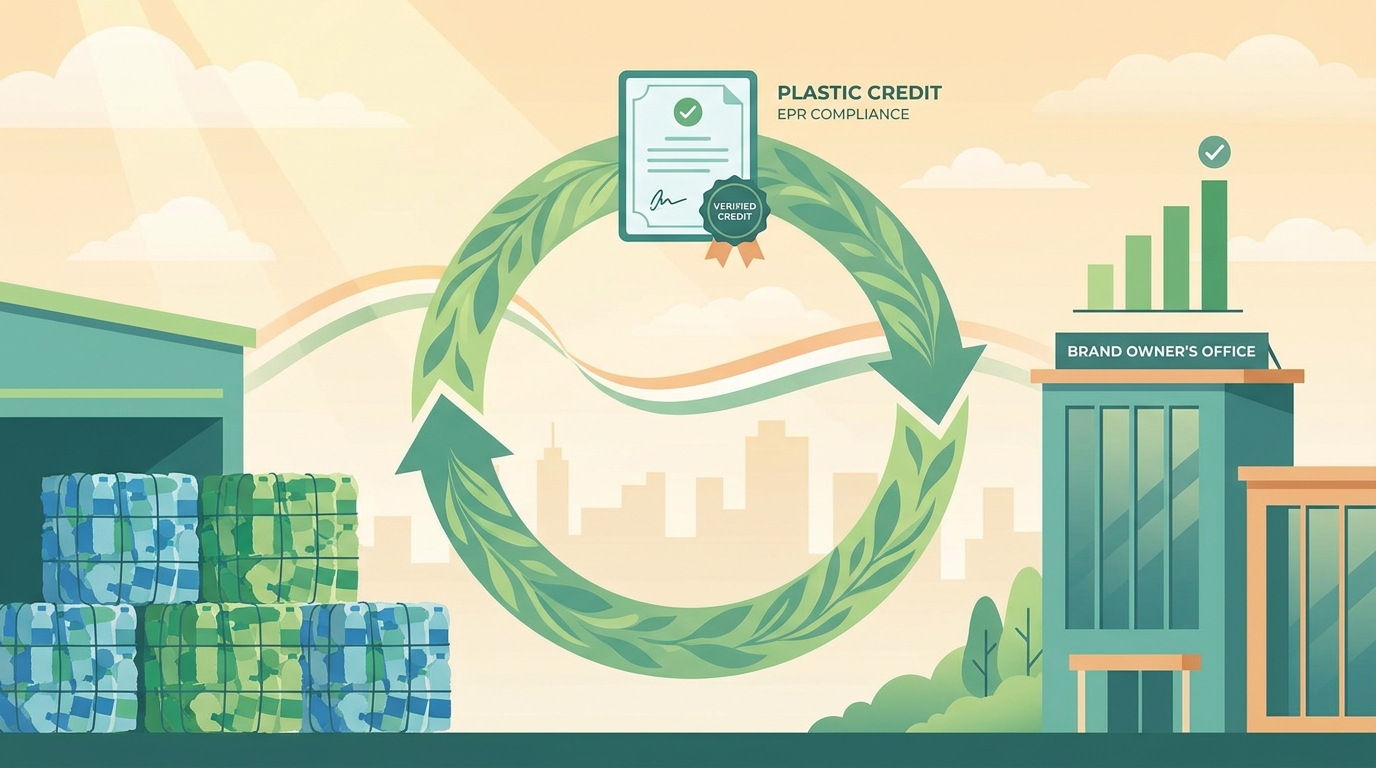
- Plastic credits are tradable digital certificates that let brands meet obligations through verified recyclers.
Introduction
For any business that sells a product wrapped in plastic in India, EPR compliance is no longer optional paperwork — it is a legal duty with financial consequences. Extended Producer Responsibility shifts the cost and responsibility of managing plastic packaging waste from municipalities and citizens onto the companies that produce it. In a country that generates approximately 3.9 million tonnes of plastic waste every year (CPCB Annual Report, 2022-23), this single principle is reshaping how brands design, track, and recover their packaging.
This 2026 guide explains exactly how Extended Producer Responsibility for plastic packaging works in India — who must register, what the four categories mean, how recycling targets escalate each year, how plastic credits function, and how organisations can stay compliant while contributing to a genuine circular economy.
What Is EPR (Extended Producer Responsibility)?
Extended Producer Responsibility is a policy principle that holds producers accountable for the entire lifecycle of their products, especially the post-consumer stage. In India, EPR for plastic packaging is governed by the Plastic Waste Management Rules, 2022, notified by the Ministry of Environment, Forest and Climate Change (MoEFCC). It legally requires every Producer, Importer, and Brand Owner — collectively called PIBOs — to ensure that a defined share of the plastic packaging they introduce is collected, recycled, or processed each year.
Why Is EPR Important for India?
EPR is important because it turns plastic from an unmanaged pollutant into a tracked, recoverable resource. It creates stable demand and financing for collection and recycling, reduces plastic leakage into rivers and landfills, and pushes brands toward recyclable design. Crucially, it underpins India’s circular economy ambition — projected to generate a $2 trillion market and 10 million jobs by 2050 (MoEFCC, 2025) — by making producers fund the recovery systems that make circularity possible.
How Does EPR Compliance Work in India?
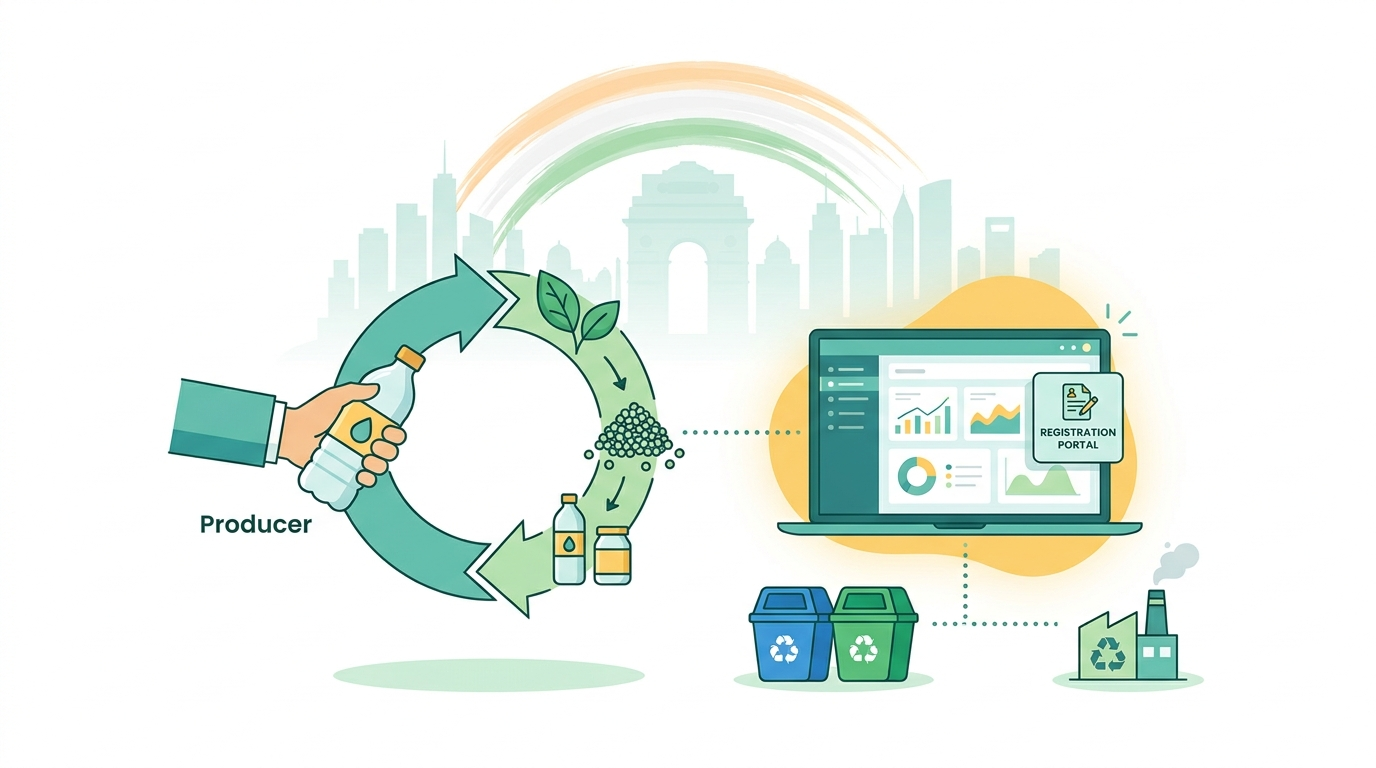
EPR compliance follows a clear, portal-driven process built around the CPCB EPR Portal:
Registration. Every PIBO must register on the CPCB Centralized EPR Portal for Plastic Packaging, declaring the quantity and category of plastic packaging they introduce to the market.
Target assignment. CPCB assigns annual EPR targets based on volumes. The core formula is EPR Target = (A + B) − C, where A is the average plastic packaging introduced over the last two financial years, B is average pre-consumer plastic waste, and C is the quantity supplied to other brand owners.
Fulfilment. PIBOs meet targets by collecting and recycling plastic, either directly or through registered recyclers and Plastic Waste Processors.
Plastic credits. Registered recyclers upload verified recycling data to the portal; the system issues EPR/plastic credits that brands can purchase to close any gap in their obligation.
Reporting. PIBOs file annual returns; failure to comply attracts environmental compensation.
The Four Categories of Plastic Packaging
India’s rules classify plastic packaging into four EPR categories, each treated differently:
Category I — Rigid plastic packaging (bottles, containers, jars).
Category II — Flexible plastic packaging (single or multi-layer films, sheets, pouches, sachets).
Category III — Multi-layered plastic packaging (at least one layer of plastic combined with at least one layer of non-plastic material).
Category IV — Plastic sheet or carry bags made of compostable plastics.
EPR Recycling Targets: Rising Year on Year
The defining feature of India’s EPR regime is its escalating targets. Recycling obligations for Category I and IV rise from 50% in FY2025 to 80% by FY2028, while Category II and III climb from 30% to 60% over the same period (Statista, 2024). The regime, notified in 2022, is being implemented in phases up to FY2027-28, giving the market time to build recycling capacity while steadily raising the bar.
Benefits of EPR Compliance
Beyond avoiding penalties, EPR compliance delivers real value. It strengthens plastic waste recovery and traceability, improves brand reputation and ESG ratings, and creates predictable demand for recycled material. It also drives eco-design — companies that switch from hard-to-recycle multi-layered plastics to recyclable formats lower both their EPR burden and their environmental footprint, turning compliance into a competitive advantage.
Challenges in EPR Implementation
EPR in India still faces real friction. Data accuracy and verification on the portal remain difficult, and a market for plastic credits can be volatile. Multi-layered plastic (Category III) is technically hard and costly to recycle. Small producers often lack awareness or capacity, and the vast informal recycling sector — which recovers much of India’s plastic — is still being formally integrated into the EPR value chain. Closing these gaps is essential for the system to deliver on paper and on the ground.
Future Trends in EPR
The direction of travel is clear: stricter verification, digital traceability, and higher targets. The 2025 amendments to the Plastic Waste Management Rules emphasise transparency and traceability, and CPCB continues to tighten credit verification. Expect deeper integration of the informal sector, growth in recycled-content mandates, and EPR frameworks expanding across e-waste, tyres, and batteries — mirroring NITI Aayog’s circular economy roadmap (NITI Aayog, 2026).
Expert Insight
For most brands, EPR is still treated as a once-a-year compliance scramble — register, buy credits, file the return. The companies pulling ahead treat it as a design signal. Every rupee spent on plastic credits is really a price on non-recyclability. The smartest move is not to optimise credit purchases; it is to redesign packaging so the obligation shrinks at source. In a regime where targets climb to 80%, recyclable-by-design packaging is the only compliance strategy that gets cheaper over time.
Case Study: The CPCB EPR Portal as India’s Compliance Backbone
The clearest real-world example of EPR in action is the CPCB Centralized EPR Portal for Plastic Packaging itself. Launched on 5 April 2022, it digitised what was previously a fragmented, paper-based system. Today, thousands of producers, importers, brand owners, and registered recyclers transact on a single platform — registering volumes, receiving targets, and trading verified plastic credits. By centralising registration and credit issuance, the portal created a transparent national market for plastic recovery, demonstrating how digital infrastructure can turn a regulatory mandate into a functioning circular economy mechanism.
Conclusion
EPR compliance has become the operating system of India’s fight against plastic waste. By making producers responsible, setting escalating recycling targets, and creating a credit market through the CPCB portal, India is converting a pollution problem into a circular economy opportunity. For brands, the message is simple: register early, design for recyclability, track diligently, and treat EPR not as a cost but as a contribution to a cleaner, more competitive India.
Data Snapshot
| Metric | Figure | Source (Year) |
|---|---|---|
| Plastic waste generated annually in India | ~3.9 million tonnes | CPCB Annual Report (2022-23) |
| CPCB Centralized EPR Portal launched | 5 April 2022 | CPCB (2022) |
| EPR categories of plastic packaging | 4 (Category I–IV) | PWM Rules / MoEFCC (2022) |
| Recycling target, Category I & IV | 50% (FY2025) rising to 80% (FY2028) | Statista (2024) |
| Recycling target, Category II & III | 30% (FY2025) rising to 60% (FY2028) | Statista (2024) |
| EPR regime phased implementation until | FY2027-28 | CPCB / MoEFCC (2022) |
| Projected circular economy value (India) | $2 trillion & 10 million jobs by 2050 | MoEFCC (2025) |
Frequently Asked Questions
What is EPR compliance in India? EPR compliance means producers, importers, and brand owners (PIBOs) legally fulfil their duty to collect and recycle the plastic packaging they put on the market, under the Plastic Waste Management Rules, 2022. They register on the CPCB EPR Portal, meet category-wise recycling targets, and use verified plastic credits to close any shortfall.
Who needs EPR registration? Every Producer, Importer, and Brand Owner (PIBO) that introduces plastic packaging into the Indian market must register on the CPCB Centralized EPR Portal. This includes manufacturers of plastic packaging, importers of packaged goods, and brands that sell products in plastic packaging, regardless of size.
What are the four EPR categories? Plastic packaging is classified as Category I (rigid plastic), Category II (flexible plastic films, pouches, sachets), Category III (multi-layered plastic with a non-plastic layer), and Category IV (compostable plastic sheets/carry bags). Each category has its own recycling target and obligations.
What are India’s EPR recycling targets? Recycling targets escalate over time. For Category I and IV, targets rise from 50% in FY2025 to 80% by FY2028; for Category II and III, from 30% to 60% over the same period (Statista, 2024). Targets are assigned by CPCB based on the volume a business introduces.
What are plastic credits? Plastic credits (EPR credits) are verifiable digital certificates representing proof of recycling. Registered recyclers generate them by recycling plastic and uploading data to the CPCB portal. Producers and brand owners buy these credits to fulfil their EPR obligations when their own collection falls short of targets.
How is the EPR target calculated? CPCB calculates EPR targets using the formula EPR Target = (A + B) − C, where A is the average plastic packaging introduced to market over the last two financial years, B is average pre-consumer plastic waste, and C is the quantity supplied to other brand owners.
What happens if a company fails EPR compliance? Non-compliant PIBOs face environmental compensation (financial penalties) levied by CPCB, along with reputational and operational risk. Persistent non-compliance can affect a company’s ability to operate and its ESG standing, making timely registration and reporting essential.
How does EPR support the circular economy? EPR finances and formalises collection and recycling, creating demand for recycled material and recyclable design. It directly supports India’s circular economy goal of a $2 trillion market and 10 million jobs by 2050 (MoEFCC, 2025) by making producers fund the recovery systems that keep plastic in use.
Related Resources
- Operation SHUDDHI Mission & Vision
- About Operation SHUDDHI
- Blog & Latest Updates
- Find a Collection Center (Locator)
- Join Operation SHUDDHI
Partner with Operation SHUDDHI for EPR
Meeting your EPR targets is easier with the right recovery partner. Operation SHUDDHI® helps producers and brands strengthen plastic waste recovery, traceability, and circular-economy compliance across India. Join Operation SHUDDHI as a Collection or Recycling Partner, install collection bins, and support verified plastic recovery. Visit opshuddhi.org to take action today — together, we turn compliance into a cleaner, circular India.
Sources & References
- CPCB — Centralized EPR Portal for Plastic Packaging
- CPCB — EPR Registration for Plastic Waste Management
- Statista — India: Plastic Packaging Waste Recycling Targets
- CPCB — Status of Implementation of Plastic Waste Management Rules
- MoEFCC / DD News — Circular Economy: $2 Trillion & 10 Million Jobs by 2050
- NITI Aayog — Circular Economy Report (2026)