
Microplastics in India: Sources, Health Impacts & Solutions (2026)
Quick Answer
Microplastics in India are plastic fragments smaller than 5 mm that have spread into the country’s water, food, air and soil. Driven by 25,940 tonnes of daily plastic waste, they are now found in salt, sugar and human tissue. Source reduction, better recovery and a circular economy are the proven solutions.
Key Takeaways
- Microplastics are plastic particles under 5 mm, formed when larger plastic waste fragments or shed from products like textiles, tyres and packaging.
- A 2024 Toxics Link study found microplastics in 100% of Indian salt and sugar samples tested, with iodised salt averaging 89.15 particles per kilogram.
- India is projected to be the world’s second-largest source of microplastics leaking into waterbodies, after China.
- Microplastics have been detected in human blood, placental tissue and major organs, prompting urgent ICMR and NGT action in 2024-2025.
- The strongest defence is stopping plastic at source: reducing single-use plastic, improving collection and recovery, and building a circular economy.
Microplastics in India: The Invisible Pollution Crisis Hiding in Our Food, Water and Air
Microplastics in India have moved from a distant scientific curiosity to an everyday reality found in the salt on our tables, the water we drink and the air our cities breathe. These near-invisible plastic fragments — each smaller than a grain of rice — are the downstream consequence of a plastic waste problem that has outpaced the country’s ability to collect and recover it. Understanding microplastics in India, where they come from, what they do to human health, and how a circular economy can stem the tide, has become one of the defining environmental questions of our time.
What Are Microplastics?
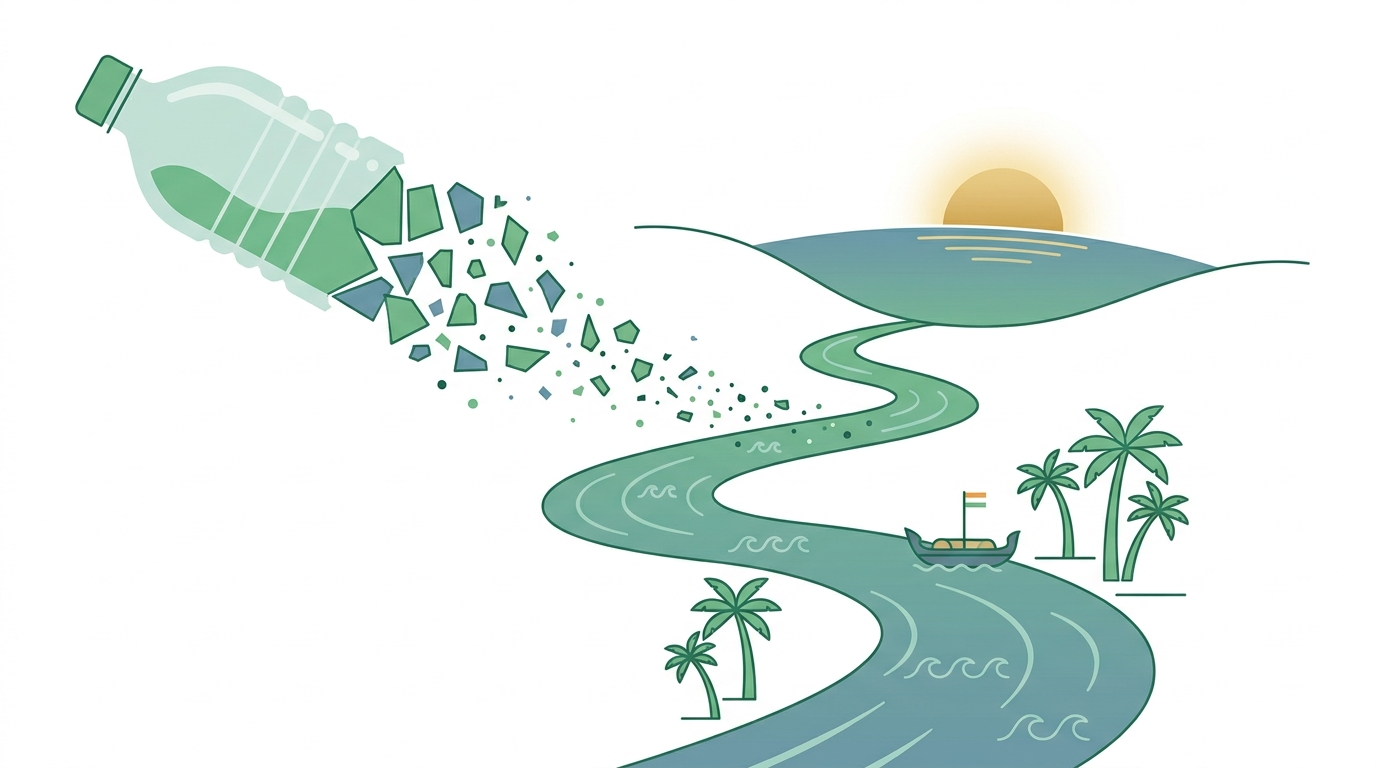
Microplastics are plastic particles smaller than 5 millimetres in diameter, as defined by the United Nations Environment Programme (UNEP). They fall into two broad categories. Primary microplastics are manufactured small on purpose — microbeads in cosmetics, industrial pellets and synthetic fibres. Secondary microplastics are created when larger plastic items such as bottles, bags and packaging break down under sunlight, heat and friction into ever-smaller pieces that never fully biodegrade. When these fragments shrink below one micrometre, they become nanoplastics, small enough to cross biological barriers in the human body.
The scale of the raw material feeding this problem is staggering. Global plastic production reached roughly 430.9 million metric tonnes in 2024, according to UNEP, and an estimated 2.7 million tonnes of microplastics seeped into the environment in 2020 alone — a figure projected to double by 2040.
Why Microplastics in India Matter
India sits at the centre of this story. The country generates about 25,940 tonnes of plastic waste every day — roughly 4.13 million tonnes a year — according to Central Pollution Control Board (CPCB) data, with Delhi alone contributing close to 690 tonnes daily. A significant share of this is mismanaged: dumped, burned or washed into rivers, where it fragments into microplastics.
The consequences are now measurable. Research reported in 2024 projected that India would release around 391,879 tonnes of microplastics into waterbodies, making it the world’s second-largest contributor after China. The Ganga, together with the combined flows of the Brahmaputra and Meghna, may discharge between one and three billion microplastic particles into the Bay of Bengal every single day. What begins as a discarded bag in a city drain ends as an invisible particle in the marine food chain — and eventually, on our plates.
How Microplastics Spread Through the Environment
Microplastics move through every environmental compartment. In water, they travel down rivers and accumulate in lakes, estuaries and oceans, where marine life mistakes them for food. In soil, they arrive through compost, sewage sludge and irrigation, affecting agricultural productivity. In air, they become airborne dust — a 2024 study in eastern India quantified significant concentrations of airborne microplastics in urban areas, and adults may inhale tens of thousands of particles daily from indoor environments.
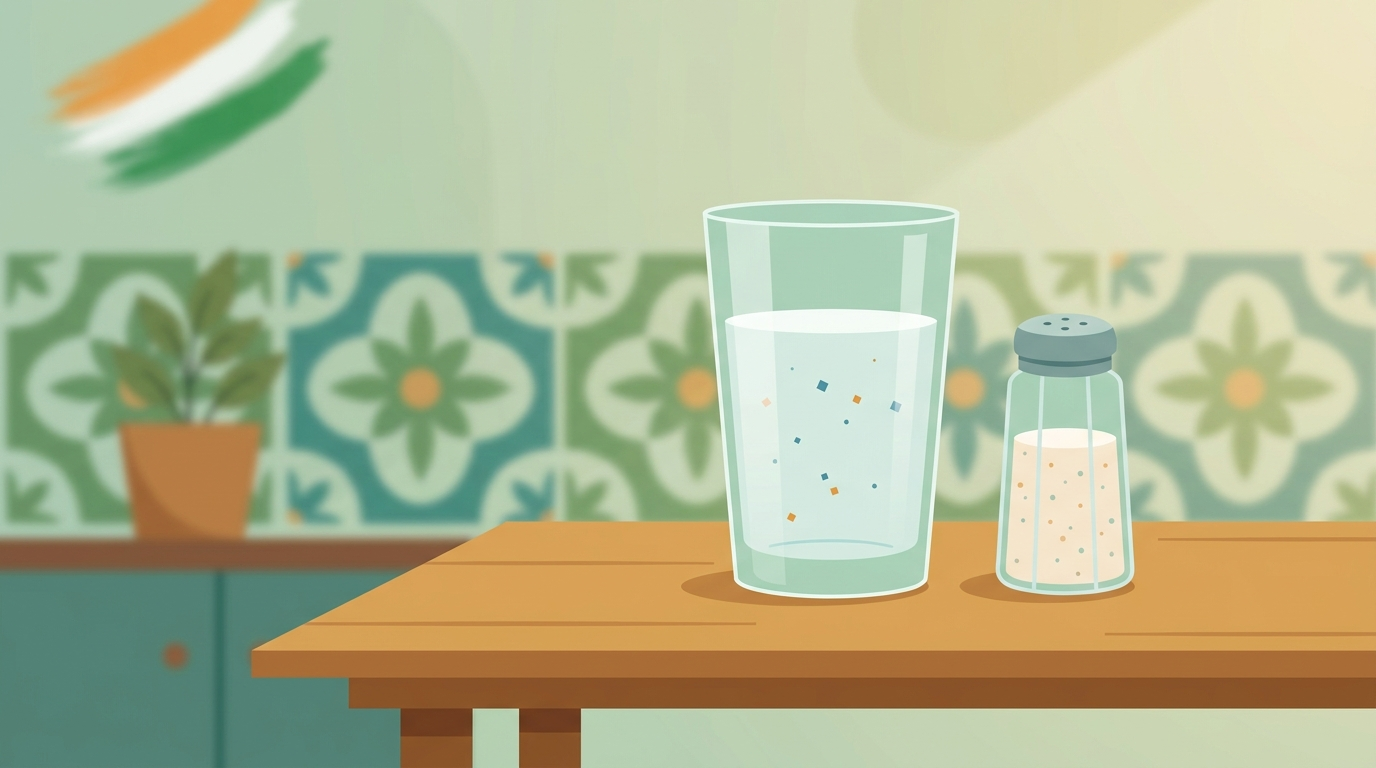
The most unsettling pathway is food. A landmark 2024 study by the Indian environmental NGO Toxics Link tested ten salt and five sugar samples sold in Indian markets and found microplastics in every single one. Iodised salt carried the highest load at 89.15 particles per kilogram, appearing as multicoloured fibres, films, pellets and fragments ranging from 0.1 mm to 5 mm. Sugar samples ranged from 11.85 to 68.25 particles per kilogram. Because salt and sugar are dietary staples consumed daily across India, this represents a continuous, unavoidable exposure route for hundreds of millions of people.
Health Impacts: What the Science Shows
Microplastics are no longer just an environmental issue — they are a human health concern. Globally, peer-reviewed studies have detected microplastics in human blood, lung tissue and the placenta, with one 2024 study measuring between 0.28 and 9.55 particles per gram of placental tissue. In India, the Indian Council of Medical Research (ICMR) confirmed the presence of microplastics in human tissues in a systematic review presented to Parliament in March 2025.
How much are we ingesting? The WWF has estimated that an average person may consume up to 5 grams of microplastics a week — roughly the weight of a credit card — through food, water and air combined. People who rely on bottled water can ingest around 90,000 additional microplastic particles each year compared with those who drink tap water.
It is important to be measured here. The World Health Organization, in its review of microplastics in drinking water, concluded that current evidence does not point to significant health risks at present exposure levels, while strongly emphasising the need for more research. Scientists are actively studying potential links to inflammation, oxidative stress, hormone disruption and reproductive effects. The honest scientific position in 2026 is that the risk is plausible and concerning, the exposure is real and rising, and precaution is warranted.
Benefits of Tackling Microplastics at Source
The encouraging news is that acting on microplastics delivers compounding benefits. Cutting plastic waste at source reduces the raw feedstock that fragments into microplastics in the first place. Improved waste collection keeps plastic out of rivers and drains, protecting both marine ecosystems and the communities downstream. A circular economy — where plastic is recovered, recycled and kept in productive use — simultaneously reduces virgin plastic demand, creates green livelihoods, and shrinks the microplastic load entering our food and water. In short, the same interventions that fight visible plastic pollution also choke off the invisible microplastic stream.
Challenges on the Road Ahead
The obstacles are real. Microplastics are extraordinarily difficult and expensive to remove once dispersed in the environment, which makes prevention far more practical than cleanup. India still lacks comprehensive ambient standards and routine monitoring for microplastics, though this is changing. Fragmentation of legacy plastic waste means that even if leakage stopped today, existing mismanaged plastic would continue generating microplastics for decades. And much of the country’s plastic recovery still depends on an under-recognised informal sector that needs integration, investment and dignity.
Future Trends and Policy Momentum
Policy is beginning to catch up. In August 2024, the National Green Tribunal (NGT) directed the CPCB to work towards integrating airborne microplastics — particles between 1 micrometre and 5 mm — into the National Ambient Air Quality Standards framework. The ICMR’s 2025 acknowledgement of microplastics in human tissue signals growing institutional concern. Globally, the OECD’s Global Plastics Outlook projects that without intervention, annual plastic leakage to the environment could double to 44 million tonnes by 2060, with accumulated plastic stocks in rivers and oceans tripling from 140 million tonnes in 2019 to 493 million tonnes. The same report shows that strong circular-economy and source-reduction policies could dramatically bend this curve — proof that the future is a choice, not a fate.
Expert Insight
“Microplastics are the receipts of a linear economy — every fragment in our salt or rivers is plastic that was made to be thrown away and never recovered. The science is clear that we cannot filter our way out of this once it has dispersed. The only durable solution is to design waste out of the system: reduce what we produce, recover what we use, and build genuine circularity. India has the opportunity to leapfrog directly to a recovery-first model rather than repeat the mistakes of high-consumption economies.” — Sustainability and circular-economy practitioners working with India’s plastic recovery sector.
Case Study: Recovery-First Action with Operation SHUDDHI
Operation SHUDDHI, AVRO India’s plastic waste recovery and circular economy mission, illustrates the prevention-at-source approach in practice. Rather than treating plastic as inevitable pollution, the mission focuses on capturing plastic waste before it fragments — installing collection bins in communities, institutions and hospitals, and channelling recovered plastic into recycling and value-recovery streams. Each kilogram of plastic intercepted at a collection centre is a kilogram that never reaches a drain, never washes into the Ganga, and never breaks down into the microplastics that end up in salt, water and human tissue. By building visible, accessible recovery infrastructure and engaging citizens directly, recovery-first missions convert the abstract threat of microplastics into concrete, local action — one bin, one community, one recovered tonne at a time.
Conclusion
Microplastics in India are a clear signal that the country’s plastic problem has crossed from the visible to the invisible. They are in our food, our water and our air, and the science increasingly suggests we should not wait for certainty before acting. The path forward is not exotic technology but disciplined fundamentals: reduce single-use plastic, dramatically improve collection and recovery, and accelerate the shift to a circular economy. The microplastic crisis was built one discarded bottle at a time — and it can be unwound one recovered tonne at a time.
Data Snapshot
| Statistic | Figure | Source | Year |
|---|---|---|---|
| Global plastic production | ~430.9 million metric tonnes | UNEP | 2024 |
| Microplastics leaked into environment | 2.7 million tonnes (to double by 2040) | UNEP | 2020 |
| India’s daily plastic waste | 25,940 tonnes/day (~4.13 MT/year) | CPCB via Down To Earth | 2024 |
| India’s projected microplastic release into waterbodies | ~391,879 tonnes (2nd after China) | Down To Earth | 2024 |
| Indian salt & sugar samples with microplastics | 100% (iodised salt: 89.15 particles/kg) | Toxics Link | 2024 |
| Microplastics in placental tissue | 0.28-9.55 particles/gram | JOGH (peer-reviewed) | 2024 |
| Estimated weekly human ingestion | Up to 5 grams (~a credit card) | WWF | 2019 |
| Projected annual plastic leakage by 2060 | 44 million tonnes (double 2019) | OECD Global Plastics Outlook | 2022 |
Frequently Asked Questions
Q1. What are microplastics?
Microplastics are plastic particles smaller than 5 millimetres. They are either manufactured small (microbeads, fibres) or formed when larger plastic waste breaks down in the environment.
Q2. How do microplastics get into our food in India?
A 2024 Toxics Link study found microplastics in 100% of Indian salt and sugar samples. They enter the food chain through contaminated water, soil, air and packaging, and accumulate in marine life harvested for food.
Q3. Are microplastics harmful to human health?
Microplastics have been detected in human blood, organs and placental tissue. While the WHO says current evidence does not confirm significant risk at present levels, scientists are concerned about inflammation, hormone disruption and reproductive effects, and recommend precaution.
Q4. How much microplastic does a person consume?
The WWF estimates a person may ingest up to 5 grams of microplastics a week — about the weight of a credit card — through food, water and air.
Q5. Where do microplastics in India mainly come from?
They come from mismanaged plastic waste (India generates ~25,940 tonnes daily), synthetic textiles, tyre wear, packaging breakdown, and industrial pellets that fragment in water, soil and air.
Q6. Is India doing anything about microplastics?
Yes. In August 2024 the NGT directed the CPCB to work towards adding airborne microplastics to air quality standards, and the ICMR confirmed microplastics in human tissue in a 2025 review to Parliament.
Q7. Can microplastics be removed from the environment?
Removal is extremely difficult and costly once microplastics disperse. Prevention — reducing plastic use and recovering waste before it fragments — is far more effective.
Q8. Does drinking bottled water increase microplastic intake?
Yes. People who rely on bottled water can ingest around 90,000 extra microplastic particles per year compared with tap water drinkers.
Q9. How does recycling help reduce microplastics?
Recovering and recycling plastic keeps it out of rivers and dumps where it fragments, and reduces demand for new plastic — cutting the microplastic load at source.
Q10. How can I help reduce microplastic pollution?
Reduce single-use plastic, segregate waste, support local collection and recovery, and use community collection points such as those run by Operation SHUDDHI.
Related Resources
- Operation SHUDDHI Mission & Vision
- About Operation SHUDDHI
- Blog & Latest Updates
- Find a Collection Center (Locator)
- Join Operation SHUDDHI
Take Action
The fight against microplastics begins long before they form — at the moment plastic is recovered instead of discarded. Operation SHUDDHI is building India’s plastic waste recovery and circular economy mission, one community at a time. Join the mission, help install collection bins in your neighbourhood, school or workplace, and turn everyday plastic into recovered value. Every tonne intercepted is microplastic prevented. Learn more at opshuddhi.org.
Sources & References
- UNEP — Everything you should know about microplastics
- UNEP — Microplastics report
- Toxics Link — Microplastics in Salt and Sugar (2024)
- Down To Earth — India among top microplastic contributors to waterbodies (2024)
- OECD — Global Plastics Outlook (2022)
- Frontiers — Microplastics in the Indian marine environment (2024)
- JOGH — Microplastics in human tissues and organs (2024)
- Frontiers — Airborne microplastics in eastern India (2024)